Monday, December 05, 2011

Household Economy of a Banneret and a Squire

The Black Book of Edward IV describing the domestic houshold economy of the squire who can spend fifty pounds a year, may be compared with Hugh Latimer's often-quoted account of his father's yeoman household. Of his £50 the squire spends in victuals £24 6s; on repairs and furniture £5; on horses, hay and carriages £4; on clothes, alms and oblations £4 more. He has a clerk or chaplain, two valletti or yeomen, two grooms, 'garciones,' and two boys, whether pages or mere servants; and the wages of these amount to £9; he gives livery of dress to the amount of £2 10s., and the small remainder is spent on hounds and the charges of hay-time and harvest.*


The annual wages amount to £2 a year each for the cleric and two yeomen, £1 each for the two grooms, and 10s each for the two boys.

The notional budget for a banneret in the Black Book is:

Victuals, including the stable: £121 13s 4d
Renewing the wardrobe, alms and oblations: £25
Necessary repairs of the house and expenses while away from it: £16
Gifts, rewards (regardis) and horseflesh (escambia equorum): £10
Wages of the household £12
Liveries: £6 6s 8d

The banneret's servants annual wages are:

Seneschal: £2 13s 4d
Pro iiii mulieribus per vadiis, per annum: 6s 8d: The value is so low I suspect scribal or typographic error, especially since the women are listed before the cleric.
Cleric: £2
Yeomen: Duorum valletorum, two of the vallets for £4, or £2 each.
et unius valleti: and one vallet at £1 6s 8d:
Grooms: 6 at £1 2s 6d each.

Squires are not listed on the banneret's payroll, but in the Black Book a count hires them for 60% more than yeomen.

Note that these budgets cover only ordinary annual consumption. They assume estates unencumbered by debt payments, and they make no allowance for saving to provide for extraordinary expenses, such as weddings, dowries, funerals or major building projects.


*Stubbs, William. 1874. The constitutional history of England, in its origin and development. Oxford: Clarendon Press.

Sunday, December 04, 2011

The Household of Alice de Bryene

The widow lived on her manor at Acton in Suffolk from around 1400 to her death in 1435. Her detailed household accounts for 1412-13 survive. At one point her liveried affinity consisted of

2 maids
6 squires and chaplains
(Treated as one group for summer livery, and given 8s each for clothes)

A chamberlain
9 of yeoman rank
(8 yards cloth at just under a shilling a yard)

6 ranked as grooms
(liveries worth 5s)

These numbers probably include both the servants in direct attendance at Acton and those that served her as bailiffs and other officers at her other manors. Besides bailiffs at the other manors, she employed other receivers in addition to her general receiver, as well as rent collectors. Her accounts do not mention stewards for her outer manors, but this seems to have been normal practice in her lifetime. Her immediate household sitting down to dinner minus guests but including Alice herself seems to have been about 15 souls.

Her employees included a steward, a receiver, a butler whose duties included snaring rabbits, a baker and several bailiffs at her manors.

The small priory established under John Fastolf's will suggests how an immediate household of this size might be organized. There were to be twelve servants. Besides the chapel there were five departments. The chamber, kitchen and brewhouse each had one yeoman servant and a groom. The pantry and buttery were under a single yeoman and the stable had a groom. Two boys assisted at services, and there was a gentleman and attendant as well.

The larger household of John Fastolf at Caister included his steward and John Kertelyng, his clerk and general attorney and receiver (clericus, supervisor domini) among the generosi with his chaplain and two women who were apparently gentle servants.

His yeoman rank servants included his daughter's maid (ancilla), a household clerk, his butler, cook, baker, gardener, bailiff, his fisher and swankeeper (piscator et custos cygnorum), Kertelyng's servant and another female servant.

His sevants ranked as grooms included a chamber groom, two grooms of the kitchen, a clerk and one woman.

Alice de Bryene had an annual income of about £400. In 1419 she spent just over £35 on liveries, summer and winter. Household wages were £44, and food for the household £163. Miscellaneous household items such as candles, kitchen utensils and household repairs another £8.

Not all of the food was consumed by the liveried servants. Besides Alice herself, guests often ate at her table, and boon workers were fed by the household at harvest time. Even so, it's striking how much of the servant's compensation was in kind.

Interestingly, she seems to have kept her own wardrobe accounts: her steward refers to records of the amount of her payment of servant wages in "the papers of the lady".

Sunday, November 27, 2011

Another Harbinger Departs into the Great Dark


MSL leaves for Mars. And there it goes.

This is harder than it it looks. The cold equations are unforgiving of any error. The team that beat us into space made their own effort at this launch window with Phobos-Grunt, which remains unable to leave low Earth orbit, unresponsive to command. Russia reports that its launch window has now closed.

Our Tik-Tok emissary is on its way, 251 days to landfall. Meanwhile, Opportunity, survivor of the pair of rovers we landed in 2004, continues to soldier on.

It would be a brave and splendid thing to keep this up. Every year, from now on, we could keep at least one proxy for our civilization active on the Martian surface, if we were willing to pay for it.

It's a good life, if you don't weaken.

Sunday, November 20, 2011

Lance Construction

The mad antics of the Knights of Mayhem inspired me to do some research into pre-1600 lance construction. I doubted that they used 1 5/8" hemlock dowels, and my suspicions were justified. What they did use was complicated.

Ash, Beech and Pine are all mentioned as lance materials in pre-1600 sources. Chretien de Troyes, writing in the 12th century, often described ash lances. Luis Zapata, a 16th c. Spaniard, recommended pine lances as superior for jousting to beech or ash, "because using lances of ash or beech for jousting (which when all is said and done is a game) among friends would be a cruel game indeed; and lances made of those woods are for enemies." Fir was also used. Compared to ash, pine and fir were lighter and allowed a thicker lance for the same weight, improving stiffness. Lances for Rennen could be 7 centimeters thick and those for the Gestech could be 9 centimeters thick at their greatest diameter.

By the end of the 15th c. hollow lances were in use in Italy. For the same weight a hollow lance could be thicker than a solid one, improving stiffness, or a lance of the same diameter could be lighter, or some combination of the two. Philippe de Commines described the Italians at the battle of Fornovo using hollow bourdonnasses that were "no heavier than a javelin, but well painted". As that example shows, they were used on the battlefield as well as within the lists.

Chastelain's Chronique de Jacques de Lalain describes Lalaing jousting with bourdons that were "marvelously long and thick." Their construction is not specified but it seems very plausible that they were hollow.

The hollow lances like  VII.550 now in the Royal Armouries, seem to have been built up from staves like a barrel and then turned. The Brandon lance was made up of four pieces. At 20 pounds, it is heavier than many solid lances. The hollow lances at the Tower ranged from 1.4-.8 pounds a foot of length, compared to .5-.4 pounds a foot for the surviving solid lances. Here is another photo of a VII.550.

Here is a photo of, from left to right, VII.634, VII.551 and VII.550.

Here is another photo of VII.551, now in Leeds.

Here is more on the lances from the Tower:


Viscount Dillon's Nos. 1&2 are VII.550, 3&4 seem to be VII.551, and 9&10 appear to be VII.634.

Commines reported an exceptional number of bourdonasses collected after Fornovo, discarded by the Venetian man-at-arms in their retreat. At the same time, he treats their construction and lightness as remarkable.

Polish and Hungarian hussars also used hollow lances on the battlefield: the hollow construction allowed their lances to be unusually long, at the cost of reduced durability.

This site has more on the Hungarian and Polish hollow lances, including the detail that the lances were hollow only from forward of the grip to the tip, which would move the balance point closer to the grip. A wooden ball forward of the grip resembles the knobs on pilgrim's staffs or bourdons, and may explain why hollow lances were called bourdonnasses.

The Polish lances were made from fir or aspen shafts that were split, hollowed, and glued back together, and reinforced with cord or twine wrapping.

Cesar d'Evoli, writing in 1583, described and disparaged the Hungarian hollow lances for their fragility, although he admitted their greater reach was an advantage. In contrast, he praised Italian solid lances as less likely to shatter.

The Arabic writer Al-Jāḥiẓ, writing in the 9th century, wrote that the Turks at that time favored short hollow lances "and short hollow lances have greater penetrating power and are lighter to carry."

Here is Galileo on hollow lances:


For any given weight, length and wood, hollow lances were stronger. They were also required more labor to construct, so that virtue came at a price. Viscount Dillon's article noted above indicates both that hollow lances were used in Tudor England and that solid lances were used as well, and were at least as common in the weapons that survive.

I conclude that hollow lances in the 16th century were common among two groups:

1: Lancers, typically the hussars of Poland and Hungary, who were expected to use a lance that was unusually light for its length to gain a reach advantage over opponents.

2: The wealthiest men-at-arms, willing to pay a premium for a lance that they might use in the lists or on the battlefield that was either stronger or lighter than the simpler solid lance used by their peers.

Giovanni dall'Agochie, writing in 1572, recommended a lance in two pieces for practice. The lower part was some four feet in length, the end of which was fitted halfway into a soldered metal tube nine inches in length. The other piece forming the sharp end of the lance was six feet long and fitted into the other half of the metal tube, which was painted to match the rest of the shaft. Presumably, most often the fore piece would break, so the two piece lance would avoid replacing the entire lance for each break.

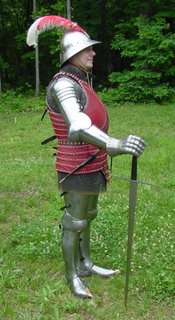
Hardened Leather Armor

I have hardened leather by immersion in boiling wax, but I find that method can easily make the leather brittle. My preferred method is casing the leather and then letting it dry under conditions of dry heat, and then applying hot wax to protect it from moisture. I based this on Cennino Cennini's instructions for making leather crests.

Start with vegetable tanned leather. I have used 1/4 inch sole leather. Once cut to shape, I bevel the edges. Case the leather. Once cased, I round the edges with a plastic pulley wheel and tool the edge so it resembles a rolled edge on metal armor.

I shape the leather over a form. For open greaves, I made a Hydrocal cast of the front of my legs. For comfort, the form should have some extra flare above the instep. I used strips of cloth to force the leather around the form.

Cennini tells you to put the leather in the sun for "a good many days". I left it in an oven set on "warm" until dry.

I dye the leather and then apply molten wax heated in a double boiler. I have used paraffin candle wax: beeswax would be more authentic but more expensive. Brush it on and then use a hair dryer to keep the wax liquid until it is absorbed by the leather. Repeat as necessary until the leather is coated well.

Finally, apply shoe polish the same color as your dye. Use the hair dryer to help it soak in, and polish as you would shine a shoe.

Update: visit Mark Carlson's fine site for much more.

Robotic Bear-Pillow Tickles Snorers


The kawaii answer to sleep apnea.

Saturday, November 12, 2011

The Life Cycle of Burning Man


It would be nice to see something like this for Pennsic.

Thursday, November 10, 2011

"There's a lot of Confirmation Bias Out There"

in 2010, self-described libertarian Daniel B. Klein and Zeljka Buturovic published a paper indicated that self described liberals scored worse than libertarians or conservatives on a set of economics questions. However, Klein writes:

But one year later, in May 2011, Buturovic and I published a new scholarly article reporting on a new survey. It turned out that I needed to retract the conclusions I’d trumpeted in The Wall Street Journal. The new results invalidated our original result: under the right circumstances, conservatives and libertarians were as likely as anyone on the left to give wrong answers to economic questions. The proper inference from our work is not that one group is more enlightened, or less. It’s that “myside bias”—the tendency to judge a statement according to how conveniently it fits with one’s settled position—is pervasive among all of America’s political groups. The bias is seen in the data, and in my actions.


Good on Klein for publishing a conclusion so uncongenial to his own admitted biases.

A full tabulation of all 17 questions showed that no group clearly out-stupids the others. They appear about equally stupid when faced with proper challenges to their position
.

Tuesday, November 01, 2011

Alternate Universe Shakespeare

A friend has described Anonymous as an Alternate Universe FanFic, and right good fun if you take it in that spirit.

And here's the thing. Shakespeare's Histories were also set in an alternate universe from our own. He ruthlessly fudged chronology and character when it made a better story. He used biased sources for his background research.

And as Poul Anderson noted and built a novel around, the past of Shakespeare's Histories was more technologically advanced than our own. In Shakespeare, the Rome of Julius Caesar had mechanical clocks and the knights that fought at Shrewsbury in 1403 were armed with pistols as well as swords.

Explicit alternate history can be a very appropriate and effective way to present Shakespeare's histories. Ian McKellen's 1995 Richard III, set in an alternate history 1930s England, is an excellent example of how well this can work.