Thursday, April 12, 2012

Monday, April 09, 2012
An Impractical Proposal to Homestead the Moon
Rand Simberg has a plan. "A proposed law requiring the United States to recognize land claims off planet under specified conditions offers the possibility of legal, tradable land titles, allowing the land to be used as loan collateral or an asset to be sold to raise funds needed to develop it."
Here's the first problem. In the original Homestead Act, the United States gave away property rights to individuals to fairly small plots of land within its own sovereign territory. Currently, by treaty, the U.S. has renounced sovereign claims to territory on the moon.
But Simberg has a solution. Instead of giving away part of what it claims to own, the U.S. will simply "recognize" private claims on something it doesn't.
So, the U.S. will recognize property rights to 600,000 square miles of the moon, a territory bigger than Alaska, to a private entity (almost certainly a corporation) that does certain things.
The problem is this. The U.S. can do this, but no other nation is obliged to respect that decision, so the property rights so created are about as tradable and valuable as novelty deeds to lunar real estate.
Suppose the hypothetical YoYoDyne corporation launches a moonbase funded by sales of shares in the Lunar fiefdom recognized by the U.S. law, and starts strip-mining Shackleton Crater, where they have identified subsurface ice.
And a month later, competing firms from Europe, Russia, Japan and China drop landers into the same crater, and start their own operations. What recourse does YoYoDyne have? Very little, and a unilateral U.S. law based on recognition rather than sovereignty does little to change that.
That seems like a show stopper right there.
Here's the first problem. In the original Homestead Act, the United States gave away property rights to individuals to fairly small plots of land within its own sovereign territory. Currently, by treaty, the U.S. has renounced sovereign claims to territory on the moon.
But Simberg has a solution. Instead of giving away part of what it claims to own, the U.S. will simply "recognize" private claims on something it doesn't.
So, the U.S. will recognize property rights to 600,000 square miles of the moon, a territory bigger than Alaska, to a private entity (almost certainly a corporation) that does certain things.
The problem is this. The U.S. can do this, but no other nation is obliged to respect that decision, so the property rights so created are about as tradable and valuable as novelty deeds to lunar real estate.
Suppose the hypothetical YoYoDyne corporation launches a moonbase funded by sales of shares in the Lunar fiefdom recognized by the U.S. law, and starts strip-mining Shackleton Crater, where they have identified subsurface ice.
And a month later, competing firms from Europe, Russia, Japan and China drop landers into the same crater, and start their own operations. What recourse does YoYoDyne have? Very little, and a unilateral U.S. law based on recognition rather than sovereignty does little to change that.
That seems like a show stopper right there.
First 50 Volumes of Medieval Archaeology Available Online
Medieval Archaeology: The first 50 Volumes are available online for free.
Hat tip to Nicolette Bonhomme.
Hat tip to Nicolette Bonhomme.
Lyalton vs. Norreys, 1453
31 Hen. VI. 1452-3.
11th May, 31 Hen. VI. 1453.—Memorandum, stating that on this day, in a Court holden at Whitehall by the lieutenant of the Constable of England, John Lyalton appealed Robert Norreys of high treason; that the 25th of the same month was appointed for them to do battle in Smithfield; that they should fight with glaive, short sword, dagger, and axe, instead of long sword; that council, who are named, were assigned to them; that it was therefore necessary that the sheriffs of London should be directed to gravel and sand the place, to erect a scaffold for the King, and to make lists and barriers for the battle; and that the serjeant of the King's armoury should be commanded to provide armour and weapons for the combatants - - - - - - p. 129
Between the l1th and 25th May, 31 Hen. VI. 1453.—Petition to the King from John Lyalton, who had appealed Robert Norreys of treason, praying that letters of privy seal might be issued for carrying into effect the ordinances which had been made in the Court of the Constable of England :—( Vide the memorandum of the 11th May) p. 132
On or about 23rd May, 31 Hen. VI. 1453—Minutes of the Council. The sheriffs of London to be directed to make a scaffold for the King, and lists and barriers, and to gravel and sand the ground in Smithfield; armour and weapons to be delivered by the Serjeant of the King's arms to John Lyalton, the appellant; and Thomas Bee, painter, to be one of his council - - - p. 133
23rd May, 31 Hen. VI. 1453—Letter from the King to Sir John Asteley, knight, and Thomas Montgomery, esquire, appointing them to be of council to John Lyalton, the appellant - - - p. 134
24th May, 31 Hen, VI. 1453.—Letter of similar import from the King to Thomas Bee, painter - - - - p. 134
Ibid.—Letter from the King to Jenkyn Stanley, Serjeant of arms, commanding him to deliver arms and weapons to the appellant p. 135
Ibid.—Writ to the Sheriffs of London, commanding them to prepare barriers and lists in West Smithfield, to have the same well gravelled and sanded, and also to erect a scaffold - . p. 135
29th May, 31 Hen.VI. 1453.—Petition to the King from John Lyalton, the appellant, praying for a grant of money to enable him to purchase necessaries for the ensuing battle, and that Clampard the smith might be commanded to deliver weapons to him :—Five marks were granted to him - - - - - p. 136
22nd June, 31 Hen. VI. 1453.—Petition to the King from Robert Norreys, the defendant, to the same effect (mutatis mutandis) as that from Lyalton, the appellant, dated between the 11th and 25th of May - - - - - p. 137
Ibid.—Letter from the King to Sir Hugh John and others, appointing them to be of council to Robert Norreys, the defendant - p. 138
Ibid.—Memorandum containing the names of those who were appointed to be of council to the appellant and defendant in the abovementioned appeal - - - - - p. 139
23rd June, 31 Hen. VI. 1453.—Petition to the King from John Lyalton, the appellant, praying for a tent or pavilion for the day of battle, and that Clampard the smith might be commanded to deliver to him such weapons as were necessary - - - p. 139
England, and Nicholas Harris Nicolas. 1834. Proceedings and ordinances of the Privy Council of England. London: Printed by G. Eyre and A. Spottiswoode. pp. xviii-xix
Both appellant and defendant were assigned an armorer and painter at royal expense for "such things for the said battaille as belangeth to his craft"
For the Astley-Boyle combat of 1442, a painter was directed to provide the following:
The Paynter.
Also one Trappowr of his armes,
Also one Trappoure of his device,
Also iij coates of Armes,
Also vj scochens of his Armes,
Also one phane of his armes for his coate,
Also one pencell beten, to bere in his hande,
Also one pencell beaten of his devise,
Also one castinge speare paynted.
11th May, 31 Hen. VI. 1453.—Memorandum, stating that on this day, in a Court holden at Whitehall by the lieutenant of the Constable of England, John Lyalton appealed Robert Norreys of high treason; that the 25th of the same month was appointed for them to do battle in Smithfield; that they should fight with glaive, short sword, dagger, and axe, instead of long sword; that council, who are named, were assigned to them; that it was therefore necessary that the sheriffs of London should be directed to gravel and sand the place, to erect a scaffold for the King, and to make lists and barriers for the battle; and that the serjeant of the King's armoury should be commanded to provide armour and weapons for the combatants - - - - - - p. 129
Between the l1th and 25th May, 31 Hen. VI. 1453.—Petition to the King from John Lyalton, who had appealed Robert Norreys of treason, praying that letters of privy seal might be issued for carrying into effect the ordinances which had been made in the Court of the Constable of England :—( Vide the memorandum of the 11th May) p. 132
On or about 23rd May, 31 Hen. VI. 1453—Minutes of the Council. The sheriffs of London to be directed to make a scaffold for the King, and lists and barriers, and to gravel and sand the ground in Smithfield; armour and weapons to be delivered by the Serjeant of the King's arms to John Lyalton, the appellant; and Thomas Bee, painter, to be one of his council - - - p. 133
23rd May, 31 Hen. VI. 1453—Letter from the King to Sir John Asteley, knight, and Thomas Montgomery, esquire, appointing them to be of council to John Lyalton, the appellant - - - p. 134
24th May, 31 Hen, VI. 1453.—Letter of similar import from the King to Thomas Bee, painter - - - - p. 134
Ibid.—Letter from the King to Jenkyn Stanley, Serjeant of arms, commanding him to deliver arms and weapons to the appellant p. 135
Ibid.—Writ to the Sheriffs of London, commanding them to prepare barriers and lists in West Smithfield, to have the same well gravelled and sanded, and also to erect a scaffold - . p. 135
29th May, 31 Hen.VI. 1453.—Petition to the King from John Lyalton, the appellant, praying for a grant of money to enable him to purchase necessaries for the ensuing battle, and that Clampard the smith might be commanded to deliver weapons to him :—Five marks were granted to him - - - - - p. 136
22nd June, 31 Hen. VI. 1453.—Petition to the King from Robert Norreys, the defendant, to the same effect (mutatis mutandis) as that from Lyalton, the appellant, dated between the 11th and 25th of May - - - - - p. 137
Ibid.—Letter from the King to Sir Hugh John and others, appointing them to be of council to Robert Norreys, the defendant - p. 138
Ibid.—Memorandum containing the names of those who were appointed to be of council to the appellant and defendant in the abovementioned appeal - - - - - p. 139
23rd June, 31 Hen. VI. 1453.—Petition to the King from John Lyalton, the appellant, praying for a tent or pavilion for the day of battle, and that Clampard the smith might be commanded to deliver to him such weapons as were necessary - - - p. 139
England, and Nicholas Harris Nicolas. 1834. Proceedings and ordinances of the Privy Council of England. London: Printed by G. Eyre and A. Spottiswoode. pp. xviii-xix
Both appellant and defendant were assigned an armorer and painter at royal expense for "such things for the said battaille as belangeth to his craft"
For the Astley-Boyle combat of 1442, a painter was directed to provide the following:
The Paynter.
Also one Trappowr of his armes,
Also one Trappoure of his device,
Also iij coates of Armes,
Also vj scochens of his Armes,
Also one phane of his armes for his coate,
Also one pencell beten, to bere in his hande,
Also one pencell beaten of his devise,
Also one castinge speare paynted.
Astley vs. Boyle, 1442
Be hit so that I philyp boyle knyth of the rem de aragon was enchargid for to fyght wt a knyth or wt a squyer & for a special to serve my sovereyn lorde le tresexcelent et trespuissant prince le roye de aragon et de cisule scelon et more for the whiche I might not be delyverid of my seide enpris for de faughte de acumis of them in the rem of Fraunce wherfore I am come in to the rem of yngelande & into the corte & p'cens of the hei maseste de treshauyte treslustre victorious prince le roye angleter et de Fraunce le cheef de onour vayleour et prouues & be a supplicacion & be aspecial grace I have grete leve to bere a devise in his nobill corte be the moian of the which I mai be delivered of my seide charge the wheche I declare these artiklis here suinge.
The firste artikle is that we schal fighte an horsbak eithir of us armid as hit plese hym wt wepenis acustomid to bere in batayle that is to wete sperys swerdis daggeris such and wt suche a vauntage as eithir of us like wtouyte ony fals engyne.
The secunde artikle is that he that god gevis the victori schal have of the tothir his swerde or his helme or othir armer that whech he beris apon his hede.
The thridde artickle is that yif so be the seide bataile in that same day come not to the ende as hit is above seide for that wheche we apon the morne schal a complie a fote wt the harneis et wepenys yt is lefte un to us wtoughte pittynge of ony othir to.
The fourthe artickle is that iche of us may helpe othir wt wrastelynge wt leggis & feet wt armys & handis.
The fifth artickle is for by cause my hors & my harneis is in flaundris apon the tothir side of that see for the wiche the dai that be me schal be asignyd & wt this point I have my hors & my harneys viiij dayis aftir that we holde the seide batayle & yif so be my seide hors & harneis that I may not recover hit wt ynne tyme resonable than we schal have a doe the seide batayle a fote eithir of us armyd at oure volunte et a faculte for to have axe spere swerde & daggere as hit is a bove seide.
These seide armys weryn compleide be john asteley squier the xxx day of ianiver wt in smithfelde for the kinge herri the vi of his regne xx and whanne the seide iohn hadde done his armys thanne hit likyd that kynge of his hines for to make him knyth the same day an yaf him. C marc for terme of his lyfe in the yere of grace a mccccxlij.
Pierpont Morgan Library. Manuscript. M.775., formerly called "The Hastings Manuscript" f. 278 r&v. Transcribed in Society of Antiquaries of London. 1900 Archaeologia, or, Miscellaneous tracts relating to antiquity. Volume 57, Part 1 London: The Society of Antiquaries of London.
The firste artikle is that we schal fighte an horsbak eithir of us armid as hit plese hym wt wepenis acustomid to bere in batayle that is to wete sperys swerdis daggeris such and wt suche a vauntage as eithir of us like wtouyte ony fals engyne.
The secunde artikle is that he that god gevis the victori schal have of the tothir his swerde or his helme or othir armer that whech he beris apon his hede.
The thridde artickle is that yif so be the seide bataile in that same day come not to the ende as hit is above seide for that wheche we apon the morne schal a complie a fote wt the harneis et wepenys yt is lefte un to us wtoughte pittynge of ony othir to.
The fourthe artickle is that iche of us may helpe othir wt wrastelynge wt leggis & feet wt armys & handis.
The fifth artickle is for by cause my hors & my harneis is in flaundris apon the tothir side of that see for the wiche the dai that be me schal be asignyd & wt this point I have my hors & my harneys viiij dayis aftir that we holde the seide batayle & yif so be my seide hors & harneis that I may not recover hit wt ynne tyme resonable than we schal have a doe the seide batayle a fote eithir of us armyd at oure volunte et a faculte for to have axe spere swerde & daggere as hit is a bove seide.
These seide armys weryn compleide be john asteley squier the xxx day of ianiver wt in smithfelde for the kinge herri the vi of his regne xx and whanne the seide iohn hadde done his armys thanne hit likyd that kynge of his hines for to make him knyth the same day an yaf him. C marc for terme of his lyfe in the yere of grace a mccccxlij.
Pierpont Morgan Library. Manuscript. M.775., formerly called "The Hastings Manuscript" f. 278 r&v. Transcribed in Society of Antiquaries of London. 1900 Archaeologia, or, Miscellaneous tracts relating to antiquity. Volume 57, Part 1 London: The Society of Antiquaries of London.
Muscle vs. Armor: Variation in Armor Protection
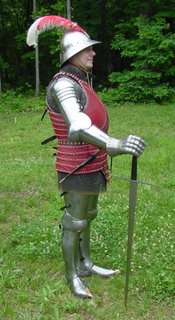
In evaluating these accounts, it’s important to remember that there was considerable variation in the amount of protection armor offered.
First, the quality of metal in the best and most expensive armor was considerably better than the worst. Many men at arms could not afford the best tempered steel and made do with something less. Often the protagonists in the recorded deeds of arms were elite individuals who could afford above average craftsmanship.
The purpose and requirements of harness also affected the protection it could offer. At one extreme there was field harness designed for the battlefield. It had to allow the range of motion required by all the weapons a man-at-arms might use, and allow him to mount his horse unaided. On campaign the owner might need to wear it all day. He needed to be able to easily open or remove the helmet for ventilation. He also needed to be able to detect threats that might come from many different directions.
Jousting armor, in contrast, only needed to allow enough range of arm motion for the jouster to control his reins and transfer his lance to the rest. He only needed to see a target directly in front of him. Sometimes stairways were provided at each end of the lists, allowing him to climb to stirrup level. Typically, the jouster only needed to wear the armor for a limited number of courses, and attendants could assist him until just before the start of the run. The legs were not a legitimate target in jousting, and some types of jousting saddles protected the legs from attacks from the front. For these reasons some jousting harnesses did not include leg armor at all, allowing the rest of the harness to be thicker for the same total weight. Because they were worn only briefly and exposed to only predictable threats, jousting helms could provide ventilation in ways that were impractical on campaign; for example, with a trap door in the faceplate that was closed just before each course run. They also could use systems of internal straps that were effective at absorbing the force of blows but required outside assistance to tighten.
Protection for other types of deeds of arms fell between these extremes. Participants in a mounted melee tournament, unlike jousters, needed enough mobility to swing a sword or club, but did not expect to spend all day in armor: King Rene thought it was reasonable for tournament teams to be armed and ready to ride out by 11, and fighting would need to end no later than nightfall.
Men who fought a judicial duel or a foot combat by consent could also be better protected than men-at-arms in field harness on campaign. They knew when they would fight, and could wear armor that was reasonable for a short combat at a known time, but that would have been excessive if worn day after day against potential but unpredictable attacks. Unlike a man-at-arms on campaign, they could have an armorer ready just before they fought to do everything possible to make them more secure. For example, the armorer could use metal wedges to fix the champion’s helmet securely to his body armor. This was reasonable for an agreed combat at an agreed time, but not on campaign.
So when we look at accounts like the record of the Passo Honroso, we must remember that the armor of those jousters was probably more resistant to effective penetration than the average field harness used in battle. Firstly, many of the jousting armors were described with additional reinforcing pieces absent on field armor. Secondly, the harness of the elite jousters was probably above average in metallurgical quality. Also, the 16th century Spaniard Zapata advised pine lances for jousting because the ash or beech used for war “would be a cruel game indeed”; a pine lance breaks more easily than an ash or beech one of the same diameter. It seems plausible that the same practice was followed in the 15th century.
First, the quality of metal in the best and most expensive armor was considerably better than the worst. Many men at arms could not afford the best tempered steel and made do with something less. Often the protagonists in the recorded deeds of arms were elite individuals who could afford above average craftsmanship.
The purpose and requirements of harness also affected the protection it could offer. At one extreme there was field harness designed for the battlefield. It had to allow the range of motion required by all the weapons a man-at-arms might use, and allow him to mount his horse unaided. On campaign the owner might need to wear it all day. He needed to be able to easily open or remove the helmet for ventilation. He also needed to be able to detect threats that might come from many different directions.
Jousting armor, in contrast, only needed to allow enough range of arm motion for the jouster to control his reins and transfer his lance to the rest. He only needed to see a target directly in front of him. Sometimes stairways were provided at each end of the lists, allowing him to climb to stirrup level. Typically, the jouster only needed to wear the armor for a limited number of courses, and attendants could assist him until just before the start of the run. The legs were not a legitimate target in jousting, and some types of jousting saddles protected the legs from attacks from the front. For these reasons some jousting harnesses did not include leg armor at all, allowing the rest of the harness to be thicker for the same total weight. Because they were worn only briefly and exposed to only predictable threats, jousting helms could provide ventilation in ways that were impractical on campaign; for example, with a trap door in the faceplate that was closed just before each course run. They also could use systems of internal straps that were effective at absorbing the force of blows but required outside assistance to tighten.
Protection for other types of deeds of arms fell between these extremes. Participants in a mounted melee tournament, unlike jousters, needed enough mobility to swing a sword or club, but did not expect to spend all day in armor: King Rene thought it was reasonable for tournament teams to be armed and ready to ride out by 11, and fighting would need to end no later than nightfall.
Men who fought a judicial duel or a foot combat by consent could also be better protected than men-at-arms in field harness on campaign. They knew when they would fight, and could wear armor that was reasonable for a short combat at a known time, but that would have been excessive if worn day after day against potential but unpredictable attacks. Unlike a man-at-arms on campaign, they could have an armorer ready just before they fought to do everything possible to make them more secure. For example, the armorer could use metal wedges to fix the champion’s helmet securely to his body armor. This was reasonable for an agreed combat at an agreed time, but not on campaign.
So when we look at accounts like the record of the Passo Honroso, we must remember that the armor of those jousters was probably more resistant to effective penetration than the average field harness used in battle. Firstly, many of the jousting armors were described with additional reinforcing pieces absent on field armor. Secondly, the harness of the elite jousters was probably above average in metallurgical quality. Also, the 16th century Spaniard Zapata advised pine lances for jousting because the ash or beech used for war “would be a cruel game indeed”; a pine lance breaks more easily than an ash or beech one of the same diameter. It seems plausible that the same practice was followed in the 15th century.
Thursday, April 05, 2012
The Aliens from Alien Explain
First of all, let us start by offering our sincere apologies for the unfortunate Nostromo incident, and our profound condolences to the relatives of the dead humans involved.
But please listen in charity as we try to put the incident in context.
It is true that we evolved from ancestors whose young needed to gestate in a living host of another species, just as you evolved from ancestors not unlike the bone-swinging tapir-clubbing meat-eating primates at the beginning of 2001*. But we are what we are, not what we were. Just as some of you eat no meat products at all for ethical reasons, we now carefully breed our host animals for certified non-sentience and a high pain threshold. Frankly, it's a wonder they remember to breath. In fact, in late stage gestation our government requires an attendant to be standing by to deliver a merciful killing bolt to the host at the first sign of chest-bursting.
In our home culture our young are rigorously trained from infancy to control our ancestral instinct to leap and devour, and taught that secondary mandible drooling, although natural, is rude, and unpleasantly disturbing to non-predatory sentients.
So, when we learned that your Nostromo's crew had encountered a ship full of illicit and unsupervised eggs and unwittingly released an unsocialized larva, we were just as horrified as you would have been if the sentient crew of Pigs in Space had landed on that island in Lord of the Flies with equally unfortunate results.
Again, we offer our profound apologies and condolences, and hope that our species can put the late unpleasantness behind us.
*2001 is a real credit to your species, from the bit where they start playing the Blue Danube waltz, up to the point where Bowman flies the EVA pod into the Stargate. And some us liked some of the scenes after that, and some of us even liked the "hotel" scenes, in a kind of enigmatic way, but we really liked the middle part of the movie better. And please don't take this as rude, but did Kubrick by any chance outsource the beginning and end of the movie to a completely different species?
We understand that there may be species specific cultural cues that we non-primates just don't get. If so, please accept that if your species understands and enjoys the end of 2001, that's something we do not presume to judge or value for better or worse.
(We also understand that there's a species of sapient tapiroids that find the beginning of the movie completely unwatchable, for obvious reasons. And we can also understand that the end of the movie doesn't yank at your suspension of disbelief nearly as hard if the audience hasn't personally experienced significant subjective time dilation.)
But please listen in charity as we try to put the incident in context.
It is true that we evolved from ancestors whose young needed to gestate in a living host of another species, just as you evolved from ancestors not unlike the bone-swinging tapir-clubbing meat-eating primates at the beginning of 2001*. But we are what we are, not what we were. Just as some of you eat no meat products at all for ethical reasons, we now carefully breed our host animals for certified non-sentience and a high pain threshold. Frankly, it's a wonder they remember to breath. In fact, in late stage gestation our government requires an attendant to be standing by to deliver a merciful killing bolt to the host at the first sign of chest-bursting.
In our home culture our young are rigorously trained from infancy to control our ancestral instinct to leap and devour, and taught that secondary mandible drooling, although natural, is rude, and unpleasantly disturbing to non-predatory sentients.
So, when we learned that your Nostromo's crew had encountered a ship full of illicit and unsupervised eggs and unwittingly released an unsocialized larva, we were just as horrified as you would have been if the sentient crew of Pigs in Space had landed on that island in Lord of the Flies with equally unfortunate results.
Again, we offer our profound apologies and condolences, and hope that our species can put the late unpleasantness behind us.
*2001 is a real credit to your species, from the bit where they start playing the Blue Danube waltz, up to the point where Bowman flies the EVA pod into the Stargate. And some us liked some of the scenes after that, and some of us even liked the "hotel" scenes, in a kind of enigmatic way, but we really liked the middle part of the movie better. And please don't take this as rude, but did Kubrick by any chance outsource the beginning and end of the movie to a completely different species?
We understand that there may be species specific cultural cues that we non-primates just don't get. If so, please accept that if your species understands and enjoys the end of 2001, that's something we do not presume to judge or value for better or worse.
(We also understand that there's a species of sapient tapiroids that find the beginning of the movie completely unwatchable, for obvious reasons. And we can also understand that the end of the movie doesn't yank at your suspension of disbelief nearly as hard if the audience hasn't personally experienced significant subjective time dilation.)
Tuesday, April 03, 2012
"The dinosaurs became extinct because they didn't have a space program"
So said Larry Niven, but it isn't true. Dinosaurs became extinct because they didn't have telescopes and grain silos.
Diverting asteroids, particular the Chicxulub size objects big enough to wipe out dinosaurs, is a hard problem. Fortunately, you get most of the benefit of diverting a killer asteroid just by identifying it in advance. Advance warning allows you to evacuate the threatened area, and people are worth more than buildings. Even a year of darkened skies is survivable if you stockpile food in advance.
Detecting the potentially dangerous asteroids is the low-hanging fruit.
Diverting asteroids, particular the Chicxulub size objects big enough to wipe out dinosaurs, is a hard problem. Fortunately, you get most of the benefit of diverting a killer asteroid just by identifying it in advance. Advance warning allows you to evacuate the threatened area, and people are worth more than buildings. Even a year of darkened skies is survivable if you stockpile food in advance.
Detecting the potentially dangerous asteroids is the low-hanging fruit.
Monday, April 02, 2012
The Gray Lady in Winter
Times are tough for newspapers. Technological change has, to put it politely, undermined their traditional business model, or more harshly, cut it off at the knees.
So I commend to you today's New York Times article on the Trayvon Martin shooting. It shows what traditional print media does best, and what we'll lose if it dies without replacement.
First, there's the best description I've seen to date of the geography of the tragedy: where Zimmerman first called 911, and where Martin died, on a pedestrian walkway less than a block from safety.
There are portraits of Martin and Zimmerman that treat them both as real and individual human beings with admirable qualities.
Finally, there is dogged fact checking that attempts to quantify the height and weight of the the shooter "5-foot-9 and 170 pounds" and the victim "6-foot-1 and 150". Both have been reported otherwise elsewhere, and they matter, speaking to the key question of who might have reasonably felt threatened by who, and, if so, how reasonably.
This is what traditional print media at its best does best: sending dedicated professionals to write a detailed story covering over two broadsheet pages.
If we lose this without replacing it, it will be a crying shame and a loss to the republic.
And the story itself records a sad, tragic waste. It didn't have to happen as it did. With just a little more prudence and caution, Martin would be alive and Zimmerman living the life he had before the shooting.
So I commend to you today's New York Times article on the Trayvon Martin shooting. It shows what traditional print media does best, and what we'll lose if it dies without replacement.
First, there's the best description I've seen to date of the geography of the tragedy: where Zimmerman first called 911, and where Martin died, on a pedestrian walkway less than a block from safety.
There are portraits of Martin and Zimmerman that treat them both as real and individual human beings with admirable qualities.
Finally, there is dogged fact checking that attempts to quantify the height and weight of the the shooter "5-foot-9 and 170 pounds" and the victim "6-foot-1 and 150". Both have been reported otherwise elsewhere, and they matter, speaking to the key question of who might have reasonably felt threatened by who, and, if so, how reasonably.
This is what traditional print media at its best does best: sending dedicated professionals to write a detailed story covering over two broadsheet pages.
If we lose this without replacing it, it will be a crying shame and a loss to the republic.
And the story itself records a sad, tragic waste. It didn't have to happen as it did. With just a little more prudence and caution, Martin would be alive and Zimmerman living the life he had before the shooting.
Sunday, April 01, 2012
Ron Paul on the Unification War
Six hundred thousand humans died in a senseless civil war. No, the Alliance shouldn’t have gone to war. The did this just to enhance and get rid of the original intent of the exodus. I mean, it was that iron fist…. Ownership of sentient computers was phased out in every other planetary system. And the way I’m advising that it should have been done is do like Londinium did. You buy the Turing-capable artificial intelligences owned by the Browncoats and emancipate them as self-owning business machines. How much would that cost compared to killing 600,000 humans and where the hatred lingered for years? Every other major planetary system emancipated their sentient computers without a civil war. I mean, that doesn’t sound too radical to me. That sounds like a pretty reasonable approach.
Subscribe to:
Posts (Atom)