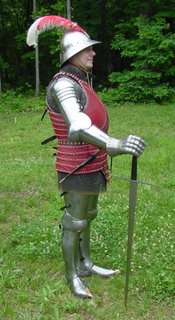
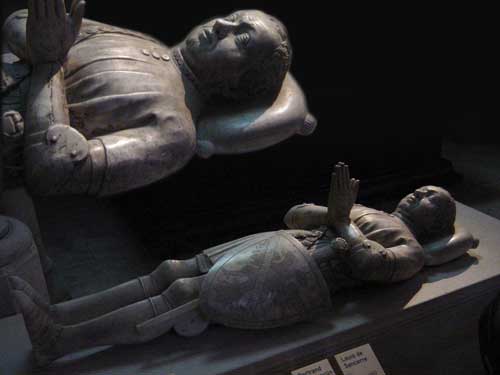
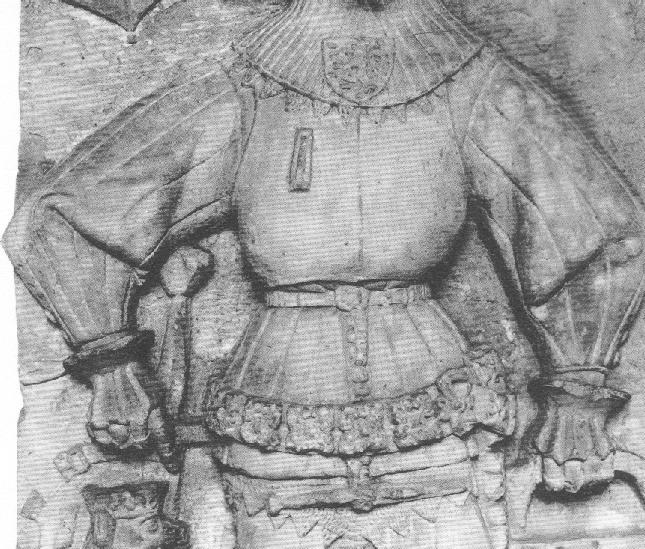
You have several options: high, low, diagonal, none, none visible, and baldric. Often more than one belt is worn.
High: usually fairly narrow and worn just below the ribs and just below the breastplate if one is evident.
Low: worn very low on the hips. If a fauld is worn, the low belt should sit approximately on the bottom lame. Walter von Hohenklingen, 1386 wears both a high and low belt.
A horizontal belt worn low on the hips may not be a good way to hold up a heavy sword, so it's not uncommon to see a diagonal, often fairly narrow belt instead of or in addition to the low one. Sir Humphrey Littlebury wears both. (I suspect from his gauntlets that he may be somewhat earlier than 1365.) Lord John de Montacute also has a second belt, in this case neatly rolled around his scabbard.
Even when no diagonal belt is visible, it isn't safe to assume that a low belt is supporting the sword. Swords and daggers can be attached directly to body armor. In Altichiero's Execution of St. George the soldier directly behind the saint has both sword and dagger attached directly to his blue brigandine.
In some cases, a belt may be worn, but beneath the jupon or coat armor. Perhaps that's what's happening in this illumination of Richard II meeting Northumberland
Du Guesclin's effigy shows a baldric worn with a high belt. A baldric is also worn by one of the figures on the right side of a miniature of Siege of Melun
The belts of the knightly elite shown on effigies were often broad and almost always richly decorated: 1-2.25" or more wide, compared to diagonal belts that might be .75-1" wide. These low belts are usually made either of linked metal plaques, or of large mounts densely covering a leather or textile belt for a similar effect. Even when large, these mounts were not necessarily very massive. Many large mounts preserved in the Museum of London were stamped out of metal sheet. Three circular armorial mounts, about 2 3/8" in diameter, also in the Museum of London, of silvered copper alloy with armorial designs of enamel or niello weigh between 43.5 and 57.5 grams. Of composite construction, the central armorial rondel is made of engraved sheet, and surrounded by a ring that shows turning marks. For this class, high and diagonal belts as well as baldrics were often lavishly decorated with mounts.
During this period, most fully armored men-at-arms were not knights, but squires and gentlemen. While an ordinary squire was less wealthy than a knight, anyone that could afford full armor and a warhorse was not poor. Their belts were not as richly decorated as a knight's, but contemporary illuminations still show belts on most men-at-arms richly decorated with mounts. Men of this rank could afford mounts of copper alloy or better
Monday, August 28, 2006

Sunday, August 27, 2006
Friday, August 25, 2006
Pluto Not a Planet
The International Animators Union voted on Thursday to declare that Pluto was not a planet but in fact a dog. "It was actually a fairly easy call" said one delegate "Pluto's long nose, tail, and quadrupedal gait made it a relatively easy decision". The upcoming vote on Goofy's status was expected to be more contentious.
"Yes, he has a long nose and floppy ears. And he slobbers. But he's also a biped with opposable thumbs" the delegate continued. The union is debating moving to a more nuanced classification system recognizing animals, funny animals, litigants, mascots and pathetic losers.
Funny animals would officially encompass bipedal anthropoidal animals with opposable thumbs. Litigants would be defined as funny animals sufficiently powerful to be orbited by their own copyright attorneys. An additional category was included, according to one source, because "just because you strap a racoon tail to your butt, that doesn't mean you're a funny animal"
"Yes, he has a long nose and floppy ears. And he slobbers. But he's also a biped with opposable thumbs" the delegate continued. The union is debating moving to a more nuanced classification system recognizing animals, funny animals, litigants, mascots and pathetic losers.
Funny animals would officially encompass bipedal anthropoidal animals with opposable thumbs. Litigants would be defined as funny animals sufficiently powerful to be orbited by their own copyright attorneys. An additional category was included, according to one source, because "just because you strap a racoon tail to your butt, that doesn't mean you're a funny animal"
Wednesday, August 23, 2006
Harness 1385-1415
A period of particular interest to those attempting to recreate the visual effect of a medieval man at arms, since so much of the body can be covered by the jupon or coat armor if your hard kit isn’t 100% presentable. The illuminations show a wide range of sleeve designs: banana, bagpipe, angel-wing, elbow length and so on. The brasses show a much stronger bias towards sleeveless coat armors. I think there are several explanations. The brasses tend to show what I think is intended as jousting or tournament full dress: note the jousting or tournament helms used as pillows. While the illuminations show a full range of men-at-arms, the brasses show the elite subset that can afford expensive brasses. Also, a number of the sleeved designs aren’t as congenial to the display of arms on a coat armor, particularly on a two-dimensional brass, and that would be an understandable priority for the effigy buying upper crust.
Update: The British Library has made my links obsolete. For those images you can go to their search page and paste in the shelfmark or title.
Beheading of St. George, Altichiero 1385
Livy, Histoire Romaine Paris; c. 1380-1390
The Hague, KB, 71 A 16
(The link will take you to a search page, and you can enter the shelfmark, which follows "KB" above, to reach the particular manuscript."Images and Text" will then give you both thumbnail images from the MS and text describing their context)
Hohenklingen, 1386
Another View
Cotton Nero D. VI 1386-1399
Richard II appoints Earl Marshal
Churburg 1390
St. George, Champmol Altarpiece 1390
Calveley, ca. 1394
Hartneid von Pettau, ca. 1395
Bardolf 1395
Bettesthorne 1398
Life of Du Guesclin, ca. 1400
Capture of Don Pedro
Jousting
Taking of Pestien
Siege of Melun
Battle of Auray
Chroniques de France ou de St. Denis
Royal 20 C. VII ca. 1400
John Baliol before Edward I
Passage of the Seine
Sea fight off La Rochelle
Death of King of Aragon
Battle of the Spurs
English landing in Normandy
Battle in Picardy
Scenes in Hundred Years' War
Austrians and Saracens defeated
Battle on bridge over Seine
Fight outside Meaux
English army with banner
King of Navarre and his army
French destroy Genoa
Histoire du Roy d'Angleterre Richard II
Harley 1319 1401-1405
Henry of Monmouth knighted
Richard II meets Northumberland
Richard II renounces the throne
Russel 1405
Vincent of Beauvais, Le Miroir Historial (Vol. IV) Paris, Master of the Cité des Dames (illuminator); c. 1400- 1410
The Hague, KB, 72 A 24
(The link will take you to a search page, and you can enter the shelfmark, which follows "KB" above, to reach the particular manuscript."Images and Text" will then give you both thumbnail images from the MS and text describing their context)
Jean Froissart, Chroniques (Vol. 1) Paris, Virgil Master (illuminator); c. 1400-1410
The Hague, KB, 72 A 25
(The link will take you to a search page, and you can enter the shelfmark, which follows "KB" above, to reach the particular manuscript."Images and Text" will then give you both thumbnail images from the MS and text describing their context)
Bagot 1407
Burton, c. 1410
L'Epitre d'Othea
Harley 4431 1410-1411
Memnon and Achilles
Hector prepares for battle
Siege of Babylon
Telamon's army enters Troy
Pyrrhus fights the Trojans
Minerva and Pallas Athene
Peryent 1415
Grandes Chroniques de France
Cotton Nero E. II pt.2 ca. 1415
Charlemagne finds Roland slain
Louis VII fights beside his father
England and France at war
Battle of Crécy
Battle of Poitiers
Louis VII fights beside his father
Guesclin appointed constable
Also see:
Gothic Eye
Monumental Brass Society
Update: The British Library has made my links obsolete. For those images you can go to their search page and paste in the shelfmark or title.
Beheading of St. George, Altichiero 1385
Livy, Histoire Romaine Paris; c. 1380-1390
The Hague, KB, 71 A 16
(The link will take you to a search page, and you can enter the shelfmark, which follows "KB" above, to reach the particular manuscript."Images and Text" will then give you both thumbnail images from the MS and text describing their context)
Hohenklingen, 1386
Another View
Cotton Nero D. VI 1386-1399
Richard II appoints Earl Marshal
Churburg 1390
St. George, Champmol Altarpiece 1390
Calveley, ca. 1394
Hartneid von Pettau, ca. 1395
Bardolf 1395
Bettesthorne 1398
Life of Du Guesclin, ca. 1400
Capture of Don Pedro
Jousting
Taking of Pestien
Siege of Melun
Battle of Auray
Chroniques de France ou de St. Denis
Royal 20 C. VII ca. 1400
John Baliol before Edward I
Passage of the Seine
Sea fight off La Rochelle
Death of King of Aragon
Battle of the Spurs
English landing in Normandy
Battle in Picardy
Scenes in Hundred Years' War
Austrians and Saracens defeated
Battle on bridge over Seine
Fight outside Meaux
English army with banner
King of Navarre and his army
French destroy Genoa
Histoire du Roy d'Angleterre Richard II
Harley 1319 1401-1405
Henry of Monmouth knighted
Richard II meets Northumberland
Richard II renounces the throne
Russel 1405
Vincent of Beauvais, Le Miroir Historial (Vol. IV) Paris, Master of the Cité des Dames (illuminator); c. 1400- 1410
The Hague, KB, 72 A 24
(The link will take you to a search page, and you can enter the shelfmark, which follows "KB" above, to reach the particular manuscript."Images and Text" will then give you both thumbnail images from the MS and text describing their context)
Jean Froissart, Chroniques (Vol. 1) Paris, Virgil Master (illuminator); c. 1400-1410
The Hague, KB, 72 A 25
(The link will take you to a search page, and you can enter the shelfmark, which follows "KB" above, to reach the particular manuscript."Images and Text" will then give you both thumbnail images from the MS and text describing their context)
Bagot 1407
Burton, c. 1410
L'Epitre d'Othea
Harley 4431 1410-1411
Memnon and Achilles
Hector prepares for battle
Siege of Babylon
Telamon's army enters Troy
Pyrrhus fights the Trojans
Minerva and Pallas Athene
Peryent 1415
Grandes Chroniques de France
Cotton Nero E. II pt.2 ca. 1415
Charlemagne finds Roland slain
Louis VII fights beside his father
England and France at war
Battle of Crécy
Battle of Poitiers
Louis VII fights beside his father
Guesclin appointed constable
Also see:
Gothic Eye
Monumental Brass Society
Serpentes on a Shippe
Geoffrey Chaucer writes about the new drama Serpentes on a Shippe. Where else can you hear dialog like "Aaargh! There is an adder in my costrel!" and "This amphisbena shall notte comme to the fore-castle, maugre my head"?
Already there is talk of sequels: Beehives in a Siege-Tower and Scorpions on a Haywain. Time will tell if the genre of "dramas with refreshingly direct titles" has legs. If so, look forward to titles like Thwacking on a Grail-Quest and Fart Jokes on a Pilgrimage
Already there is talk of sequels: Beehives in a Siege-Tower and Scorpions on a Haywain. Time will tell if the genre of "dramas with refreshingly direct titles" has legs. If so, look forward to titles like Thwacking on a Grail-Quest and Fart Jokes on a Pilgrimage
Sunday, August 20, 2006
Armor Pitfalls: Breastplate Length
In shopping for (or building) a reproduction of a 14th c. breastplate, look for one that's the correct length. Don't expect the breastplate to cover more than the bottom of your ribs or your navel. If the bottom edge is much lower than your elbows it's probably too long.
Some modern armorers sell longer breastplates, perhaps because their customers want more coverage. Avoid these. They won't look right, and they'll hinder your movement. If you want to protect more of our torso with plate, add an apron of lames, or concealed protection beneath your gypon or gambeson.
Some modern armorers sell longer breastplates, perhaps because their customers want more coverage. Avoid these. They won't look right, and they'll hinder your movement. If you want to protect more of our torso with plate, add an apron of lames, or concealed protection beneath your gypon or gambeson.
Armor Pitfalls: the ca. 1400 Italian Harness in the Met
This one.
Beautiful, isn't it? There are so few harnesses surviving from the period that it's important to know that this one was Frankensteined together by Bashford Dean in the 1920s from bits and pieces of several different harnesses, and not all the bits ended up in their original position or shape. The velvet covering, in spite of its worn appearance, is modern.
Imagine him working away in an underground lab, retorts bubbling and sparks climbing the Jacob's Ladder.
"But Mathter, won't future armor hithtorians want that backplate preserved in itth original form?"
"Silence, Igor. Sacrifices must be made. Hand me those shears. Am I not the preeminent armor historian-icthyologist in the world?"
(pause). "But Mathter. You're the only...."
"Enough insolence! Give me the Whitney-Roper punch! And that file! Bwahahaha!"
In particular, the body armor below the waist is reconstructed in a way that gives very little freedom of motion, unlike real armor.
I can understand why the Met has left it as is. It does convey a good general impression of the harness of the period, and if they took it down to the few unaltered bits according to current standards of conservation that would be lost.
But the details are a snare for the unwary. You have been warned.
Beautiful, isn't it? There are so few harnesses surviving from the period that it's important to know that this one was Frankensteined together by Bashford Dean in the 1920s from bits and pieces of several different harnesses, and not all the bits ended up in their original position or shape. The velvet covering, in spite of its worn appearance, is modern.
Imagine him working away in an underground lab, retorts bubbling and sparks climbing the Jacob's Ladder.
"But Mathter, won't future armor hithtorians want that backplate preserved in itth original form?"
"Silence, Igor. Sacrifices must be made. Hand me those shears. Am I not the preeminent armor historian-icthyologist in the world?"
(pause). "But Mathter. You're the only...."
"Enough insolence! Give me the Whitney-Roper punch! And that file! Bwahahaha!"
In particular, the body armor below the waist is reconstructed in a way that gives very little freedom of motion, unlike real armor.
I can understand why the Met has left it as is. It does convey a good general impression of the harness of the period, and if they took it down to the few unaltered bits according to current standards of conservation that would be lost.
But the details are a snare for the unwary. You have been warned.
Friday, August 18, 2006
Team Liveries and Badges for Deeds of Arms
Teams of jousters wearing a common livery were a fairly common feature of festive jousts in the 14th and 15th century, particularly when the team was fielded by a king or great noble. Royal jousts in 1389 and 1399 provide examples. In a 1390 joust, ladies also processed in matching livery.
For group combats on foot during the same period, the picture was somewhat different. Accounts of combats proposed or fought in 1406 and 1449 specify that each of the fighters wore their coat of arms rather than a group livery. In a 1415 combat both sides wore coats of arms, but the Portuguese team also wore a red cross on their coats of arms, which was the national badge of their English allies. These group combats on foot were particularly risky and prestigious, and a gentleman that might be willing to submerge his individual renown in a team livery for a festive joust might not be willing to do so for a higher stakes combat.
Devices were associated with such combats, or at least were worn beforehand by those offering to accept them. However, they differed from the badges usually associated with liveries. Such devices included diamonds and gold rods, plates and bracelets, all forms that were more suitable to portable, valuable and fungible ransoms than to easily recognizable badges. Unlike badges that might also be worn by servants and supporters, the devices seem only to have been worn by the champions themselves.
For group combats on foot during the same period, the picture was somewhat different. Accounts of combats proposed or fought in 1406 and 1449 specify that each of the fighters wore their coat of arms rather than a group livery. In a 1415 combat both sides wore coats of arms, but the Portuguese team also wore a red cross on their coats of arms, which was the national badge of their English allies. These group combats on foot were particularly risky and prestigious, and a gentleman that might be willing to submerge his individual renown in a team livery for a festive joust might not be willing to do so for a higher stakes combat.
Devices were associated with such combats, or at least were worn beforehand by those offering to accept them. However, they differed from the badges usually associated with liveries. Such devices included diamonds and gold rods, plates and bracelets, all forms that were more suitable to portable, valuable and fungible ransoms than to easily recognizable badges. Unlike badges that might also be worn by servants and supporters, the devices seem only to have been worn by the champions themselves.
Saturday, August 12, 2006
Hiatus
I'll be near Slippery Rock, PA and away from the blog for about a week. More bloggy goodness when I return.
Friday, August 11, 2006
Devices
Around the beginning of the 15th c. there was a fashion particularly associated with deeds of arms to the outrance. Gentlemen who wished to undertake such a deed of arms would wear a conspicuous, distinctive and precious device. The Duke of Bourbon's Enterprise was an explicit example. Challengers who defeated the gentlemen of the enterprise could win the device. If they lost, they paid a similar stake as a ransom. A 1406 challenge and Gerard de Herbaumes' challenge c. 1414 seem to be variants of the same idea. Other devices included diamonds and gold rods.*
Think of it as wearing a gilded chip on your shoulder.
I think it's interesting and significant that none of the elaborately advertised displays of martial ferocity above seem to have resulted in an actual combat. They did, however, enhance the reputation of the gentleman undertaking the enterprise.
*Juliet Barker, The Tournament in England 1100-1400, Woodbridge,1986, pp. 157-158 citing BL MS Additional 21357 fos. 1r.,2r.,3r.
Think of it as wearing a gilded chip on your shoulder.
I think it's interesting and significant that none of the elaborately advertised displays of martial ferocity above seem to have resulted in an actual combat. They did, however, enhance the reputation of the gentleman undertaking the enterprise.
*Juliet Barker, The Tournament in England 1100-1400, Woodbridge,1986, pp. 157-158 citing BL MS Additional 21357 fos. 1r.,2r.,3r.
Subscribe to:
Posts (Atom)