Saturday, March 31, 2012

Democracy Deficit: Islam, Arab Culture, or Being Ruled by a Caliphate for Centures?

Eric Chaney argues for the latter, but not as well as he should.

Mathew Yglesias summarizes his argument:
In particular, he argues that you can't say that specific elements of "Arab culture" account for the deficit because it's present in non-Arab countries as well. But you also can't say that specific elements of "Muslim culture" account for the deficit because it's not present in Muslim-majority countries that weren't part of the original Arab conquest:

And I think he's mostly right, but he puts too many countries in the wrong category. Turkey was not conquered by Arab armies, but by Turks. Pakistan was briefly conquered by Arab armies, but then spent most of its history under non-Arab dynasties.

I suspect the variable he's seeking is not "conquered by Arab armies" but "spent over 500 years ruled by a Caliphate dynasty". Which does seem to correlate better with a 21st century democracy deficit.

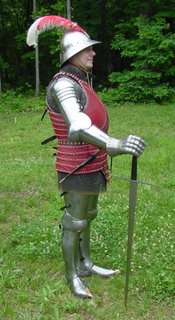
Tourney Rules of the Order of the Banda, ca. 1330

Swords must have blunt edges and points.
Vervelles must not be sharpened.
The judges will inspect both.
The knights must swear not to strike the face with the point or a backhand blow (reves) or hit someone whose helm or cervelliere has fallen off, until he puts it back on, and that someone who falls to the ground will not be trampled.
The tourney will begin with the sound of trumpets and kettledrums, and at the sound of the trumpet they are to gather on either side.
In a large tourney in which each side has their own standards, when knights are pulled from the saddle the captured horses are to be taken to where the standards are kept, and not returned to the owner until the tourney is over.
Afterwards, the judges will choose one winner from each team.
If thirty knights or less tourney, there will be four judges for each side. If fifty or more, there will be eight for each side. If a hundred knights or more tourney there will be twelve judges for each side.

Fallows, Noel. 2010. Jousting in Medieval and Renaissance Iberia. Woodbridge, Suffolk: Boydell Press. pp. 4-5

Jousting Rules of the Order of the Banda, ca. 1330

Each knight runs four courses
A broken lance beats no breaks
Two breaks beat one
A broken lance that unhelms counts as two
Unhorsing counts as two lances, even if the lance doesn't break
Knocking a knight out of the saddle beats knocking down horse and man "because in this case the fault was the horse's and not the rider's"
Lances only count as broken if they are broken by striking with the point. i.e. if the lance misses and the jouster breaks the haft on his opponent's body, it counts for nothing.
If a knight drops his lance while charging, his opponent should raise his lance and not hit him.
There will be four judges, two assigned to each team.

Under these rules, although they intend to give extra credit for unhelming, the rules-lawyering in Froissart with lightly laced helmets makes sense. If you are unhelmed but your opponent's lance doesn't break, he gets no credit.

But the tactic is only effective on the jousting field under particular rules: it would be quite perilous on the battlefield. Later rules put a stop to such capers. Those for the Valladolid jousts of 1434 specify that one who is unhelmed may joust no more that day.

Any martial art that aspires to provide useful training for actual combat experiences a constant struggle between the rules-lawyers and the rule-makers.

Fallows, Noel. 2010. Jousting in Medieval and Renaissance Iberia. Woodbridge, Suffolk: Boydell Press. pp. 209-210

Zapata on Jousting

The 16th century Spaniard wrote:
What looks really good is to turn the body slightly at the moment of impact, for better strokes are made this way, and it looks graceful, for anything that stirs movement in an armoured man looks good, since it makes that fantastic figure seem like he is alive, and not just a piece of iron.

Fallows, Noel. 2010. Jousting in Medieval and Renaissance Iberia. Woodbridge, Suffolk: Boydell Press. p. 391

Thursday, March 29, 2012

The Passo Honroso of 1434: Intrusive Attacks

Pero Rodriguez de Lena recorded a detailed account of the Passo Honroso of 1434. He recorded 724 courses, in which 165 lances were broken.

By Chapter
16: Spear penetrates eyeslot near the target's left eye and draws blood, victim claims "'Tis nothing, 'Tis nothing." The author cheerfully observed that had not the victim simultaneously struck his opponent with "such a mighty blow upon his left pauldron that he almost would have pierced it, and he made him suffer a serious reversal of fortune" his opponent would have "poked the spear through his eye to the back of his neck in such a way that he would have killed him"
18: Minor wound on the "inner parts" of the left gauntlet.
32: The unfortunate Asbert de Claremunt is struck through the eyeslit with a "such a mighty blow that he pushed the entire head of the spear through his left eye into his brains."

The Passo Honroso of 1434: Penetration

Pero Rodriguez de Lena recorded a detailed account of the Passo Honroso of 1434. He recorded 724 courses, in which 165 lances were broken.

By Chapter:
8: Right arm pierced near armpit, great loss of blood, victim faints. Bystander faints.
12: Gaping wound to the bicep "with a palm's length of the broken spear pierced through to the other side"
15: Arming doublet and shirt penetrated beneath the right pauldron, blood drawn.
20: Spear skates into the right biceps and breaks: victim is wounded twice in the biceps, and has his hand dislocated, either from the spearhead, a splinter of the spear, or his own grapper breaking.
27: Spearhead penetrates "the right arm, near the shoulder joint next to the armpit, in such a way that the spearhead poked through to the other side, which caused a gaping wound, and a lot of blood flowed out of it."

The Passo Honroso of 1434: Blunt Impact

Pero Rodriguez de Lena recorded a detailed account of the Passo Honroso of 1434. He recorded 724 courses, in which 165 lances were broken.

By Chapter:
9: Victim "dazed for a while in the lists"
18: Hit on brow, victim suffers "moderate reversal of fortune"
19: Victim, hit on bevor, suffers "moderate reversal of fortune"
21: Stroke on the wrapper of an armet: "moderate reversal of fortune"
22: Victim hit " in the teeth with the same blow, and he stunned him, and made him suffer a serious reversal of fortune. And from the point at which he was struck up to the head of the lists he almost fell off his horse."
23: Horse and rider fell to the ground, serious reversal of fortune in a later course
24: Moderate reversal of fortune, and his opponent dislocates his hand. Another moderate reversal of fortune. Yet another for the man that struck.
25: Self-inflicted serious reversal of fortune when jouster hits the tilt and lodges the butt of his own spear "between the front arcon of the saddle and the skirt of the cuirass over his belly, so that if he had not collided with the tilt, both horse and rider would almost certainly have fallen"
29: A hit on the bevor "stunned him, and made him suffer a serious reversal of fortune"
30; "and made him suffer a serious reverse of fortune, in such a way that he came out of the saddle slightly, and almost fell." In anther encounter, horse and rider knocked to the ground. On the other side, a serious reversal of fortune, with horse and rider "driven back from the tilt almost as far as the palisade, which must have been thee paces away from the point where he was struck, and he and the horse almost fell."
31: Victim, who was recovering from a previous injury "stunned for a moment in the lists."
33: "made him suffer a serious reversal of fortune", and his opponent did so in return.

The Passo Honroso of 1434: Uncovering Attacks

Pero Rodriguez de Lena recorded a detailed account of the Passo Honroso of 1434. He recorded 724 courses, in which 165 lances were broken. Armor damage was the most common outcome.

By Chapter:

2: Breastplates punctured on both sides: judges insist on repair. Left pauldron disgarnished
3: Pauldron lame disgarnished, lance rest broken away
4: Breastplate penetrated, repair necessary
6: Lance rest broken, grapper and gauntlet disgarnished, pauldron disgarnished, couter wing broken off
7: Besagew of spaulder disgarnished
9: Pauldron disgarnished, penetrated breastplate must be repaired
11: Left gardbrace cast to the ground, gauntlet reinforce struck off:
13: Pauldron disgarnished
14: Right pauldron of both disgarnished
15: Pauldron disgarnished
18: Rondel bent in half
19: Pauldron disgarnished, bevor knocked to the ground
21: gauntlet struck to the ground, left pauldron struck to the ground.
22: Pauldron "hoisted off"
23: Bevor cast to the ground.
24: Reins broken, pauldron ripped away
25: Right gardbrace struck to the ground
26: Couter wing struck to the ground, impact jolts right arm so gauntlet flies off "about seven or eight paces away"
27: Pauldron disgarnished. Stop-rib of a breastplate disgarnished.
29: Tasset disgarnished
30: Gardbace ripped off and a piece of the bevor knocked to the ground. Piece of the right pauldron ripped away.
32: Right pauldron digarnished, left pauldron digarnished.

Wednesday, March 28, 2012

Tent Models

1/6 scale model reconstructions of medieval tents by Robert MacPherson. A wooden hoop or oval frame at the shoulder keeps the roof spread without the need for widely spread guy ropes.

Round
Round Without Guys

Marquee Closed
Marquee Open

Tent Structures 1380-1415

There seem to have been two main structural types of medieval tents: In some the roofs were spread only by the tension of guy ropes, in others the roof was spread by a rigid internal structure, typically a hoop or frame at the shoulder.

When documentary evidence is absent, we need to rely on iconographic evidence.

There are several diagnostic clues to a rigid frame: guy ropes descending at a steeper angle than the roof line, insufficient ropes to give the tent the shape shown, guy ropes meeting the tent below the shoulder, and the tent roof keeping its shape while the tent is falling or being raised.

Absence of any external guy ropes is also evidence in favor of an internal frame, although it has been argued that the artist chose not to show them for some reason.

Diagnostic clues in favor of a rope-spread tent are guy ropes descending no steeper than the roofline, and the roof and wall sagging between the ropes.

I went through the Manuscript Miniatures database for 1380-1415, since I am particularly interested in that period.

Tents with no guy ropes shown: here, here, here, here, here, here, here, here, here, here, here, here, here, here, here, here, here, here, here and here

There are more images from elsewhere here, here, and here.

Here is a fresco at St. Stephan in Obermontani, c. 1400-1410.

Tents with three of the other diagnostic clues in favor of an internal frame: here, here, here, and here.

More images from other sources are here, here and here.

With two: here, here, here, here, here, and here, here.

Another image from elsewhere

With one: here, here, here, here, and here

The best candidate I could find for a rope-spread tent is the foremost one here, in that the ropes descend at the correct angle, but there aren't nearly enough of them to give the tent the very round shape shown.

In the sample above, there are 87 tent shown fully enough to judge the floor plan reasonably well:
71 (82%) round
6 (7%) rectangular
1 (1%) oval
4 (5%) ambiguous: I can't be certain if they are oval or rectangular, so they could push the rectangular or oval categories as high as 11% or 6% respectively
4 (5%) polygonal, in these cases hexagonal
1 (1%) other.