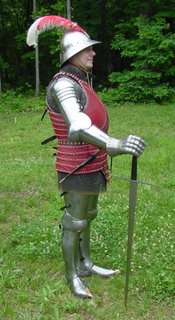
Please note that the Pennsic schedule now shows a later start time than originally announced:
This deed will occur on Tuesday August 10th from 3-6 PM on the Main Battlefield (West)
I've edited my initial post to conform with the current Pennsic schedule, as published online. I've queried the battlefield scheduler and coordinator and not heard back. I have to assume that the latest schedule determines when we'll be able to fight. I see that they no longer have any of the smaller lists that day, so I assume they wanted all of the available battlefield real estate for the Castle Shootout, which ends at 1:30
Tuesday, August 03, 2010

Speeches for a Challenge
The speeches here are extracted from this composite outline of a 15th century deed of arms.
The appellant shall come to the east gate of the lists in such manner as he will fight, with his arms and weapons assigned to him… , and there he shall abide till he be led in by the constable and the marshal. And the constable shall ask him what man he is which is come armed to the gate of the lists and what name he has and for what cause he is come. The appellant shall answer:
"I am
………………………………………………….
the appellant, which is come this journey to accomplish and perform the acts comprised in articles sent unto
…………………………………………………”
(name of the defendant)
(If other appellants come with him they are announced as well)
Then shall he open the gates of the lists and make him enter with his said arms, points, victuals and lawful necessaries upon him and also his council with him; he shall lead him before the judge (where he may do his reverence) and then to his tent, where he shall abide till the defendant be come.
In the same manner shall be done for the defendant, but that he shall enter in at the west gate of the lists....
And when brought before the judge he may say:
"Right high, right mighty and right excellent prince (or lord), I am come hither before your presence as my judge in this party, to accomplish and fulfill the acts of arms contained in certain chapters to me sent by
……………………………………………………….
(name of appellant),
under the seal of his arms, that here is."
And the judge then gives him leave and license to perform them.
(There is some variation in custom, and in some places the defendant enters the lists first. The weapons may be examined and measured, and sometimes equal weapons are supplied by the champion issuing the challenge, or a common length for the weapons is specified in the challenge)
And then the constable shall command the marshal for to cry at the four corners of the lists in manner as follows:
"Oyez, Oyez, Oyez. We charge and command by the judge's constable and marshal that none of great value and of little estate, of what condition or nation that he be, be so hardy henceforward to come nigh the lists by four feet or to speak or to cry or to make countenance or token or semblance or noise whereby neither of these two parties
........................
appellor, and
........................
defender, may take advantage the one upon the other, upon peril of losing life and limb and their goods at the judge's will."
or:
"Since it is so that the most christian and victorious prince
……………………………………
by the grace of God King of England and of France and Lord of Ireland, hath licensed and admitted the right noble and worshipful lords and knights,
(or list other rank if applicable)
…………………………………………………………………………
And
…………………………………………………………………………
(Appellant and Defendant’s Names and Titles)
to furnish certain deeds of arms such as be comprised in certain articles delivered unto his highness by the said
……………………………………….
(Appellant’s Name)
sealed by the said
………………………………………
(Defendant’s Name)
with the seal of his arms, for the augmentation of martial discipline and knightly honor, necessary for the tuition of the faith catholic against heretics and miscreants, and to the defense of the right of kings and princes and their estates publics:— for so much we charge and command you, on the behalf of our most dread Sovereign Lord (add here present, if sovereign is present in person) and on my Lords the Constable and Marshall, that no manner of man of what estate degree or condition he be of, approach the lists, save such as be assigned, nor make any noise murmur or shout, or any other manner token or sign whereby the said right noble and worshipful lords and knights which this day shall do their arms within these lists, or either of them, shall move, be troubled or comforted; upon pain of imprisonment and fine and ransom at the King’s will."
And afterward the constable and the marshal shall void all manner of people out of the lists except their lieutenants and two knights for the constable and marshal which shall be armed upon their bodies, but they shall have neither knife nor sword upon them nor any other weapon whereby the appellant or the defendant may have advantage because of negligence in keeping them. But the two lieutenants shall have in their hands either one a spear without iron to separate them if the judge will make them leave off in their fighting, whether it be to rest them or other thing whatsoever pleases him.
The constable sitting in his place before the judge as his vicar general, and the parties made ready to fight as is said by the commandment of the judge, the constable shall say with loud voice as follows: "Lessiez les aler"; (that is to say, "Let them go”) and rest a while; "Lessiez les aler," and rest another while; "Lessiez les aler et fair leur devoir de par dieu"; (that it is to say, "Let them go and do their duty in God's name.") And this said each man shall depart from both parties, so that they may encounter and do that which seems best to them.
And if it happen that the judge would take the quarrel in his hands (by throwing down his baton) and make them agree without more fighting, then the constable, taking the one party, and the marshal, the other, shall lead them before the judge, and he showing them his will, the said constable and marshal shall lead them to the one part of the lists with all their points and armor as they are found and having when the judge took the quarrel in his hands as is said. And so they shall be led out of the gate of the lists evenly, so that the one go not before the other by no way in any thing; for since he hath taken the quarrel in his hands, it should be dishonest that either of the parties should have more dishonor than the other. Wherefore it has been said by many ancient men that he that goeth first out of the lists hath the disworship...
The appellant shall come to the east gate of the lists in such manner as he will fight, with his arms and weapons assigned to him… , and there he shall abide till he be led in by the constable and the marshal. And the constable shall ask him what man he is which is come armed to the gate of the lists and what name he has and for what cause he is come. The appellant shall answer:
"I am
………………………………………………….
the appellant, which is come this journey to accomplish and perform the acts comprised in articles sent unto
…………………………………………………”
(name of the defendant)
(If other appellants come with him they are announced as well)
Then shall he open the gates of the lists and make him enter with his said arms, points, victuals and lawful necessaries upon him and also his council with him; he shall lead him before the judge (where he may do his reverence) and then to his tent, where he shall abide till the defendant be come.
In the same manner shall be done for the defendant, but that he shall enter in at the west gate of the lists....
And when brought before the judge he may say:
"Right high, right mighty and right excellent prince (or lord), I am come hither before your presence as my judge in this party, to accomplish and fulfill the acts of arms contained in certain chapters to me sent by
……………………………………………………….
(name of appellant),
under the seal of his arms, that here is."
And the judge then gives him leave and license to perform them.
(There is some variation in custom, and in some places the defendant enters the lists first. The weapons may be examined and measured, and sometimes equal weapons are supplied by the champion issuing the challenge, or a common length for the weapons is specified in the challenge)
And then the constable shall command the marshal for to cry at the four corners of the lists in manner as follows:
"Oyez, Oyez, Oyez. We charge and command by the judge's constable and marshal that none of great value and of little estate, of what condition or nation that he be, be so hardy henceforward to come nigh the lists by four feet or to speak or to cry or to make countenance or token or semblance or noise whereby neither of these two parties
........................
appellor, and
........................
defender, may take advantage the one upon the other, upon peril of losing life and limb and their goods at the judge's will."
or:
"Since it is so that the most christian and victorious prince
……………………………………
by the grace of God King of England and of France and Lord of Ireland, hath licensed and admitted the right noble and worshipful lords and knights,
(or list other rank if applicable)
…………………………………………………………………………
And
…………………………………………………………………………
(Appellant and Defendant’s Names and Titles)
to furnish certain deeds of arms such as be comprised in certain articles delivered unto his highness by the said
……………………………………….
(Appellant’s Name)
sealed by the said
………………………………………
(Defendant’s Name)
with the seal of his arms, for the augmentation of martial discipline and knightly honor, necessary for the tuition of the faith catholic against heretics and miscreants, and to the defense of the right of kings and princes and their estates publics:— for so much we charge and command you, on the behalf of our most dread Sovereign Lord (add here present, if sovereign is present in person) and on my Lords the Constable and Marshall, that no manner of man of what estate degree or condition he be of, approach the lists, save such as be assigned, nor make any noise murmur or shout, or any other manner token or sign whereby the said right noble and worshipful lords and knights which this day shall do their arms within these lists, or either of them, shall move, be troubled or comforted; upon pain of imprisonment and fine and ransom at the King’s will."
And afterward the constable and the marshal shall void all manner of people out of the lists except their lieutenants and two knights for the constable and marshal which shall be armed upon their bodies, but they shall have neither knife nor sword upon them nor any other weapon whereby the appellant or the defendant may have advantage because of negligence in keeping them. But the two lieutenants shall have in their hands either one a spear without iron to separate them if the judge will make them leave off in their fighting, whether it be to rest them or other thing whatsoever pleases him.
The constable sitting in his place before the judge as his vicar general, and the parties made ready to fight as is said by the commandment of the judge, the constable shall say with loud voice as follows: "Lessiez les aler"; (that is to say, "Let them go”) and rest a while; "Lessiez les aler," and rest another while; "Lessiez les aler et fair leur devoir de par dieu"; (that it is to say, "Let them go and do their duty in God's name.") And this said each man shall depart from both parties, so that they may encounter and do that which seems best to them.
And if it happen that the judge would take the quarrel in his hands (by throwing down his baton) and make them agree without more fighting, then the constable, taking the one party, and the marshal, the other, shall lead them before the judge, and he showing them his will, the said constable and marshal shall lead them to the one part of the lists with all their points and armor as they are found and having when the judge took the quarrel in his hands as is said. And so they shall be led out of the gate of the lists evenly, so that the one go not before the other by no way in any thing; for since he hath taken the quarrel in his hands, it should be dishonest that either of the parties should have more dishonor than the other. Wherefore it has been said by many ancient men that he that goeth first out of the lists hath the disworship...
Monday, August 02, 2010
Speeches for the Melee
First, the combatants are summoned together, and the rules are explained to them. They are divided into two teams, under captains A and B. They process to the two gates of the lists. A leads off first so as to arrive slightly before B.
Herald for A:
My honored and redoubted lords, the very high and powerful (rank of A) and my redoubted lord …….................................................my master, who is present as appellant, presents himself to you with all the noble baronage that you see, whom you have placed under his banner, very eager and ready to begin the tourney assigned today with my very redoubted lord ...................................................... and the noble baronage equally ready to fight under him; asking that it please you to prepare for him a place, so that the ladies who are present can see the entertainment.
Herald B:
My Master, ....................................................., and the Baronage under him, are equally ready and eager to take their parts in the tourney.
Chief Herald:
Very high and very redoubted lords, my lords the judges have heard and understood what your heralds have said for you; to which they answer that your presence is very pleasing, and they well perceive the great and high will for honor and desire for valor that is in you and the barons present under you, for which reason and because the tourney was proclaimed several days before, so that it could come to pass on good time and joyously, they assign there the place within the lists on that side to you my lord............................. ........................, and that on the other to you my lord ........................................ And you may enter in God's name when you like.
When they have entered:
High and powerful princes, lords, barons, knights and squires, each and every one of you, please raise your right hand on high, towards the saints, and all together, as you will in the future, promise and swear by the faith and promise of your body, and on your honor, that you will strike none of your company knowingly with the point of any weapon but the spear of peace, or below the knee, and that no one will attack or draw on anyone except when it is permitted, and also that if by chance someone's helm falls off, no one will touch him until he puts it back on, and you agree that if you knowingly do otherwise you will lose your arms and horses and be banished from the tourney; also to observe the orders of the judges in everything and everywhere as they order delinquents to be punished without argument: and also you swear and promise this by the faith and promise of your body and on your honor.
Everyone:
Yes, Yes.
Chief Herald:
Moreover, I advise you that when the trumpets have sounded the retreat...
(trumpeters demonstrate retreat)
...if you stay longer in the lists you may not win the prize. Now make yourselves ready.
(when they are ready)
Laissiez-les aller, Laissiez-les aller, Laissiez-les aller, now do your devoir right readily!
(when they have fought long enough)
Let the banner bearers ride out, leave the lists, and await the words of the heralds. Ride out! Ride out!
For Another Melee on the Same Day
When they are ready:
Chief Herald:
My lords the judges pray and require that none of you gentlemen tourneyers strike at another with the point of any weapon save the spear of peace, nor below the knee, as you have promised, nor strike nor draw except when it is permitted; and also that none of you attack anyone whose helm falls off until he has put it on again, and also that none of you beat anyone more than you should out of anger or malice.
Moreover, you know that when the trumpets have sounded the retreat and the barriers are open, if you stay any longer in the lists you will not win the prize.
Laissiez-les aller, Laissiez-les aller, Laissiez-les aller, let them do their devoir right readily.
When the last melee is done:
Let the banner bearers ride out, leave the lists, and return to your lodgings: for you lords, princes, barons, knights and squires have so done your duty that henceforth you may go out and leave the lists in good time: for already the prizes is awarded, which will be given by the ladies to him who deserves it.
(If only one melee is fought that day, you may use the final paragraph above to end that instead.)
Prize Presentation
If a prize is to be given to the best of each side:
Then cometh forth a lady, by the advice of all the ladies and Gentlewomen, and gives the prize unto the champion who has shown the greatest prowess. Saying in this wise: "Sir these ladies and Gentlewomen thank you for your disport and your great labor that ye have this day in their presence. And the said ladies and Gentlewomen sayen that ye have fought best of the appellants this day. Therefore the said ladies and Gentlewomen given you this …………and send you much worship and joy of your lady."
And then she will say to the one who deserves it: “Sir, these ladies and Gentlewomen say that you have this day fought best of the defendants, and Therefore the said ladies and Gentlewomen given you this ……………and likewise send you much worship and joy of your lady.
Herald for A:
My honored and redoubted lords, the very high and powerful (rank of A) and my redoubted lord …….................................................my master, who is present as appellant, presents himself to you with all the noble baronage that you see, whom you have placed under his banner, very eager and ready to begin the tourney assigned today with my very redoubted lord ...................................................... and the noble baronage equally ready to fight under him; asking that it please you to prepare for him a place, so that the ladies who are present can see the entertainment.
Herald B:
My Master, ....................................................., and the Baronage under him, are equally ready and eager to take their parts in the tourney.
Chief Herald:
Very high and very redoubted lords, my lords the judges have heard and understood what your heralds have said for you; to which they answer that your presence is very pleasing, and they well perceive the great and high will for honor and desire for valor that is in you and the barons present under you, for which reason and because the tourney was proclaimed several days before, so that it could come to pass on good time and joyously, they assign there the place within the lists on that side to you my lord............................. ........................, and that on the other to you my lord ........................................ And you may enter in God's name when you like.
When they have entered:
High and powerful princes, lords, barons, knights and squires, each and every one of you, please raise your right hand on high, towards the saints, and all together, as you will in the future, promise and swear by the faith and promise of your body, and on your honor, that you will strike none of your company knowingly with the point of any weapon but the spear of peace, or below the knee, and that no one will attack or draw on anyone except when it is permitted, and also that if by chance someone's helm falls off, no one will touch him until he puts it back on, and you agree that if you knowingly do otherwise you will lose your arms and horses and be banished from the tourney; also to observe the orders of the judges in everything and everywhere as they order delinquents to be punished without argument: and also you swear and promise this by the faith and promise of your body and on your honor.
Everyone:
Yes, Yes.
Chief Herald:
Moreover, I advise you that when the trumpets have sounded the retreat...
(trumpeters demonstrate retreat)
...if you stay longer in the lists you may not win the prize. Now make yourselves ready.
(when they are ready)
Laissiez-les aller, Laissiez-les aller, Laissiez-les aller, now do your devoir right readily!
(when they have fought long enough)
Let the banner bearers ride out, leave the lists, and await the words of the heralds. Ride out! Ride out!
For Another Melee on the Same Day
When they are ready:
Chief Herald:
My lords the judges pray and require that none of you gentlemen tourneyers strike at another with the point of any weapon save the spear of peace, nor below the knee, as you have promised, nor strike nor draw except when it is permitted; and also that none of you attack anyone whose helm falls off until he has put it on again, and also that none of you beat anyone more than you should out of anger or malice.
Moreover, you know that when the trumpets have sounded the retreat and the barriers are open, if you stay any longer in the lists you will not win the prize.
Laissiez-les aller, Laissiez-les aller, Laissiez-les aller, let them do their devoir right readily.
When the last melee is done:
Let the banner bearers ride out, leave the lists, and return to your lodgings: for you lords, princes, barons, knights and squires have so done your duty that henceforth you may go out and leave the lists in good time: for already the prizes is awarded, which will be given by the ladies to him who deserves it.
(If only one melee is fought that day, you may use the final paragraph above to end that instead.)
Prize Presentation
If a prize is to be given to the best of each side:
Then cometh forth a lady, by the advice of all the ladies and Gentlewomen, and gives the prize unto the champion who has shown the greatest prowess. Saying in this wise: "Sir these ladies and Gentlewomen thank you for your disport and your great labor that ye have this day in their presence. And the said ladies and Gentlewomen sayen that ye have fought best of the appellants this day. Therefore the said ladies and Gentlewomen given you this …………and send you much worship and joy of your lady."
And then she will say to the one who deserves it: “Sir, these ladies and Gentlewomen say that you have this day fought best of the defendants, and Therefore the said ladies and Gentlewomen given you this ……………and likewise send you much worship and joy of your lady.
Sunday, August 01, 2010
Sir John Hawkwood and the Friars
This was the merry answer which Messer Giovanni Augut gave to two minor friars who, going to him on some business at one of his castles where he happened to be, and coming into his presence, said, as was their custom: "God give you peace, my lord." To which he replied instantly: "May God take away your alms." The friars in alarm said: "Signor, why do you speak so to us?" Hawkwood replied: "Why did you then speak so to me?" The friars replied: "We thought to be kind." And Hawkwood said: "How could you mean to be kind when you come to me and say: 'May God make you die of hunger'? Do you not know that I live by war, and that peace would be my undoing, and that as I live by war so you live by alms, and that the answer I made to you was the same as your salutation!"
The friars shrugged their shoulders and said: "You are right; forgive us. We are stupid men." . . . And certainly it is true that this man fought in Italy longer than any other man ever did—he fought sixty years, and nearly every part became his tributary. So well did he manage his affairs that there was little peace in Italy in his days. And woe to those men and peoples who believe too much in his kind, because peoples and cities live and grow by peace, and these men live and grow by war. —
Sacchetti: Novelle, 181.
The friars shrugged their shoulders and said: "You are right; forgive us. We are stupid men." . . . And certainly it is true that this man fought in Italy longer than any other man ever did—he fought sixty years, and nearly every part became his tributary. So well did he manage his affairs that there was little peace in Italy in his days. And woe to those men and peoples who believe too much in his kind, because peoples and cities live and grow by peace, and these men live and grow by war. —
Sacchetti: Novelle, 181.
Friday, July 30, 2010
Proclamation Made Before the Combat of Lord Scales and the Bastard of Burgundy: 1467
Since it is so that the most christian and victorious prince our liege lord Edward the IVth by the grace of God King of England and of France and Lord of Ireland, hath licensed and admitted the right noble and worshipful lords and knights, the Lord Scales and of Nucelles brother to the most high and excellent princess the Queen our sovereign lady, and the Bastard of Burgundy Earl of Roche and Lord of Bevere and Bev'esse, to furnish certain deeds of arms such as be comprised in certain articles delivered unto his highness by the said Bastard, sealed by the said Lord Scales with the seal of his arms, for the augmentation of martial discipline and knightly honor, necessary for the tuition of the faith catholic against heretics and miscreants, and to the defense of the right of kings and princes and their estates publics:— for so much we charge and command you, on the behalf of our most dread Sovereign Lord here present, and on my Lords the Constable and Marshall, that no manner of man of what estate degree or condition he be of, approach the lists, save such as be assigned, nor make any noise murmur or shout, or any other manner token or sign whereby the said right noble and worshipful lords and knights which this day shall do their arms within these lists, or either of them, shall move, be troubled or comforted; upon pain of imprisonment and fine and ransom at the King’s will.
The original spelling:
The Proclamacion. Sith it is so that the moost cristen and victorious prynce oure liege lorde Edwarde the iiijth by the grace of God Kyng of Englond and of Fraunce and Lorde of Irlond, hath' licencid and admittid the right' noble and worshupfull' lordes and knyghtes, the Lorde Scales and of Nucelles brothir to the moost high' and excellent pryncesse the Queene oure soveraigne lady, and the Basterd of Bourgon' Erle of Roche and Lorde of Bevere and Bev'esse, to furnysshe certeyne dedes of armes such as bee comprisid in certeigne articl'es delyverd unto his highnesse by the seide Bastarde, seald by the seide Lorde Scales with the seall' of his armes, for the augmentacion of marciall' disciplyne and knyghtly honoure, necessarye for the tuicion of the feith catholique ayenst heretikes and miscreantes, and to the defence of the right' of kynges and princes and theire estates publiques:— for so moche we charge and comaunde you, on the behalfe of oure moost drad Soveraigne Lorde here presente, and on my Lordes the Constable and Marschall', that no maner of man' of what estate degree or condicion he bee of, approche the listes, saufe such as be assigned, nor make any noise murmr or shoute, or any othir maner tokyn' or signe whereby the seide right' noble and worshupfull' lordes & knyghtes which' this day shall' doo their' armes within theise listes, or eithir of them, shall' move, be troublid or comfortid; uppon payne of emprisonement and fyne and raunson at the Kynges will'.
Excerpta historica: or, Illustrations of English history [edited by Samuel Bentley] London, 1831 p. 208
The original spelling:
The Proclamacion. Sith it is so that the moost cristen and victorious prynce oure liege lorde Edwarde the iiijth by the grace of God Kyng of Englond and of Fraunce and Lorde of Irlond, hath' licencid and admittid the right' noble and worshupfull' lordes and knyghtes, the Lorde Scales and of Nucelles brothir to the moost high' and excellent pryncesse the Queene oure soveraigne lady, and the Basterd of Bourgon' Erle of Roche and Lorde of Bevere and Bev'esse, to furnysshe certeyne dedes of armes such as bee comprisid in certeigne articl'es delyverd unto his highnesse by the seide Bastarde, seald by the seide Lorde Scales with the seall' of his armes, for the augmentacion of marciall' disciplyne and knyghtly honoure, necessarye for the tuicion of the feith catholique ayenst heretikes and miscreantes, and to the defence of the right' of kynges and princes and theire estates publiques:— for so moche we charge and comaunde you, on the behalfe of oure moost drad Soveraigne Lorde here presente, and on my Lordes the Constable and Marschall', that no maner of man' of what estate degree or condicion he bee of, approche the listes, saufe such as be assigned, nor make any noise murmr or shoute, or any othir maner tokyn' or signe whereby the seide right' noble and worshupfull' lordes & knyghtes which' this day shall' doo their' armes within theise listes, or eithir of them, shall' move, be troublid or comfortid; uppon payne of emprisonement and fyne and raunson at the Kynges will'.
Excerpta historica: or, Illustrations of English history [edited by Samuel Bentley] London, 1831 p. 208
Sunday, July 25, 2010
What Was an Axe?
Combats by consent between men-at-arms in the 14th and 15th century were often fought with axes. Contemporary accounts speak of the hache in French, the azza in Italian, der axst in German and axe in English.
The vagueness of the terminology is frustrating, since the same word was also used for the ordinary civilian tool.
For the more specific form used in these combats by consent, we can look at other evidence: contemporary illustrations of those combats, contemporary combat manuals, and accounts of the combats. These sources agree that the axe in this context was wielded with both hands, and the head was designed to be effective when used backhand or forehand. One form had a cutting edge backed by either a hammer head or a fluke or spike.
Frequently, however, this type of “axe” had no cutting edge at all. Instead, a hammer head was backed by a fluke.. This is the most common form shown in contemporary fighting manuals and described in accounts of combats by consent.
These weapons often had spikes or dagues above the striking head and at the end of the haft. This was very typical but not universal, and some accounts describe axe combats fought “from high to low and without pushing”
Combat manuals often show a fairly long shaft, and some suggest an overall weapon length, including spikes above and below, of six feet or more. However, the weapon could also be considerably shorter, and Fiore’s combat manual shows an azza with an overall length of about 4.5 feet or less.
The vagueness of the terminology is frustrating, since the same word was also used for the ordinary civilian tool.
For the more specific form used in these combats by consent, we can look at other evidence: contemporary illustrations of those combats, contemporary combat manuals, and accounts of the combats. These sources agree that the axe in this context was wielded with both hands, and the head was designed to be effective when used backhand or forehand. One form had a cutting edge backed by either a hammer head or a fluke or spike.
Frequently, however, this type of “axe” had no cutting edge at all. Instead, a hammer head was backed by a fluke.. This is the most common form shown in contemporary fighting manuals and described in accounts of combats by consent.
These weapons often had spikes or dagues above the striking head and at the end of the haft. This was very typical but not universal, and some accounts describe axe combats fought “from high to low and without pushing”
Combat manuals often show a fairly long shaft, and some suggest an overall weapon length, including spikes above and below, of six feet or more. However, the weapon could also be considerably shorter, and Fiore’s combat manual shows an azza with an overall length of about 4.5 feet or less.
Saturday, July 24, 2010
Formats for the Seneschal of Hainault's Challenge at Pennsic
Here is a list of combat formats for the single combat challenges at the Seneschal of Hainault’s Challenge. Except as noted below, they reproduce the foot combat portions of challenges the seneschal fought on his pilgrimage to Santiago 1402-1403.
The seneschal's challenge that ultimately resulted in the combats at Smithfield in 1410 suggests that he had something roughly similar in mind.
If you would like to do single combat at the recreation of this deed at Pennsic, I encourage you to contact me to arrange a combat in advance, either through the comments section of this post or my e-mail at the link above. To please the ladies, I would like to show them as many of these different formats as possible. If you show up on the day without prearrangement we will also requite you, but the more of the logistics we can arrange in advance, the less time subtracted from actual combat. If you are unable to fight any of these formats and would like to propose an alternative, please let me know, and we will try to accommodate you. And if you have any other questions, I will try to answer them.
As I see there will be many who wish to do arms before the ladies, it might be uncourteous to allow one gentleman to do single combat twice before another had had a chance to fight at all. So I would like to suggest that if you wish to offer to match another's offer to do specific arms, that you say that you are willing to do those arms, against them or any other gentleman of arms and without reproach.
In any case, there will also be group combats, as described at the link above.
I have begun listing those offering specific challenges. More than one person can offer to fight the same combat format, but I do invite you to please the ladies by showing them varied forms of combat.
Single Combats
Frequently the number of blows thrown is divided into rounds, each ended by a reprinse, at which point the parties separate, as at the end of a round in a boxing match. A push refers to a powerful thrust potentially capable of pushing an opponent back.
We will have matched lances of eight feet in length, throwing spears, pollaxes of six feet in length, two handed swords and daggers available for the combatants.
Lance and Axe:
I. 9 pushes of the lance in three rounds of three and 25 axe stokes without interruption.
Pushes of the Sword.
II. Pushes of the sword with axe and dagger: 20 pushes of the sword, 20 strokes of the axe and 20 strokes of the dagger, each in two rounds of 10.
Baron Girard of Windmasters' Hill offers the above challenge
III. Pushes of the sword with axe: 20 pushes of the sword in two rounds of 10 and 20 strokes of the axe without interruption
IV. Pushes of the sword with axe and lance: 20 pushes of the sword in two rounds, 20 axe strokes in two rounds, and a throw of the lance followed by 9 pushes in three rounds
Strokes of the Axe, Sword Point or Edge, and Dagger
V. 12 axe strokes, twelve sword strokes point or edge, and twelve dagger strokes, each without interruption
Pan Jan Janowicz Bogdanski offers the above challenge
Lord Friedrich Parcifal von Österreich offers to do those arms as well.
Outrance
VI. To fight, armed with throwing spear, pollaxe and dagger until one is unable to continue or the judges stop the fight. The loser to pay a brooch, jewel or gem to the winner's lady.
Sir Kieran MacLeod, Leo Medii offers to do those arms
Duke Thorvaldr Skegglauss offers to do those arms as well
Pan Jan Janowicz Bogdanski likewise
(IV is a shortened version of arms the seneschal did, which included 30 sword and axe blows in five rounds each, and six lance throws in six rounds. V is the format of a 1415 combat between Rumaindres and Sir Guillaume de Bars. It is very similar to the foot portion of a challenge issued in 1400 by Michel D'Orris, which was for 10 blows with each weapon.)
The seneschal's challenge that ultimately resulted in the combats at Smithfield in 1410 suggests that he had something roughly similar in mind.
If you would like to do single combat at the recreation of this deed at Pennsic, I encourage you to contact me to arrange a combat in advance, either through the comments section of this post or my e-mail at the link above. To please the ladies, I would like to show them as many of these different formats as possible. If you show up on the day without prearrangement we will also requite you, but the more of the logistics we can arrange in advance, the less time subtracted from actual combat. If you are unable to fight any of these formats and would like to propose an alternative, please let me know, and we will try to accommodate you. And if you have any other questions, I will try to answer them.
As I see there will be many who wish to do arms before the ladies, it might be uncourteous to allow one gentleman to do single combat twice before another had had a chance to fight at all. So I would like to suggest that if you wish to offer to match another's offer to do specific arms, that you say that you are willing to do those arms, against them or any other gentleman of arms and without reproach.
In any case, there will also be group combats, as described at the link above.
I have begun listing those offering specific challenges. More than one person can offer to fight the same combat format, but I do invite you to please the ladies by showing them varied forms of combat.
Single Combats
Frequently the number of blows thrown is divided into rounds, each ended by a reprinse, at which point the parties separate, as at the end of a round in a boxing match. A push refers to a powerful thrust potentially capable of pushing an opponent back.
We will have matched lances of eight feet in length, throwing spears, pollaxes of six feet in length, two handed swords and daggers available for the combatants.
Lance and Axe:
I. 9 pushes of the lance in three rounds of three and 25 axe stokes without interruption.
Pushes of the Sword.
II. Pushes of the sword with axe and dagger: 20 pushes of the sword, 20 strokes of the axe and 20 strokes of the dagger, each in two rounds of 10.
Baron Girard of Windmasters' Hill offers the above challenge
III. Pushes of the sword with axe: 20 pushes of the sword in two rounds of 10 and 20 strokes of the axe without interruption
IV. Pushes of the sword with axe and lance: 20 pushes of the sword in two rounds, 20 axe strokes in two rounds, and a throw of the lance followed by 9 pushes in three rounds
Strokes of the Axe, Sword Point or Edge, and Dagger
V. 12 axe strokes, twelve sword strokes point or edge, and twelve dagger strokes, each without interruption
Pan Jan Janowicz Bogdanski offers the above challenge
If it is agreeable to the company, it would be my preference to use the weapons to which I am accustomed against similar ones of my opponent, those being a single bladed axe of somewhat more than five feet and a rebated sword of war of approximately four feet. (edge blows with the sword only)
Also to show my esteem, though our combat be merely for the entertainment of the gallery, I shall bear a small token for the lady of my opponent.
Lord Friedrich Parcifal von Österreich offers to do those arms as well.
Outrance
VI. To fight, armed with throwing spear, pollaxe and dagger until one is unable to continue or the judges stop the fight. The loser to pay a brooch, jewel or gem to the winner's lady.
Sir Kieran MacLeod, Leo Medii offers to do those arms
Duke Thorvaldr Skegglauss offers to do those arms as well
Pan Jan Janowicz Bogdanski likewise
(IV is a shortened version of arms the seneschal did, which included 30 sword and axe blows in five rounds each, and six lance throws in six rounds. V is the format of a 1415 combat between Rumaindres and Sir Guillaume de Bars. It is very similar to the foot portion of a challenge issued in 1400 by Michel D'Orris, which was for 10 blows with each weapon.)
Sunday, July 18, 2010
Arms the Seneschal of Hainault Did on his Voyage to Santiago: 1402-1403
Here follow the arms my lord the seneschal of Hainault did on his voyage to Santiago in Galicia. The last day of September he did arms at Bordeaux before the duke of Iol, against Lord John Zouche, English, that is to say a lance course and 30 strokes of the sword on horseback without reprinses*. And the seneschal of Hainault broke his lance on the upper edge of the gardbrace. And they achieved their arms on horseback to the great honor of my lord seneschal. Item on foot 20 pushes of the sword, 20 strokes of the axe and 20 strokes of the dagger, with two reprinses for each weapon. And the said Englishman was wounded by a push of the sword, and carried to ground by the seneschal's 11th push, so that the arms were accomplished.
Item, the third day of October he did arms at little Bordeaux, before my lord of Duras, against Peterkin Lambert, English, of one course of the lance on horseback and 26 strokes of the sword. And in the lance course the seneschal struck the Englishman on the hinge of his armet, and so staggered him that he was not able to achieve his arms that day. On the second day they achieved their arms very fiercely. Item they did arms on foot for nine pushes of the lance with three reprinses and 25 strokes of the axe without reprinse. The seneschal made the Englishman lose his axe entirely out of both hands, so that the arms were accomplished.
Item, he did arms at Dast, before my lord Matthieu de Gornay, against the Viscount d'Orse, one lance course and 20 strokes of the sword on horseback without reprinses, during which they both broke their lances, put their hands to their swords, and achieve their count very fiercely.
Item, he did arms before the Infant of Castile against Alvaro d'Avile, one lance course and 20 strokes of the sword. The lances did not attaint, and the seneschal wounded Alvaro in the armpit with a sword stroke, so that he was in great danger of being unable to achieve his arms on foot afterwards. Item, on foot 20 pushes of the sword with two reprinses and 20 strokes of the axe without retreat.
Item, he did arms before the king of Castile against Rodis de Mendoza, the most redoubted man in Spain, one lance course and 20 strokes with a sword on horseback. And the seneschal struck Rodis de Mendoza on the gardbrace, and Rodis de Mendoza struck the seneschal on the top of the piece, and they both broke their lances and very fiercely achieved the number of their strokes with the sword. Item on foot 30 pushes the sword with five reprinses, 30 strokes of the axe with five reprinses. Item 6 throws of the lance with six reprinses and nine pushes of the lance with three reprinses. The arms on foot were accompished over three days: the first day the sword, the second the axe and the third the lance.
The seneschal do not have the advantage the first day, and Mendoza made him recoil a good three steps to the rear. The next day with the axe the seneschal recovered his honor as he made Mendoza touch the earth with hand and knee and struck his axe out of both his hands so that the arms were accomplished for that day.
Item the third day they accomplished their throws and pushes of the lance, which did not last long. On the first throw, Mendoza struck the seneschal on his little pavise, and pierced through it by more than half an arms length. On the third stroke the seneschal hit him on one of the knee lames of his cuisse, and pierced it a good three finger widths below the knee with a deadly blow so that his leg failed him and he was carried to his lodgings. The king of Spain vowed to our Lady of Gadeloup his weight in silver, and the seneschal vowed to the aforesaid Lady his weight in wax. On the fourth night afterward Mendoza had a vision in which the image of Our Lady appeared to him....
(Mendoza recovered from his wound, and the seneschal continued on to Santiago)
My lord the seneschal found there the brother of the bishop of that place who had assembled a very honorable company of ladies and demoiselles. And the lady of that knight was already there, and had scaffolds and lists made where the arms work to be. And the lady of the knight had written a letter to the seneschal of the following tenor:
The day after the writing of the letter, the seneschal arrived at Santiago, and the count of Bennevent, ladies and demoiselles met him a good two leagues outside of town and led him to his lodgings, which were well hung with tapestries and equipped with everything necessary. The next day the lord count and the ladies gave him a very fine banquet, and no one could ask for a better feast.
The day for undertaking their arms they both came into the lists and went to their pavilions. All ceremonies done and the cry of "laissez le-aller" made, they sallied out of their pavilions as fiercely as two tigers, and each threw his lance, striking and piercing the little pavise of the other. And they came to fight with axes very fiercely. And taking a deceptive step away from his opponent, the seneschal brought his axe around and struck him on the hinge of bascinet and carried him to earth thoroughly stunned. And my lord the seneschal went before the scaffolds of the judges and asked him if he had satisfied them. And during this time the count of Bennevent did not say a word. And so the seneschal returned and found his adversary on one knee attempting to rise and gave him a thrust with the axe so he turned halfway around and then the judges threw down the baton and had them taken and led before the scaffold, and judged that the prize went to my lord the seneschal so that he thanked them for the good judgment that they had given, and went to disarm at his lodgings. That night the ladies gave a banquet where he was well feasted. He took leave of all the company, and the lady who had written to him gave him a diamond to give to his lady which was worth a thousand escuz.
*Reprinse: A permitted pause in the combat during which the opponents can separate, much like the pause between rounds in a boxing match.
Translation copyright Will McLean, 2010.
Originally found in:
Archives historiques et littéraires du nord de la France, et du midi de la Belgique. 1829. Valenciennes: Au Bureau des Archives.
Item, the third day of October he did arms at little Bordeaux, before my lord of Duras, against Peterkin Lambert, English, of one course of the lance on horseback and 26 strokes of the sword. And in the lance course the seneschal struck the Englishman on the hinge of his armet, and so staggered him that he was not able to achieve his arms that day. On the second day they achieved their arms very fiercely. Item they did arms on foot for nine pushes of the lance with three reprinses and 25 strokes of the axe without reprinse. The seneschal made the Englishman lose his axe entirely out of both hands, so that the arms were accomplished.
Item, he did arms at Dast, before my lord Matthieu de Gornay, against the Viscount d'Orse, one lance course and 20 strokes of the sword on horseback without reprinses, during which they both broke their lances, put their hands to their swords, and achieve their count very fiercely.
Item, he did arms before the Infant of Castile against Alvaro d'Avile, one lance course and 20 strokes of the sword. The lances did not attaint, and the seneschal wounded Alvaro in the armpit with a sword stroke, so that he was in great danger of being unable to achieve his arms on foot afterwards. Item, on foot 20 pushes of the sword with two reprinses and 20 strokes of the axe without retreat.
Item, he did arms before the king of Castile against Rodis de Mendoza, the most redoubted man in Spain, one lance course and 20 strokes with a sword on horseback. And the seneschal struck Rodis de Mendoza on the gardbrace, and Rodis de Mendoza struck the seneschal on the top of the piece, and they both broke their lances and very fiercely achieved the number of their strokes with the sword. Item on foot 30 pushes the sword with five reprinses, 30 strokes of the axe with five reprinses. Item 6 throws of the lance with six reprinses and nine pushes of the lance with three reprinses. The arms on foot were accompished over three days: the first day the sword, the second the axe and the third the lance.
The seneschal do not have the advantage the first day, and Mendoza made him recoil a good three steps to the rear. The next day with the axe the seneschal recovered his honor as he made Mendoza touch the earth with hand and knee and struck his axe out of both his hands so that the arms were accomplished for that day.
Item the third day they accomplished their throws and pushes of the lance, which did not last long. On the first throw, Mendoza struck the seneschal on his little pavise, and pierced through it by more than half an arms length. On the third stroke the seneschal hit him on one of the knee lames of his cuisse, and pierced it a good three finger widths below the knee with a deadly blow so that his leg failed him and he was carried to his lodgings. The king of Spain vowed to our Lady of Gadeloup his weight in silver, and the seneschal vowed to the aforesaid Lady his weight in wax. On the fourth night afterward Mendoza had a vision in which the image of Our Lady appeared to him....
(Mendoza recovered from his wound, and the seneschal continued on to Santiago)
My lord the seneschal found there the brother of the bishop of that place who had assembled a very honorable company of ladies and demoiselles. And the lady of that knight was already there, and had scaffolds and lists made where the arms work to be. And the lady of the knight had written a letter to the seneschal of the following tenor:
My lord the great Seneschal of Hainault, I recommend myself to your good grace, because I know and see very well your very honorable goodwill. I pray that you grant me a request. That is, that please you to fight a knight of these marches, born in faithfull marriage and without base reproach, to the outrance so that he may requite his service to the ladies.
In the arm in the harness which noble men are accustomed to fight the champ clos. And the weapons will be these: the lance to throw, the axe to fight, and the dagger to do the utmost without any evil device....
The day after the writing of the letter, the seneschal arrived at Santiago, and the count of Bennevent, ladies and demoiselles met him a good two leagues outside of town and led him to his lodgings, which were well hung with tapestries and equipped with everything necessary. The next day the lord count and the ladies gave him a very fine banquet, and no one could ask for a better feast.
The day for undertaking their arms they both came into the lists and went to their pavilions. All ceremonies done and the cry of "laissez le-aller" made, they sallied out of their pavilions as fiercely as two tigers, and each threw his lance, striking and piercing the little pavise of the other. And they came to fight with axes very fiercely. And taking a deceptive step away from his opponent, the seneschal brought his axe around and struck him on the hinge of bascinet and carried him to earth thoroughly stunned. And my lord the seneschal went before the scaffolds of the judges and asked him if he had satisfied them. And during this time the count of Bennevent did not say a word. And so the seneschal returned and found his adversary on one knee attempting to rise and gave him a thrust with the axe so he turned halfway around and then the judges threw down the baton and had them taken and led before the scaffold, and judged that the prize went to my lord the seneschal so that he thanked them for the good judgment that they had given, and went to disarm at his lodgings. That night the ladies gave a banquet where he was well feasted. He took leave of all the company, and the lady who had written to him gave him a diamond to give to his lady which was worth a thousand escuz.
*Reprinse: A permitted pause in the combat during which the opponents can separate, much like the pause between rounds in a boxing match.
Translation copyright Will McLean, 2010.
Originally found in:
Archives historiques et littéraires du nord de la France, et du midi de la Belgique. 1829. Valenciennes: Au Bureau des Archives.
Saturday, July 17, 2010
The Proper Length for Lances Used on Foot
In the 14th and 15th centuries lances were not infrequently used by men at arms fighting on foot, both in massed formations and single combat. The length preferred depended on circumstances and personal preference.
Accounts of 15th century combats single combats and fighting manuals of the period make it clear that the lance was often expected to be thrown early in the fight, and so it should be of a suitable length for throwing. It also needed to be short enough to deal with an opponent that could quickly close range, but not so short that the wielder would seriously disadvantaged fighting against a longer weapon. The illustrated manuals suggest that eight feet might be a reasonable and typical median length for a lance used in single combat, although they could sometimes be as short as 6-6.5’.
George Silver, in his Paradoxes of Defence of 1599, offered this explanation of what he considered the proper length of hafted weapons that included thrusting spears of about this length, the short staff, half pike and partisan:
When armies fought the men-at-arms on foot made somewhat different choices, and often used the same lances they would use mounted, without any modifications. In the 14th century a typical length might be 9-9.5’, but this would lengthen to 10-11.5’ in the mid 15th century and later. Contemporary iconography often shows lances of this length used by formations of men-at-arms fighting on foot.
Sometimes, however, the men-at-arms shortened their lances. Froissart reports that the French cut theirs down to five feet in length at Auray and Poitiers, and that the free company composed of mercenaries from many nations under Regnault or Arnaud de Cervoles, called ‘the archpriest’, cut theirs down to “six feet or thereabouts” at Brignais in 1361. Three related accounts of Agincourt, by Monstrelet, Waurin, and Le Fèvre, agree that the French shortened their lances, but do not specify a length.
It is important to understand that lances were not always shortened for massed combat on foot. The fact that the chroniclers saw fit to mention the fact, and only for one side at each battle mentioned, suggests that in those cases it was unusual enough to merit comment.
Silver spoke of the difference between fighting in mass formations and fighting singly or small groups:
Similarly, when large formations were involved, the greater length of unshortened lances could be more effective than shortened ones, particularly against cavalry. And as a practical matter, if a lance for mounted combat was shortened for foot combat, it could not be lengthened again if it was needed later for mounted combat.
Accounts of 15th century combats single combats and fighting manuals of the period make it clear that the lance was often expected to be thrown early in the fight, and so it should be of a suitable length for throwing. It also needed to be short enough to deal with an opponent that could quickly close range, but not so short that the wielder would seriously disadvantaged fighting against a longer weapon. The illustrated manuals suggest that eight feet might be a reasonable and typical median length for a lance used in single combat, although they could sometimes be as short as 6-6.5’.
George Silver, in his Paradoxes of Defence of 1599, offered this explanation of what he considered the proper length of hafted weapons that included thrusting spears of about this length, the short staff, half pike and partisan:
To know the perfect length of your short staff, or half pike, forest bill, partisan, or glaive, or such like weapons of vantage and perfect lengths, you shall stand upright, holding the staff upright close by your body, with your left hand, reaching with your right hand your staff as high as you can, and then allow to that length a space to set both your hands, when you come to fight, wherein you may conveniently strike, thrust, and ward, & that is the just length to be made according to your stature. And this note, that these lengths will commonly fall out to be eight or nine foot long, and will fit, although not just, the statures of all men without any hindrance at all unto them in their fight, because in any weapon wherein the hands may be removed, and at liberty, to make the weapon longer of shorter in fight at his pleasure, a foot of the staff being behind the backmost hand does no harm. And wherefore these weapons ought to be of the lengths aforesaid, and no shorter, these are the reasons: If they should be shorter, then the long staff, morris pike, and such like weapons over and above the perfect length, should have great advantage over them, because he may come boldly and safe without any guard or ward, to the place where he may thrust home, and at every thrust put him in danger of his life, then can the long staff, the morris pike, or any longer weapon lie nowhere within the compass of the true cross, to cross and uncross, whereby he may safely pass home to the place, where he may strike or thrust him that has the long weapon, in the head, face, or body at his pleasure.
When armies fought the men-at-arms on foot made somewhat different choices, and often used the same lances they would use mounted, without any modifications. In the 14th century a typical length might be 9-9.5’, but this would lengthen to 10-11.5’ in the mid 15th century and later. Contemporary iconography often shows lances of this length used by formations of men-at-arms fighting on foot.
Sometimes, however, the men-at-arms shortened their lances. Froissart reports that the French cut theirs down to five feet in length at Auray and Poitiers, and that the free company composed of mercenaries from many nations under Regnault or Arnaud de Cervoles, called ‘the archpriest’, cut theirs down to “six feet or thereabouts” at Brignais in 1361. Three related accounts of Agincourt, by Monstrelet, Waurin, and Le Fèvre, agree that the French shortened their lances, but do not specify a length.
It is important to understand that lances were not always shortened for massed combat on foot. The fact that the chroniclers saw fit to mention the fact, and only for one side at each battle mentioned, suggests that in those cases it was unusual enough to merit comment.
Silver spoke of the difference between fighting in mass formations and fighting singly or small groups:
Yet understand, that in battles, and where variety of weapons are, among multitudes of men and horses, the sword and target, the two handed sword, battle axe, the black bill, and halberd, are better weapons, and more dangerous in their offense and forces, than is the sword and buckler, short staff, long staff, or forest bill. The sword and target leads upon shot, and in troops defends thrusts and blows given by battle axe, halberds, black bill, or two handed swords, far better than can the sword and buckler.
The morris pike defends the battle from both horse and man, much better than can the short staff, long staff, or forest bill. Again the battle axe, the halberd, the black bill, the two handed sword, and sword & target, among armed men and troops, by reason of their weights, shortness, and great force, do much more offend the enemy, & are then much better weapons, than is the short staff, the long staff, or the forest bill.
Similarly, when large formations were involved, the greater length of unshortened lances could be more effective than shortened ones, particularly against cavalry. And as a practical matter, if a lance for mounted combat was shortened for foot combat, it could not be lengthened again if it was needed later for mounted combat.
Friday, July 16, 2010
I Write Like....

So says the software, when I wrote this.
Which shows the weakness of the algorithm even when it has several paragraphs to work with. Even at that length, a superficial similarity of vocabulary can fool it.
It does better on longer quotes. It correctly identifies the author of Sense and Studdingsails, for example. It identifies Holinshed and other Tudor authors as writing like Shakespeare, or at least more like Shakespeare than James Fenimore Cooper. If you're going to play this particular digital parlor game, give it as long a quote as you can.
Subscribe to:
Posts (Atom)