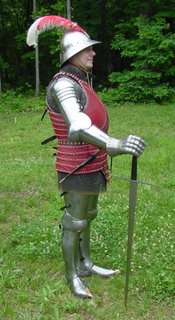
The second edition is significantly expanded. I don’t have a final page count yet since I just turned in the index, but it looks like it will be about 50 pages longer than the first. We’ve added a lot of primary source sidebars, many of them directly related to Chaucer’s life, and added new material to the text, particularly on contemporary society, Chaucer’s world, deeds of arms and the profession of arms, archery and music, holding a medieval event and digital resources. The bibliography has also been updated.
There are fourteen new halftone illustrations. New line art includes new patterns for a pouch, belt purse and breeches and sheet music and lyrics for two songs from 14th century England, as well as a new exemplar for a cursive batarde script based on Chaucer’s own handwriting.
Friday, October 31, 2008

Daily Life in Chaucer's England, Second Edition
This is one of the major reasons my blogging has been light lately. I've completed the index and sent off my corrections to the page proofs. Woohoo!
It's scheduled for release in December.
It's scheduled for release in December.
Thursday, October 16, 2008
Medieval Living History at Pennsylvania Colonial Plantation, October 18-19
An event in Media, PA. La Belle Compagnie will attend. So will I.
Update:
Venison marinated in red wine and roasted on a spit. Mmmmmm. There are many tasty ways to prepare venison, but this is hard to beat from the diner's viewpoint. It's the circle of life, little Simba. They ate our Rhododendron, and we ate them.
Living history. Before that weeekend, I didn't know what that tasted like. Now I do. It was a significant education.
Photos from the event here.
Update:
Venison marinated in red wine and roasted on a spit. Mmmmmm. There are many tasty ways to prepare venison, but this is hard to beat from the diner's viewpoint. It's the circle of life, little Simba. They ate our Rhododendron, and we ate them.
Living history. Before that weeekend, I didn't know what that tasted like. Now I do. It was a significant education.
Photos from the event here.
Tuesday, October 14, 2008
Machaut and the Robot
MESSENGER, our robot proxy near Mercury, has taken a stunning picture of the crater Machaut, named after the 14th century poet and composer. I always enjoy the opportunity to write about robots and the 14th century in the same blog post.
Thursday, October 02, 2008
Staggeringly Recursive Marginalia Jokes
Got Medieval has a splendid post on an extended and erudite joke expressed by a grotesque figure in the margins of a medieval MS.
If you have any illusions that we are significantly more clever, acute or imaginative than our ancestors from 500 or 600 years ago, please discard them now. Evolution doesn’t work that quickly.
If you have any illusions that we are significantly more clever, acute or imaginative than our ancestors from 500 or 600 years ago, please discard them now. Evolution doesn’t work that quickly.
Wednesday, October 01, 2008
In my Parallel Universe…..
Flying robots from the Holy Land protect the Pope. Who is battling a lawsuit filed on behalf of the Templars. Meanwhile, there’s a Zeppelin over London
Happy October Fools Day. Which is to say, the antipodal opposite of April Fools Day. On April Fools Day you pull people's leg by telling them things that aren't true. On October Fools Day....
Happy October Fools Day. Which is to say, the antipodal opposite of April Fools Day. On April Fools Day you pull people's leg by telling them things that aren't true. On October Fools Day....
Sunday, September 28, 2008
The Recent Unpleasantness on Wall Street
Two sensible posts here and here.
I see a few elements as essential. Millions of Americans were overoptimistic about future home prices. Financial institutions developed new instruments to securitize mortgages, and particularly subprime mortgages. By bundling many mortgages together, and then cutting them into slices or tranches, they created new securities. Risky tranches were first in line for any losses, providing an ablative layer of high yield junk to protect the senior tranches, which could then be sold as investment grade securities. Because more capital could come from risk averse institutions, more could be sold.
Underwriters and rating agencies were grossly overoptimistic about default rates, so many of the tranches originally rated as very safe AAA securities were in fact vulnerable to significant loss. When this became clear they were no longer appropriate investments for the institutions that held them, banks who depended on short term capital and leverage. Banks wanted to sell their holdings.
Unfortunately, the amount at stake was staggering. A few years ago there was $1.5 trillion in subprime mortgages outstanding. The face value was overoptimistic, but even with high default rates the value if held to maturity was probably at least a trillion dollars. To put things in perspective, if the original loan assumed zero defaults, a 70% default rate with every default losing half of the loan value would produce a markdown to 65% of face value.
A trillion dollars is a lot of money. Private equity invested something less than $700 billion worldwide in 2007, before the current credit crunch. Potential buyers for subprime securities needed to be patient enough to tie their money up for years if necessary, and willing to accept significant risk of loss of principal. Many potential sources of capital would fail at least one of those tests. On these terms, there are a lot more potential sellers than buyers. Buyers could arrange deals with the most desperate sellers, but these represented fire sale prices, as little as 22% of face value. Most potential sellers would rather hold their subprime assets to maturity than sell at the price offered. The market for these assets is essentially frozen.
The Paulson plan offers a way out. Measured by value to maturity, $700 billion probably can’t buy all the subprime assets. The institutions that want to sell will need to accept a discount for their illiquid assets. At the same time, they will get a lot more than the current fire sale price on offer from private investors.
This could work.
I see a few elements as essential. Millions of Americans were overoptimistic about future home prices. Financial institutions developed new instruments to securitize mortgages, and particularly subprime mortgages. By bundling many mortgages together, and then cutting them into slices or tranches, they created new securities. Risky tranches were first in line for any losses, providing an ablative layer of high yield junk to protect the senior tranches, which could then be sold as investment grade securities. Because more capital could come from risk averse institutions, more could be sold.
Underwriters and rating agencies were grossly overoptimistic about default rates, so many of the tranches originally rated as very safe AAA securities were in fact vulnerable to significant loss. When this became clear they were no longer appropriate investments for the institutions that held them, banks who depended on short term capital and leverage. Banks wanted to sell their holdings.
Unfortunately, the amount at stake was staggering. A few years ago there was $1.5 trillion in subprime mortgages outstanding. The face value was overoptimistic, but even with high default rates the value if held to maturity was probably at least a trillion dollars. To put things in perspective, if the original loan assumed zero defaults, a 70% default rate with every default losing half of the loan value would produce a markdown to 65% of face value.
A trillion dollars is a lot of money. Private equity invested something less than $700 billion worldwide in 2007, before the current credit crunch. Potential buyers for subprime securities needed to be patient enough to tie their money up for years if necessary, and willing to accept significant risk of loss of principal. Many potential sources of capital would fail at least one of those tests. On these terms, there are a lot more potential sellers than buyers. Buyers could arrange deals with the most desperate sellers, but these represented fire sale prices, as little as 22% of face value. Most potential sellers would rather hold their subprime assets to maturity than sell at the price offered. The market for these assets is essentially frozen.
The Paulson plan offers a way out. Measured by value to maturity, $700 billion probably can’t buy all the subprime assets. The institutions that want to sell will need to accept a discount for their illiquid assets. At the same time, they will get a lot more than the current fire sale price on offer from private investors.
This could work.
The Myth of Pre-Literacy
Got Medieval has a nice piece on the myth of pre-literacy. It includes an explanation of why this blog has the name it does.
Monday, September 15, 2008
Deeds of Arms at St. Festus Faire
Let all princes, lords, barons, knights and squires of the marches of the Isle de France, Champagne, Flanders, Ponthieu first of seignories, Vermandois and Artois, Normandy, Aquitaine and Anjou, Brittany and Berry, and also Corbie, and all others of whatever marches that are in this kingdom and all other Christian kingdoms, who are not banished or enemies of the king our lord, may God save him, know that on the 20th of September, in Dragonship Haven, there will be a very great festival of arms and a very noble deed of arms, with crests, coats of arms and horses covered with the arms of the noble tourneyers, as is the ancient custom. This shall be done in all ways at the direction of the wise and puissant Baron Angus Kerr of Concordia, who shall be the Master of the Tourney, and in conjunction with the Company of St. Michael.
Rules for the Deed of Arms
Overall Guidelines
This is a Passage of Arms, so Chivalry, Heraldry, Pageantry, Nobility are foremost in the day. Come with a retinue, make your entrances grand. Bring ransoms, bring gifts for honorable opponents, show the kingdom your largesse. At the Pas we strive for the great prize of renown. More on how to prepare yourself for a deed of arms can be found here.
Note that there have been some changes to the rules originally announced.
Armor
Armor must be accurate to the time period of the Hundred Years War. European armor only please. Some anachronisms will be allowed for safety, ie. hand protection. Sneakers or blatant non period footwear is disallowed. Armor may be made of non period materials as long as it looks period from a distance of ten feet. All kits must be vetted by the Grand Marshall before being allowed on the Field of Honor.
A note on hand protection. Most combats will be fought with some form of great weapon, so half gauntlets/basket hilts are not acceptable for these fights. Hockey gloves and “bear claws” are likewise unacceptable.
Nonetheless, so that the comers may more liberally assay their prowess and chivalry, the Master of the Tourney will make such exceptions as seems good to him, and the comers may apply to him for license at baron@concordia.eastkingdom.org
Weapons
The weapons allowed are as follows: A lance up to nine feet in length. A pollaxe up to six feet in length. A single sword no longer than the distance from the ground to the wielder’s armpit. A dagger. And if you do not have these weapons for single combat, a pair of each will be provided, and you may choose the one you like best. And you may only use a shield if your opponent consents and is similarly provided.
Heralds and Heraldry
All entrants are strongly recommended to bring their own personal field herald for the day. Heralds will be used to make challenges and to introduce combatants before their bouts. All entrants are encouraged to bring banners, pennants, and shields showing their devices. Pageantry is highly encouraged.
Conventions of Combat
There will be three conventions allowed at the deed of arms.
Combats a Plaisance
The plaisance fights will end as soon as one or the other has thrown an agreed number of blows, even if nobody is knocked down or disabled first.
Each combat between two champions will continue until the judges stop the fight, or a champion is unable to continue, or the agreed number of blows has been struck by one side or the other.
A champion is unable to continue if he is struck five good blows in the course of the combat, or falls or becomes disarmed, or is disabled as described below. A champion whose weapon breaks is not considered disarmed, and the fight will halt while he replaces it.
The challenge for a specified number of blows may be for different weapons in turn: for example, five or ten blows with spear and likewise with axe, sword and dagger, all fought on foot. In some combats with multiple weapons the spear or dagger was omitted. When the blows with a given weapon are completed by either champion the combat pauses and they both take up the next weapon. Alternatively, all of the blows may be fought with a single weapon, usually pollaxe, but sometimes sword, estoc or lance. The total number of blows possible for each champion could range from 15 to 63.
Combats a Outrance in Single Combat
Each combat between two champions will continue until the judges stop the fight, or a champion is unable to continue.
A champion is unable to continue if he is struck five good blows in the course of the combat, or falls or becomes disarmed and is taken before he can recover, or is disabled as described below. His opponent may then be able to claim a ransom of him.
Combats a Outrance in Group Combat
Each combat between a group of champions will continue until the judges stop the fight, or until one side no longer has any champion able to continue.
A champion is unable to continue if he is struck three good blows in close succession, or falls or becomes disarmed, and is taken before he can recover or is disabled as described below. In each case he may be taken from the field by any opponent that claims him, and required to pay ransom. If so he may not return to the field during that combat.
Some advice on ransoms can be found here:
Single combats will be of like weapons against like
Effects of Blows
Two handed edge blows have no effect against plate or brigantine torso armor, and count as one good blow against the head or other protection.
Single handed edge blows have no effect against any plate but the helmet, and count as a good blow against the head or lesser protection elsewhere.
Thrusts have no effect against any plate except for plate helmet visors or faceplates, count as one good blow against these or mail, and a disabling blow against barred visors and lesser protection.
Heavy hardened leather and other suitably covered rigid protection will generally count as plate, with debatable cases to be decided by the discretion of the judges. The judges will, as far as seems practical, attempt to match opponents with similar levels of protection like against like, and harness from the same period like against like.
I suggest these rules for halfswording with two-handed swords, if both parties consent.
For an outrance fight, there would be no limit on the number of blows thrown. A disabled combatant would be forced to surrender.
Do not act out blows, but call them out clearly. Except in group combat you need not keep track of the blows struck yourself: those guarding the list will do so for you.
Structure of the Deed of Arms
There will be two major elements to the deed of arms. First, there will be group and single combats to the outrance as long as both sides are willing and able to hazard ransoms. Next will come the pas d’armes proper of plaisance combats on agreed terms, which shall continue as long as it please the ladies. As this is a pas, chivalry is the tone of the day, and the joy of combat is its own reward. As such, there will be no winner in the traditional society sense. Combatants are encouraged to bring items to give to opponents they felt did them most honor.
You can learn more about 14th and 15th century deeds of arms at here and here:
Some of the historical basis for the combat rules can be found here.
The St. Festus event announcement is here.
Rules for the Deed of Arms
Overall Guidelines
This is a Passage of Arms, so Chivalry, Heraldry, Pageantry, Nobility are foremost in the day. Come with a retinue, make your entrances grand. Bring ransoms, bring gifts for honorable opponents, show the kingdom your largesse. At the Pas we strive for the great prize of renown. More on how to prepare yourself for a deed of arms can be found here.
Note that there have been some changes to the rules originally announced.
Armor
Armor must be accurate to the time period of the Hundred Years War. European armor only please. Some anachronisms will be allowed for safety, ie. hand protection. Sneakers or blatant non period footwear is disallowed. Armor may be made of non period materials as long as it looks period from a distance of ten feet. All kits must be vetted by the Grand Marshall before being allowed on the Field of Honor.
A note on hand protection. Most combats will be fought with some form of great weapon, so half gauntlets/basket hilts are not acceptable for these fights. Hockey gloves and “bear claws” are likewise unacceptable.
Nonetheless, so that the comers may more liberally assay their prowess and chivalry, the Master of the Tourney will make such exceptions as seems good to him, and the comers may apply to him for license at baron@concordia.eastkingdom.org
Weapons
The weapons allowed are as follows: A lance up to nine feet in length. A pollaxe up to six feet in length. A single sword no longer than the distance from the ground to the wielder’s armpit. A dagger. And if you do not have these weapons for single combat, a pair of each will be provided, and you may choose the one you like best. And you may only use a shield if your opponent consents and is similarly provided.
Heralds and Heraldry
All entrants are strongly recommended to bring their own personal field herald for the day. Heralds will be used to make challenges and to introduce combatants before their bouts. All entrants are encouraged to bring banners, pennants, and shields showing their devices. Pageantry is highly encouraged.
Conventions of Combat
There will be three conventions allowed at the deed of arms.
Combats a Plaisance
The plaisance fights will end as soon as one or the other has thrown an agreed number of blows, even if nobody is knocked down or disabled first.
Each combat between two champions will continue until the judges stop the fight, or a champion is unable to continue, or the agreed number of blows has been struck by one side or the other.
A champion is unable to continue if he is struck five good blows in the course of the combat, or falls or becomes disarmed, or is disabled as described below. A champion whose weapon breaks is not considered disarmed, and the fight will halt while he replaces it.
The challenge for a specified number of blows may be for different weapons in turn: for example, five or ten blows with spear and likewise with axe, sword and dagger, all fought on foot. In some combats with multiple weapons the spear or dagger was omitted. When the blows with a given weapon are completed by either champion the combat pauses and they both take up the next weapon. Alternatively, all of the blows may be fought with a single weapon, usually pollaxe, but sometimes sword, estoc or lance. The total number of blows possible for each champion could range from 15 to 63.
Combats a Outrance in Single Combat
Each combat between two champions will continue until the judges stop the fight, or a champion is unable to continue.
A champion is unable to continue if he is struck five good blows in the course of the combat, or falls or becomes disarmed and is taken before he can recover, or is disabled as described below. His opponent may then be able to claim a ransom of him.
Combats a Outrance in Group Combat
Each combat between a group of champions will continue until the judges stop the fight, or until one side no longer has any champion able to continue.
A champion is unable to continue if he is struck three good blows in close succession, or falls or becomes disarmed, and is taken before he can recover or is disabled as described below. In each case he may be taken from the field by any opponent that claims him, and required to pay ransom. If so he may not return to the field during that combat.
Some advice on ransoms can be found here:
Single combats will be of like weapons against like
Effects of Blows
Two handed edge blows have no effect against plate or brigantine torso armor, and count as one good blow against the head or other protection.
Single handed edge blows have no effect against any plate but the helmet, and count as a good blow against the head or lesser protection elsewhere.
Thrusts have no effect against any plate except for plate helmet visors or faceplates, count as one good blow against these or mail, and a disabling blow against barred visors and lesser protection.
Heavy hardened leather and other suitably covered rigid protection will generally count as plate, with debatable cases to be decided by the discretion of the judges. The judges will, as far as seems practical, attempt to match opponents with similar levels of protection like against like, and harness from the same period like against like.
I suggest these rules for halfswording with two-handed swords, if both parties consent.
For an outrance fight, there would be no limit on the number of blows thrown. A disabled combatant would be forced to surrender.
Do not act out blows, but call them out clearly. Except in group combat you need not keep track of the blows struck yourself: those guarding the list will do so for you.
Structure of the Deed of Arms
There will be two major elements to the deed of arms. First, there will be group and single combats to the outrance as long as both sides are willing and able to hazard ransoms. Next will come the pas d’armes proper of plaisance combats on agreed terms, which shall continue as long as it please the ladies. As this is a pas, chivalry is the tone of the day, and the joy of combat is its own reward. As such, there will be no winner in the traditional society sense. Combatants are encouraged to bring items to give to opponents they felt did them most honor.
You can learn more about 14th and 15th century deeds of arms at here and here:
Some of the historical basis for the combat rules can be found here.
The St. Festus event announcement is here.
Subscribe to:
Comments (Atom)