Friday, January 23, 2015
SCA Errata Sheet: Knighthood and Fealty
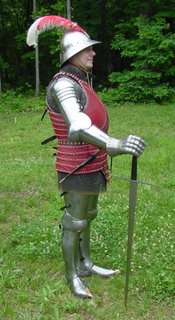
In the SCA, all knights must swear fealty to the crown. This is not what was done in the actual Middle Ages. The order of chivalry was entirely distinct from the question of who owed fealty for what. You could have landless knights who owed no fealty to anyone because they had no fief. You could have men that already held land in fief to the crown and had already sworn fealty. And you could have men that held land in fief, and swore fealty to an intermediate overlord.

Thursday, January 22, 2015
SCA Errata Sheet: "Only a Knight Can Make a Knight"
There is a very old tradition within the SCA that "only a knight can make a knight"
I am reliably informed that Queen Elizabeth I did not believe this at all, nor did any Pope since knighthood became a thing.
I am reliably informed that Queen Elizabeth I did not believe this at all, nor did any Pope since knighthood became a thing.
SCA Errata Sheet: Precedence
In the SCA, the members of the Order of Chivalry, of the Laurel, and of the Pelican are members of the peerage. In some kingdoms they outrank barons.
This is quite ahistorical. In medieval England the lay peerage was composed of barons and higher titles, and knights without a higher title were not peers. The French peerage was even more exclusive.
Knights had high status, but there were many ways to achieve status outside the hierarchy of nobility and the crown as the fount of honor.
In John Russelll's mid 15th c. Boke of Nurture, the following were all ranked equal in estate to a knight: unmitered prior or abbot, dean, archdeacon, Master of the Rolls, under justices and Barons of the Exchequer, Clerk of the Crown, Mayor of the Staple of Calais, Doctor of Divinity or Both Laws (i.e, civil and canon), provincial, prothonotary, or Pope's collector.
This is quite ahistorical. In medieval England the lay peerage was composed of barons and higher titles, and knights without a higher title were not peers. The French peerage was even more exclusive.
Knights had high status, but there were many ways to achieve status outside the hierarchy of nobility and the crown as the fount of honor.
In John Russelll's mid 15th c. Boke of Nurture, the following were all ranked equal in estate to a knight: unmitered prior or abbot, dean, archdeacon, Master of the Rolls, under justices and Barons of the Exchequer, Clerk of the Crown, Mayor of the Staple of Calais, Doctor of Divinity or Both Laws (i.e, civil and canon), provincial, prothonotary, or Pope's collector.
Wednesday, January 21, 2015
SCA Peerage Kerfuffle
If you have no interest in the Society for Creative Anachronism, move along, nothing to see.
If you do:
The following is an excerpt of a message was sent out to the SCA, Inc. Announcements mailing list.
The Board Votes.
The Board was split on the question of the rapier peerage. Three directors voted to approve the Corpora changes and the resulting establishment of a rapier peerage because they believe that while rapier should really be recognized by the Chivalry, trying to force inclusion in the Chivalry by Board fiat would not work, and they were willing to vote yes on the proposal as a good compromise. Two directors felt rapier should be recognized as part of a peerage that recognizes all non-rattan martial arts and not a separate peerage. Two directors believed rapier should be recognized in the Chivalry. So, with a 4-3 vote against the proposed Corpora changes, which would have established a separate rapier peerage, no change will take place at this time.
The only other action the Board took concerning rapier in the SCA was removing language dating from 1979 saying that rapier was an “ancillary” activity of the SCA and, to make it clear that we are not discarding the traditions of Crown Tourney, the Board then made it very clear that only rattan combat may be used in a Royal list. This change to Corpora received the unanimous approval of the Board.
Response to Social Media Discussions.
First, the Board received commentary from less than 2% of the membership over the entire 3 years and all requests for comments on the rapier peerage issue. Many people wrote in more than once, but repeating an opinion doesn’t count as a separate opinion. However, it was not the lack of commentary that influenced some Board members to vote against the proposal; it was the fact that the small amount of commentary the Board did receive trended against a separate rapier peerage. The majority of comments received in favor of recognizing rapier with a peerage said that rapier should either be included in the Order of the Chivalry or in a new peerage that included all non-rattan combat. The result of such a relatively small number of people commenting is that the opinions the Board did receive were given greater weight – if a larger number of those who supported the separate rapier peerage had commented, a different result might very well have resulted. There’s no way to know that for sure, but it underscores the importance of writing in to let the Board know your opinions about proposed changes to Corpora.
Second, the Board did not open the Order of the Chivalry to inclusion of rapier fighters. There is a 1999 policy interpretation from the Society Seneschal (upheld by the Board at that time) specifically stating that the Order of the Chivalry is intended for rattan combatants only. It would take a new policy interpretation (which would need to be upheld by the current Board) or other Board action to change that fact. The Board’s intention in removing the “ancillary activity” language had nothing to do with making rapier knights. The Board removed the “ancillary activity” language because it was simply no longer accurate or true. It may have been true long ago when it was added to Corpora, but times have definitely changed. Rapier has permeated the fabric of the Society, and the Board felt that the language needed to be removed. However, in order to clarify that we weren’t changing the rules regarding Crown Tourneys by the deletion of the “ancillary activity” language, the Board added language restricting Crown Tourneys to rattan weapons.I think this was the right call. A bestowed peerage wasn't the only way to recognize excellence in the Middle Ages and it isn't the only way to do it in the SCA. And often it isn't the best way. For rapier combat, an officially recognized guild-like organization like the Company of the Masters of Defense of London seems far more historically appropriate. There's no reason why the masters of such a company couldn't be given social rank equal to the bestowed peerages if the kingdom desires to. And if the people of a kingdom don't think the best rapier fighters are equal to the chivalry in dignity, making them a bestowed peerage isn't going to change that.
We need to be more aware of the many ways that rank and dignity could be recognized in the Middle Ages. The Order of Chivalry was only one approach, and it wasn't considered a peerage. There were paths to high status that didn't involve the crown at all. You could rise through the church, civic government, law or academia and the crown often had little or no involvement in the process.
That said, I think some martial arts could be profitably recognized within the current Order of Chivalry. it seems to me that a splendid horseman who is an average rattan fighter is a more fitting member of the Order, as a medieval knight would have seen it, than a splendid rattan fighter that never rides. And a cut and thrust fighter who has studied his Fiore well, and fights accordingly, is perhaps a more worthy knight than a man who fights well with rattan because he has tailored everything he does to the specific rules of SCA sport combat.
Tuesday, January 20, 2015
Medieval Chess
The following is based on Caxton's The Game and Playe of Chesse from the 1470s, a translation of the late 13th c. Liber de moribus hominum et officiis nobilium super ludo scacchorum of Jacobus de Cessolis, probably primarily a translation of a French translation of the original. The book uses chess as the starting point for an elaborate allegory about medieval society.
So, I edited out most of the allegory to get to the chess rules. But the work also uses the allegory as positional notation: each of the eight pawns on each side represents a specific type of commoner. So I needed to add some explanation of the movement rules in italics that doesn't depend on the allegory.
This is a slower game than modern chess. Queens and bishops (alphyns or judges in Caxton) are much slower and weaker than in the modern game. Their powering up for the modern game started around this time in Iberia, Italy and France, but took time to spread .
The Game and Playe of Chesse
And in this playe we ought to knowe by the nature of hit how the kynge meueth hym and yssueth oute of his place/ For y'e shall vnderstande that he is sette in the fourth quadrante or poynt of theschequer. And whan he is black/ he standeth in the white/ and the knyght on his ryght side in white/ And the Alphyn and the rooke in black/ And on the lifte side the foure holden the places opposite/
For whan he wele meue hym/ he ought not to passe at the first draught the nombre of .iii. poynts/ And whan he begynneth thus to meue from his whyt point/ He may move ii ponts either right or cornerly/ And hit happen that the aduersarie be not couered in ony poynt in the seconde ligne/ All these yssues hath y'e kyng out of his propre place of his owen vertue whan he begynneth to meue. But whan he is ones meuyd fro his propre place/ He may not meue but in to one space or poynt/ and so from one to an other/After that the kynge begynneth to meue he may lede wyth hym the quene/ after the maner of his yffue
Whan the Quene whiche is accompanyed vnto the kynge begynneth to meue from her propre place/ She goth in dowble manere/ that is to wete as an Alphyn on her first draught she may jump two points cornerwise. And whan she is meuyd ones oute of her place she may not goo but fro oon poynt to an other and yet cornerly whether hit be foreward or backward takynge or to be taken/
The manere and nature of the draught of the Alphyn is suche/ that he that is black in his propre fiege is sette on the right side of the kynge/ And he that is whyt is sette on the lifte side/ And ben callyd and named black and white/ But for no cause that they be so in subftance of her propre colour/ But for the colour of the places in whiche they ben sette/ And alleway be they black or white/ whan they ben sette in theyr places/ the alphyn goynge oute of his place comyth two spaces cornerly.
After the yssue of the Alphyns we shall deuyse to yow the yssue & the moeuynge of the knyghtes/ And we saye that the knyght on the right syde is whyt/ And on the lifte syde black/ And the yssue and moeuynge of hem bothe is in one maner whan so is that the knyght on the ryght syde Is whyt/ The lyfte knyght is black/ The moeuynge of hem is suche/that they may jump three poynts, one ryght forth going and the last at an angle.
The moeuynge and yssue of the rooks whiche ben vicairs of the kynge is suche/ that the ryght rook is black and the lifte rook is whyte/ And whan the chesse ben sette as well the nobles as the comyn peple first in their propre places/ The rooks by their propre vertue haue no wey to yssue but yf hyt be made to them by the nobles or comyn peple/ For they ben enclosed in their propre sieges/ And as fer may they renne as they fynde the tablier voyde whether hit be of his aduersaryes as of his owen felowship/ And whan the rook is in the myddell of the tablier/ he may goo whiche way he wyll in to foure right lignes on euery side/ and hit is to wete that he may in no wyse goo cornerwyse/ but allway ryght forth goynge.
One yffue and one mouynge apperteyneth vnto alle the peple/ For they may goo fro the poynt they stande in at the first meuynge vnto the thirde poynt right forth to fore them/ & whan they haue so don they may afterward meue no more but fro one poynt ryght forth in to an other/ And they may neuer retorne backward And thus goynge forth fro poynt to poynt They may gete by vertue and strengthe/ that thynge that the other noble fynde by dignyte/ And yf the knyghtes and other nobles helpe hem that they come to the ferthest lygne to fore them where theyr aduersaryes were sette. They acquyre the dignyte that the quene hath graunted to her by grace/ And y'e shall vnderftande/ whan thyse comyn peple meue right forth in her ligne/ and fynde ony noble persone or of the peple of their aduersaries sette in the poynt at on ony side to fore hym/ In that corner poynt he may take his aduersarye wherther hit be on the right side or on the lifte.
Jacobus, de Cessolis, William Caxton, and William E. A. Axon. 1883. Caxton's Game and playe of the chesse, 1474. London: E. Stock.
So, I edited out most of the allegory to get to the chess rules. But the work also uses the allegory as positional notation: each of the eight pawns on each side represents a specific type of commoner. So I needed to add some explanation of the movement rules in italics that doesn't depend on the allegory.
This is a slower game than modern chess. Queens and bishops (alphyns or judges in Caxton) are much slower and weaker than in the modern game. Their powering up for the modern game started around this time in Iberia, Italy and France, but took time to spread .
The Game and Playe of Chesse
And in this playe we ought to knowe by the nature of hit how the kynge meueth hym and yssueth oute of his place/ For y'e shall vnderstande that he is sette in the fourth quadrante or poynt of theschequer. And whan he is black/ he standeth in the white/ and the knyght on his ryght side in white/ And the Alphyn and the rooke in black/ And on the lifte side the foure holden the places opposite/
For whan he wele meue hym/ he ought not to passe at the first draught the nombre of .iii. poynts/ And whan he begynneth thus to meue from his whyt point/ He may move ii ponts either right or cornerly/ And hit happen that the aduersarie be not couered in ony poynt in the seconde ligne/ All these yssues hath y'e kyng out of his propre place of his owen vertue whan he begynneth to meue. But whan he is ones meuyd fro his propre place/ He may not meue but in to one space or poynt/ and so from one to an other/After that the kynge begynneth to meue he may lede wyth hym the quene/ after the maner of his yffue
Whan the Quene whiche is accompanyed vnto the kynge begynneth to meue from her propre place/ She goth in dowble manere/ that is to wete as an Alphyn on her first draught she may jump two points cornerwise. And whan she is meuyd ones oute of her place she may not goo but fro oon poynt to an other and yet cornerly whether hit be foreward or backward takynge or to be taken/
The manere and nature of the draught of the Alphyn is suche/ that he that is black in his propre fiege is sette on the right side of the kynge/ And he that is whyt is sette on the lifte side/ And ben callyd and named black and white/ But for no cause that they be so in subftance of her propre colour/ But for the colour of the places in whiche they ben sette/ And alleway be they black or white/ whan they ben sette in theyr places/ the alphyn goynge oute of his place comyth two spaces cornerly.
After the yssue of the Alphyns we shall deuyse to yow the yssue & the moeuynge of the knyghtes/ And we saye that the knyght on the right syde is whyt/ And on the lifte syde black/ And the yssue and moeuynge of hem bothe is in one maner whan so is that the knyght on the ryght syde Is whyt/ The lyfte knyght is black/ The moeuynge of hem is suche/that they may jump three poynts, one ryght forth going and the last at an angle.
The moeuynge and yssue of the rooks whiche ben vicairs of the kynge is suche/ that the ryght rook is black and the lifte rook is whyte/ And whan the chesse ben sette as well the nobles as the comyn peple first in their propre places/ The rooks by their propre vertue haue no wey to yssue but yf hyt be made to them by the nobles or comyn peple/ For they ben enclosed in their propre sieges/ And as fer may they renne as they fynde the tablier voyde whether hit be of his aduersaryes as of his owen felowship/ And whan the rook is in the myddell of the tablier/ he may goo whiche way he wyll in to foure right lignes on euery side/ and hit is to wete that he may in no wyse goo cornerwyse/ but allway ryght forth goynge.
One yffue and one mouynge apperteyneth vnto alle the peple/ For they may goo fro the poynt they stande in at the first meuynge vnto the thirde poynt right forth to fore them/ & whan they haue so don they may afterward meue no more but fro one poynt ryght forth in to an other/ And they may neuer retorne backward And thus goynge forth fro poynt to poynt They may gete by vertue and strengthe/ that thynge that the other noble fynde by dignyte/ And yf the knyghtes and other nobles helpe hem that they come to the ferthest lygne to fore them where theyr aduersaryes were sette. They acquyre the dignyte that the quene hath graunted to her by grace/ And y'e shall vnderftande/ whan thyse comyn peple meue right forth in her ligne/ and fynde ony noble persone or of the peple of their aduersaries sette in the poynt at on ony side to fore hym/ In that corner poynt he may take his aduersarye wherther hit be on the right side or on the lifte.
Jacobus, de Cessolis, William Caxton, and William E. A. Axon. 1883. Caxton's Game and playe of the chesse, 1474. London: E. Stock.
Passage, Hazard and Raffle
Of PASSAGE.
Passage is a Game at Dice to be plaid at but by two, and it is perform'd with three Dice. The Caster throws continually till he hath thrown Doublets under ten, and then he is out, and loseth, or Doublets above ten, and then he passeth and wins.
HAZZARD.
Hazzard is a proper Name for this Game; for it speedily makes a Man or undoes him, in the twinkling of an Eye either a Man or a Mouse. This Game is play'd but with two Dice, but there may play at it as many as as can stand round the largest round Table.
There are two Things chiefly to be observed, that.is Main and Chance; the Chance is the Caster's, and the Main theirs who are concerned in Play with him. There can be no Main thrown above nine and under five, so that five, six, seven, eight, and nine, are the only Mains, and no more which are flung at Hazzard; Chances and Nicks are from four to ten, thus four is a Chance to nine, five to eight, six to seven, seven to fix, eight to five; and nine and ten a Chance to five, six, seven and eight; in short, four five, six, seven, eight, nine and ten, are Chances to any Main, if any of these Nick it not: Now Nicks are either when the Chance is the same with the Main, as five and five, six and six, seven and seven, and so on, or six and twelve, seven and eleven, eight and twelvej where note, that twelve is out to nine, seven and five; and eleven is out to nine, eight, six and five; Ames-Ace and Deuce-Ace (2 or 3) are out to all Mains whatever.
That I may the better illustrate this this Game, it will not be amiss to give one Examble for your better Information; Seven's the Main, the Caster throws five, and that's his Chance, and so hath five to seven; if the Caster throw his own Chance, he wins all the Money was set him, but if he throw seven, which was the Main, he must pay as much Money as is on the Board, if again seven be the Main, and the Caster throws eleven, that is a Nick, and sweeps away all the Money on the Table; but if he throws a Chance, he must wait which will come first. Lastly, if seven be the Main, and the Caster throws Ames-Ace, Deuce-Ace or twelve, he is out, but if he throw from four to ten, he hath a Chance, though they are accounted the worst Chances on the Dice, as seven is reputed the best and easiest Main to be flung thus it is in eight or six, if either of them be the Main, and the Caster throws either four, five, seven, nine or ten, this is is Chance, which if he throw first, he wins, otherwise loseth, if he throw twelve to eight, or six to the same Cast with the Main, he wins; but if Ames-Ace or Deuce-Ace to all he loseth or if twelve, when the Main is either five or nine. Here note, that nothing nicks five but five, nor nothing nine but nine.
THIS IS THE GAME OF RIFFA (raffle?)
There is another kind of game which they call riffa that is played in this way: he who first rolls the dice should roll them as many times until he rolls a pair on two, then he should roll the other one. Then the pips of this third die are to be counted with the pips of the other first two dice. And if the other who is playing with him, in rolling the dice in this same way rolls more points he wins, and if as many he ties, and if less he loses.
Cotton, Charles. 1725. The compleat gamester: or, Full and easy instructions for playing at above twenty several games upon the cards with variety of diverting fancies and tricks upon the same now first added ; as likewise at all the games on the tables, together with the royal game of chess and billiards. London: J. Wilford.
Musser Golladay, Sonja. 2007. Los libros de acedrex dados e tablas: historical, artistic and metaphysical dimensions of Alfonso X's Book of Games. Ann Arbor, Michigan, USA: UMI Dissertation Services, from ProQuest Co.
Wednesday, January 14, 2015
The Grey Lady and Charlie
The New York Times has chosen not to reprint controversial cartoons from Charlie Hebdo. Some have condemned this decision.
I think they gravely misunderstand the kind of paper the NYT is. It is the kind of paper, as my father would say, that considers itself a guest in the family home, and acts accordingly.
That means, for example, no cussing in front of the children. Or quoting cussing, unless the story absolutely, positively demands it.
If you offend your readers, you don't get invited back. Which is bad for business, but also make it impossible to tell the stories you want to tell to that family.
Similarly, the Times is fairly reticent about photographs of full frontal nudity or gore, or showing the faces of murder victims, unless absolutely essential to telling the story properly. Even though many of their readers would not be offended by this, or by quoted profanity.
The choice not to reprint the controversial cartoons is, I think, an appropriate one for the Times. given the kind of newspaper they are. They have conveyed the essence of the story adequately by describing the cartoons in words.
I think they gravely misunderstand the kind of paper the NYT is. It is the kind of paper, as my father would say, that considers itself a guest in the family home, and acts accordingly.
That means, for example, no cussing in front of the children. Or quoting cussing, unless the story absolutely, positively demands it.
If you offend your readers, you don't get invited back. Which is bad for business, but also make it impossible to tell the stories you want to tell to that family.
Similarly, the Times is fairly reticent about photographs of full frontal nudity or gore, or showing the faces of murder victims, unless absolutely essential to telling the story properly. Even though many of their readers would not be offended by this, or by quoted profanity.
The choice not to reprint the controversial cartoons is, I think, an appropriate one for the Times. given the kind of newspaper they are. They have conveyed the essence of the story adequately by describing the cartoons in words.
Monday, January 12, 2015
Calais under English Rule: 1347-1558
The town of Calais, while ruled by England, was very much an English town. Most of the original French inhabitants were expelled when Edward III took the town, and English settlers brought in. The names of streets and inns were all English.
This was less true of the Pale of Calais, the territory under English control outside Calais proper, including the outlying forts at Hammes and Guisnes (now Guînes). While some English settled in the Pale, the population outside the town remained predominantly French or Flemish. The Pale covered about 20 square miles, and Guînes is about 6.5 miles from Calais by road.
Even though Edward III expelled most of the original population of the town, a few were allowed to remain: a priest, "and other auncyent personages such as knewe the customes, lawes and ordynaunces of the towne and to signe out the herytages howe they were devyded", and some others by special leave of the king. Foreigners could not become a burgess, hold freehold property or keep an inn. Over time these regulations became less well enforced, and in 1364 there was a complaint of foreigners owning hostelries in Calais. In 1413, Henry V renewed the prohibition on foreigners becoming burgesses or keeping an inn, and required foreigners settling in Calais to be taxed at 1/15th of their wealth.
Lodging keepers were required to make a report of what strangers were lodging with them each night.
During herring time, between the feasts of Michaelmas and St. Andrew, when many foreign fishermen brought their catch to Calais, there were extra precautions: only one of the town gates was open, there was an additional watch, and foreign fishermen were not allowed in town overnight.
The Calais Staple was an important institution under English Rule. From 1348 until the French retook Calais, with brief lapses in the 14th century, most wool, woolfells, tin and lead exported from England was required to pass through the Staple, a marketplace governed by the Company of the Staple, where it could be conveniently taxed. The Staple was an important source of revenue for the Crown, and the Staplers an important source of financing.
After the garrison mutinied over unpaid wages, in 1407 Henry IV assigned half of the wool duties to pay the garrison. This was insufficient, and Henry borrowed the remainder from the Staplers, repaying them by excusing them from wool customs for a time.
While most of the Staplers and members of the garrison expected to eventually return to England, some of the burgesses, descendants of the original English settlers, expected Calais to be their home for life.
From 1365 on, the town was ruled by a mayor and 12 aldermen, but there was also a Mayor of the Staple, leading to repeated conflicts as to who had precedence, the Mayor of the Town or the Mayor of the Staple. This bickering would continue into the reign of Edward IV, to be resolved for a time in favor of the Mayor of the Staple, only to be revived in the early 16th c.
The town is estimated to have had a population of 4,500 in the 15th c.
When Henry VIII visited in 1532, the town was reckoned capable of providing 2,400 beds and stables for 2,000 horses.
Brewing beer was a major local industry. There were at least 7 brewhouses in the 16th c., including a large one owned by the crown.
A 16th century English report on Calais spells the name of its inhabitants "Calisian"
Sandeman, George Amelius Crawshay. 1908. Calais under English rule. Oxford: B.H. Blackwell; [etc., etc.].
This was less true of the Pale of Calais, the territory under English control outside Calais proper, including the outlying forts at Hammes and Guisnes (now Guînes). While some English settled in the Pale, the population outside the town remained predominantly French or Flemish. The Pale covered about 20 square miles, and Guînes is about 6.5 miles from Calais by road.
Even though Edward III expelled most of the original population of the town, a few were allowed to remain: a priest, "and other auncyent personages such as knewe the customes, lawes and ordynaunces of the towne and to signe out the herytages howe they were devyded", and some others by special leave of the king. Foreigners could not become a burgess, hold freehold property or keep an inn. Over time these regulations became less well enforced, and in 1364 there was a complaint of foreigners owning hostelries in Calais. In 1413, Henry V renewed the prohibition on foreigners becoming burgesses or keeping an inn, and required foreigners settling in Calais to be taxed at 1/15th of their wealth.
Lodging keepers were required to make a report of what strangers were lodging with them each night.
During herring time, between the feasts of Michaelmas and St. Andrew, when many foreign fishermen brought their catch to Calais, there were extra precautions: only one of the town gates was open, there was an additional watch, and foreign fishermen were not allowed in town overnight.
The Calais Staple was an important institution under English Rule. From 1348 until the French retook Calais, with brief lapses in the 14th century, most wool, woolfells, tin and lead exported from England was required to pass through the Staple, a marketplace governed by the Company of the Staple, where it could be conveniently taxed. The Staple was an important source of revenue for the Crown, and the Staplers an important source of financing.
After the garrison mutinied over unpaid wages, in 1407 Henry IV assigned half of the wool duties to pay the garrison. This was insufficient, and Henry borrowed the remainder from the Staplers, repaying them by excusing them from wool customs for a time.
While most of the Staplers and members of the garrison expected to eventually return to England, some of the burgesses, descendants of the original English settlers, expected Calais to be their home for life.
From 1365 on, the town was ruled by a mayor and 12 aldermen, but there was also a Mayor of the Staple, leading to repeated conflicts as to who had precedence, the Mayor of the Town or the Mayor of the Staple. This bickering would continue into the reign of Edward IV, to be resolved for a time in favor of the Mayor of the Staple, only to be revived in the early 16th c.
The town is estimated to have had a population of 4,500 in the 15th c.
When Henry VIII visited in 1532, the town was reckoned capable of providing 2,400 beds and stables for 2,000 horses.
Brewing beer was a major local industry. There were at least 7 brewhouses in the 16th c., including a large one owned by the crown.
A 16th century English report on Calais spells the name of its inhabitants "Calisian"
Sandeman, George Amelius Crawshay. 1908. Calais under English rule. Oxford: B.H. Blackwell; [etc., etc.].
Sunday, January 11, 2015
Name a Crater on Mercury
Immortalize an important person in the Arts and Humanities from any nation or cultural group by having a crater on the planet Mercury named in their honor! The MESSENGER Team is seeking help from all Earthlings to suggest names for five impact craters on Mercury. We will accept submissions beginning midnight (00:00 UTC) December 15, 2014 until January 15, 2015 (23:59 UTC). All entries will be reviewed by Team representatives and expert panels. Then, 15 finalist names will be submitted to the International Astronomical Union (IAU) for selection of the 5 winners. Winning submissions will be announced by the IAU to coincide with MESSENGER’s End of Mission Operations in late March/April 2015.Details here.
According to the IAU rules for Mercury, impact craters are named in honor of people who have made outstanding or fundamental contributions to the Arts and Humanities (visual artists, writers, poets, dancers, architects, musicians, composers and so on). The person must have been recognized as an art-historically significant figure for more than 50 years and must have been dead for at least three years.I have submitted Christine de Pizan and Cab Calloway.
When I make a submission using a Mac with Safari as a browser, the second page appears blank until I scroll up. I then see the relevant requests for additional reference documentation.
Tuesday, January 06, 2015
Cab Calloway (1907-1994)
Cabell "Cab" Calloway III was a jazz singer and bandleader, well known for his performances at Harlem's Cotton Club and scat singing.
His music was worked into several of Fleischer Studios' Betty Boop cartoons, including "Minnie the Moocher", in which Calloway provided the voice for a spectral walrus.
That's right, a spectral walrus. You can't make this up. At least, I can't.
He created music that people loved, and that is worthy of some appropriate memorial. Like a crater on Mercury, where they name craters after artists.
His music was worked into several of Fleischer Studios' Betty Boop cartoons, including "Minnie the Moocher", in which Calloway provided the voice for a spectral walrus.
That's right, a spectral walrus. You can't make this up. At least, I can't.
He created music that people loved, and that is worthy of some appropriate memorial. Like a crater on Mercury, where they name craters after artists.
Subscribe to:
Posts (Atom)