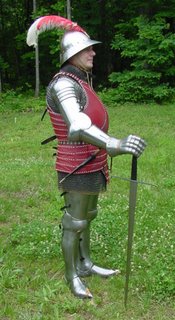
How Sir Jacques de Lalaing did arms in Scotland; and of many other particulars in the house of Burgundy.
And when Sir Jacques saw that he could find nothing more to do there he returned and found the good Duke of Burgundy in his city of Lilles where he received him full lightly and with a great heart. But it was not long before he took leave of the Duke, and took himself by sea to the realm of Scotland. And he was accompanied by Simon de Lalainge, his uncle and Herves de Meriadet and many other good people. And as I understand Sir James Douglas, brother of the Earl Douglas, and the said Sir Jacques de Lalaing had formerly agreed to do the will of one against the other and each sought each other to meet together, and so Sir James Douglas arranged that a battle would be done before the King between him and Sir Jacques de Lalaing. But the matter increased and multiplied so that a battle to the outrance was concluded, for three noble Scotsmen to meet with Sir Simon de Lalaing, Sir Jacques de Lalaing and Herve de Meriadet, and that they would all do arms at one time for the King of Scotland. And when the day came for the battle, the King received them in the lists most honorably, and because I was not there at that feat of arms I must omit certain ceremonies which occurred as an example in times to come.
But there were three memorable things in the battle, which was very fiercely fought on both sides. The first was that when the three were being armed at the lodgings of the Duke of Burgundy, each one with his coat of arms on his back and about to leave to go to the battle, Sir Jacques de Lalaing spoke to Sir Simon de Lalaing, his uncle, and to Meriadet and told them “My lords and my brother, in this fine day of battle you know that it is for my enterprise that we have come into the realm and that the battle has been put together by agreement with Sir James Douglas, and although each one of us is able to aid his companion, I pray and require of you that whatever happens to me today neither of you come to me or rescue me, because it will seem that you have crossed the sea and entered into this battle only to help me, and that you do not hold or know me as a man to sustain the assault and the battle of a single knight, and hold a low account of me and my chivalry.”
And after that request the champions left their pavilions armed and equipped with axes, lances, swords and daggers, and they were able to either throw or push with the lances as they pleased. The two knights, James Douglas and Jacques de Lalaing were in the middle to encounter each other as they did; and on the right hand was sir Simon de Lalaing, who was to encounter the Scots squire, and Meriadet to encounter with a very powerful and renowned knight; but they found themselves in the opposite position so that the knight was on the end with Sir Simon. And so Meriadet who desired to meet with the one that he intended, without having regard or thought of his fame, crossed to put himself before the said Sir Simon to meet with his man. But the good knight with coolness and assurance turned himself towards Meriadet and said to him “Brother let each one hold with the one that he meets and I will do well, if it please God” And the said Meriadet returned to face his man and that is the second thing which I wish to recount.
And the champions took themselves to march the one against the other, and the three of the party of Burgundy doubted that the place was suitable for the lances, and they all at one time threw their lances behind them and that is the third matter of my tale, and taking their axes they ran against the Scots, who came to the push of the lance but it profited them nothing. While they all fought at one time, I am only able to speak of their adventures one after the other.
The two knights, James Douglas and Jacques de Lalaing approached each other and pressed each other so closely that they had no weapons remaining to them,neither the one not the other, except for a dagger that the Scotsman held; and the said Sir Jacques held him by the arm near the hand in which he held the said dagger, and he held him with the other hand beneath the elbow, so that they turned themselves around the lists by the strength of their arms, and that went on for a long time.
Sir Simon de La Laing and the Scots knight were two powerful knights and there was no doubt of the subtlety of their axe play, and like two valiant knights and hardy, they so sought each other and found each other so often that in a little while they damaged the visors of their bassinets and their weapons and their harness with the strokes that they had given and received, and they gave up little ground to each other.
And on the other part came Herves de Meriadet and the Scotsman came to hit Meriadet with a push of the lance; but Meriadet turned aside the blow with the handle of his axe, so that the lance fell out of the hands of the Scotsman and Meriadet followed up so vigorously that before the Scotsman was able to unsling his axe he entered within, and with a throw carried him to earth. And Meriadet stepped back to let the Scotsman rise who was quick, light and of great courage, and he lifted himself quickly and ran under at the said Meriadet for the second time, and Meriadet who was a man who was one of the most redoubted squires of his time, strong, light, cool and dextrous in arms and in wrestling, received the Scotsman coolly and with great watchfulness and soon after made an entry on the Scotsman. And with that entry he gave such a great blow that he carried him to earth with a stroke of the axe, and quickly the Scotsman sought to lift himself, but Meriadet put his palm and knee against the back of the Scotsman, and again made him fall and kiss the sand. And despite the request that Sir Jacques de Lalaing had made of him, the said Meriadet, seeing the two knights wrestle together, went to aid the said Sir Jacques, but the King of Scotland threw down his baton and had them parted with the said Meriadet free in his battle to rescue his companions at his pleasure. And because this was done against my order I have written of this battle without personally having seen it. I have written the truth according to the report of the Scots and those of our party, so that I was able to recount it without error, because I would charge to Sir Jacques the enterprise of this fine adventure and others that came about.
Oliver de la Marche, Memories Paris 1884 II. 105
Translation by Will McLean, Copyright 2006
Thursday, June 29, 2006

Wednesday, June 28, 2006
Alvaro Continge vs. Clugnet de Brabant 1415
In the month of April, 1415, two knights did arms before the Duke of Bar at Bar le Duc, one named Alvaro Continge of the realm of Portugal, the other a Frenchman, Sir Clugnet de Brabant. On the day of their arms they were well accompanied by knights, squires and many others. The two knights were to fight with thrown lance, axe, sword and dagger. And when they had reached the hour to meet, the weapons examined and measured and the cries, warnings and ceremonies accomplished, Sir Clugnet issued from his pavilion, holding his lance in his hand and garnished with his other weapons. They could see that to perform his arms he had his visor raised so that he might throw his lance more easily. Sir Clugnet advanced quickly against his man, and sought him near his pavilion, and hastened so near to the Portuguese that he did not have space to throw his lance. And so Sir Clugnet let fall his own, and they came together to fight with axes. Sir Clugnet at first stepped back to close his visor, and they had only struck two or three blows and no more when the Duke of Bar threw down his baton and they were separated with honor on both sides.
Jean Le Févre, Seigneur de Saint-Remy Chronique Paris 1876 I. 205-206
Translation copyright 2006 Will McLean
Jean Le Févre, Seigneur de Saint-Remy Chronique Paris 1876 I. 205-206
Translation copyright 2006 Will McLean
Review: Jousts and Tournaments
Muhlberger, Steven
Jousts and Tournaments:
Charny and the Rules for Chivalric Sport in Fourteenth-Century France
Union City: The Chivalry Bookshelf 2002 ISBN 1-891448-28-5
Reviewed by Will McLean
The number of surviving medieval treatises on tournaments and jousts is small, and the number that are accessible to the general reader are even smaller. Charny’s Questions are a unique survival from the mid-14th century, and Steven Muhlberger’s translation fills a significant gap in the study of deeds of arms.
Around 1350, Geoffroi de Charny, strenuous knight, captain, bearer of the Oriflamme and first recorded owner of the Shroud of Turin, wrote down a series of questions related to the joust, tournaments and war. We do not have the answers. Even so, the questions asked tell us a great deal we would not otherwise know about how such deeds of arms were performed in Charny’s time. They show us the questions his companions, the members of the doomed Order of the Star, considered both debatable and worth debating. The work illuminates not only the mechanics of contemporary deeds of arms, but also the chivalric values of the time. Charny was a knight writing for knights, and his unfiltered voice is one of the charms of the work.
Muhlberger translates all of Charny’s questions on the joust and tournaments, as well as those questions on war that relate to more peaceful deeds of arms. The French text is presented in parallel. While the questions often give vivid glimpses into situations that might arise at such deeds of arms, they also leave much unsaid. Charny does not answer the questions he raises, and he wrote for men who already knew and understood how such events might be expected to proceed.
Muhlberger analyzes the questions, and refers to a great deal of other medieval material to flesh out the information implicit in Charny’s work. Invitations to jousts in 1390 are quoted, as are tournament regulations from the end of the 13th century, accounts of jousts in Froissart and other sources. Many elements of these are also recognizable in the questions Charny raises. However, the customs clearly changed over time. Without Charny’s questions we would have a weaker grasp of how his deeds of arms differed from earlier and later ones. Comparisons with other surviving treatises, such as that written by Sicily Herald sometime before 1437, and King René’s, written in the mid-15th century, show that the customs of the joust and tournament formed a conservative but evolving tradition. Muhlberger is careful to recognize that the evidence of the questions is often suggestive without giving us explicit answers to our questions.
For Charny, formal jousts and tournaments were events where one could gain the horse of an opponent either by unhorsing them in a joust or by capturing the horse in a tournament. There were also less formal events where horses were not necessarily at stake. Many of Charny’s questions hinge on what distinguishes formal, high stakes jousts and tournaments from lesser events. Formal announcement, proper division into teams, and recognized formalities in beginning and ending the contest were all seen as factors. Charny also raises the possibility that an event held between two towns rather than within one may not count as a true tourney; or that the failure of some of the eligible knights present to take part may invalidate the event as a legitimate tourney. Jousts for knights and jousts for squires are contrasted, with the implication that the second may involve different equipment and different assumptions about the loss of horses. This logical hierarchy is quickly complicated when Charny discusses cases where a knight enters a joust for squires and vice versa.
Other questions examine what constitutes proper unhorsing. Suppose a knight is knocked off his horse, saddle and all, but stays in the saddle. Is he unhorsed? If compensation is owed for killed or injured horses, how promptly must it be claimed? Under what circumstances can retainers dissolve a contract to serve so that they may accept a more favorable arrangement?
A warhorse could represent half a year’s income for the owner, so these are serious issues indeed. Muhlberger notes the tension that must have been inherent in high stakes disputes between men whose profession is violence. The value of a body of precedent to resolve such cases is clear. Charny refers repeatedly to “the law of arms and tourneys”, so some sort of body of precedent, frequently oral, must have been available to guide Charny and his fellow men-at arms in disputes that might arise in their profession. However, each of Charny’s questions represents an issue on which the “law of arms” does not, at the time of writing, give a clear answer. His questions, then, represent an attempt to codify and extend the existing “law of arms” in written form.
Steven Muhlberger may be better known to members of the Society for Creative Anachronism as Duke Finnvarr de Taahe. He is also a horse owner, which may give him some insight into the men that gave so much attention to the loss and gain of expensive horseflesh. He writes with sympathy about their concerns, and offers some interesting speculation into the role these deeds of arms may have served as a market for the scarce and troublesome stallions prized as warhorses. Other work about medieval deeds of arms that he has written or edited may be found here.
This is a fine work, invaluable to anyone with an interest in the jousts and tournaments of the period. It also offers a rare window into the values of a strenuous knight in the middle of the 14th century, manifested not in the observations of others, but in his own words and voice.
Copyright 2003 by Will McLean
Review originally published in Tournaments Illuminated Issue 147, Summer 2003
Saturday, June 24, 2006
Tarte of Parys
Geoffrey Chaucer has interviewed the famous Paris Launcecrona. I’ve never believed that the Parys Launcecrona Naughtie Marginalia was produced and released without her knowledge and consent, The image with her and the wheelbarrow alone must have involved several minutes of posing, even with a quick illuminator.
She wore hir hemlines verray, verray hye
And sikerly she hadde a lazy eye
As a wezel was hir body gent and small
And in hir brain there were no thoughts at al
She wore hir hemlines verray, verray hye
And sikerly she hadde a lazy eye
As a wezel was hir body gent and small
And in hir brain there were no thoughts at al
14th Century English Armor Terminology
Listing from the feet up and the skin out:
Sabatons: Feet
Greeves: Lower Legs
Polayne: Knees
Cuisses, Cuissews (earlier pronunciation) Thighs
Legharness: Complete leg protection
Shirt: Frequently worn as inmost layer, but 15th c. Howe a man shall be armyd recomends lining for doublet instead
Doublet: Closely fitted inner garment to which hose and armor can be laced with points
Aketoun, Acton: Padded garment worn beneath armor or as only defense for body
Hauberk, Bruny: mail shirt
Habergeon: as above, but generally shorter
Jesserawnte, Gesserawnte, Iesserante: Mail shirt lined and covered with fabric
Pauncer: belly protection, may be plate or mail
Plates: Body armor of overlapping plates riveted below or above textile or leather
Gambisoun: Padded garment worn with or as armor. May be made of silk and brightly colored
Jupon, Gypoun, Gypon, Gyppon, Gippon, Iepon, Iopon: Garment that can be worn over armor, or beneath breastplate but over other harness. One variant is worn by the knight in the Ellesmere Chaucer, with points visible on the chest where a breastplate might be laced on over the gypoun
Breastplate: Breast
Cote-armure: Garment worn by men-at-arms over armor or by heralds, frequently if not always embroidered or otherwise decorated with heraldic design.
Gauntlets, Gloves of plate: hands
Bracers: Arms
Couters: Elbows
Vambrace and Rerebrace: Upper and lower arm protection. Dividing point between them may or may not be at elbow.
Pisan: Mail collar
Aventail: Mail cape to bascinet
Urison: Fabric covering for aventail
Bascinet: Bowl shaped or conical helmet
Kettlehat: Kettle or hat-shaped open helmet
Wednesday, June 21, 2006
Authentically Medieval Ahistorical Tripe
It turns out that a lot of the historical travesties in Braveheart aren't actually Hollywood inventions. Wallace's romance with babesome English royalty? Straight out of Blind Harry's 15th c. poem. Mass hanging of Scottish nobles in a barn based on misunderstanding of earlier account? Blind Harry. Nonexistent assault on York? Blind Harry. Undocumented encounter between the Bruce and Wallace at Falkirk? Blind Harry.
However, Gibson's team still get the blame for the anachronistic blue face paint that makes the Scots look like homicidal smurfs. And filming the battle of Stirling Bridge without the bridge because it got in the way. Which is a lot like filming storming Omaha Beach in Omaha because it's more convenient.
However, Gibson's team still get the blame for the anachronistic blue face paint that makes the Scots look like homicidal smurfs. And filming the battle of Stirling Bridge without the bridge because it got in the way. Which is a lot like filming storming Omaha Beach in Omaha because it's more convenient.
Eureka: Ringeck/von Danzig Study Aid
I downloaded a big chunk of von Danzig. I then cut apart pages when necessary so that I could fit each technique between the appropriate pages of Tobler's Ringeck translation. I did the same with illustrations from Goliath. Now I can easily reference two different versions of the same technique and illustrations when available.
Sunday, June 18, 2006
Myths About the Middle Ages
Everybody was much shorter then.
Knights always lived in Castles.
The King could do whatever he wanted.
The English had a weapon they called the English Longbow. It was so deadly that the English could stop charges by armored knights with arrow fire alone.
Medieval people weren't as smart as we are.
In 1492, everyone said "OK, time to have the Renaissance now."
Saturday, June 17, 2006
When Adam Delved and Eve Span, Who Was Then the Gentleman, eh?
That was the question John Ball and his followers were asking in the late 14thc. It’s a pretty pithy attack on hereditary privilege. If we are all equally sons of Adam or daughters of Eve, how do some of us get the hereditary right to lord it over the others?
As it turns out, the other side had an answer. You don’t get to stay at the top of the social pyramid by sticking your fingers in your ears and saying “Lalalala I can’t hear you”. The argument is laid out in a fairly coherent form in the Book of Saint Albans, and goes like this:
“A bond man or a churl will say we all be comen of Adam: so Lucifer with his company may say we all be comen of heaven” Adam and Eve did not have gentilesse, any more than they had umbilical cords. Since gentilesse is defined by your parents, the term didn’t apply to them. Cain, however, became a churl through his slaying of his brother: nothing could be more ungentle. Seth became gentle through his father’s blessing, and so their children after them. Seth’s offspring, Noah, was likewise gentle.
Noah had thee sons: Shem, Ham and Japheth. Ham looked on Noah in his nakedness, and “laughed his father to scorn. Japheth….reproved his brother”. Noah cursed Ham’s son Canaan to bondage. “I give to thee the north part of the world to draw thine inhabitation, for there shall it be: where sorrow and care cold and mischief as a churl thou shalt have in the third part of the world: which shall be called Europe, that is to say the country of churls.”
Noah blessed Shem and Japheth “and made them gentlemen.” The quoted material is the Book of Saint Albans’ interpolation, and not actually found in the Bible. However, in an age when very few people had access to the Old Testament in a form they could read, few readers would notice the liberty taken.
However, even without refuting the Book of Saint Albans’ version of Genesis, there are limits to the hereditary elitist argument. The Book of Saint Albans itself warns that gentle birth is at best a necessary but not sufficient condition for gentilesse. Cain and Ham are horrible examples of men of gentle birth who lost gentilesse because of their base actions.
Chaucer goes further at the end of the Wife of Bath’s Tale and in his own voice in the poem Gentilesse. Christ’s redemption trumps Old Testament curses and pride in distinguished ancestors. Gentilesse comes not from them, but ultimately from him. Gentle is as gentle does.
Medieval Superheroes
Geoffrey Chaucer is up to his usual form, although I'm sorry to see that he left out my favorite medieval superhero, Everyman.
Geoffrey Chaucer writes better than any dead author I know of. Even L. Ron Hubbard. (d. 1986, but it hardly slowed him down at all)
Geoffrey Chaucer writes better than any dead author I know of. Even L. Ron Hubbard. (d. 1986, but it hardly slowed him down at all)
Subscribe to:
Posts (Atom)