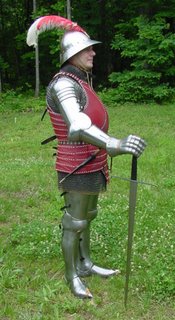
When the Lion's fierce roar conquers your Iron Door
That's Fiore!
When the Elephant's knees are unbending as trees
That's Fiore!
Bells will ring ting-a-ling-a-ling, ting-a-ling-a-ling
When you’re hit by fendente
Points will stab jibby-jibby-jab, jibby-jibby-jab
Like a sharp-toothed serpente
When the Lynx's keen sight sees you move in the night
That's Fiore!
When your skills can defeat the assassins you meet
With a glove
When you make all your foes scream with the tricks that you’ve
Learned from Fiore
When the Tiger's swift leap makes you flinch and say "eep!"
That's Fiore!
That's Fiore.......
Wednesday, June 23, 2010

Monday, June 07, 2010
Flags of Forgotten Countries
Note to flag designers: avoid eagles and crowns, there seems to be a negative correlation with regime survival. And you must use an eagle, try to design it with no more than one head.
Saturday, June 05, 2010
Falcon Flies
The Economist has an appreciation of Falcon 9's successful first flight.
This is an impressive achievement. The launcher is considerably more capable than the Atlas and Titan rockets that launched NASA's first astronauts: it's reportedly a bit more capable than the Saturn 1 that launched a boilerplate Apollo capsule in 1964.
The biggest government funded launchers of the U.S., Russia, Europe, Japan and China are more powerful, as is the the Zenit launcher that Ukraine inherited from the Soviet Union, but it can lift more than India's biggest launcher, the next most capable government program.
The Challenge of the Seneschal of Hainault: Pennsic 2010
The Seneschal of Hainault and certain companions have come to do single combats against the Company of St. Michael. Those who wish may also offer challenges against one side or the other, either for an agreed number of blows or until one champion or the other falls to the ground. Also, there will be group combats with rebated weapons as often and as long as the ladies wish.
This deed will occur on Tuesday August 10th from 3-6 PM on the Main Battlefield (West) at Pennsic.
The Historical Basis:
This is based on deeds of arms done by the Seneschal of Hainault and certain others at Smithfield in 1410.
“And in the tenth year of King Harry's reign the IVth, come the seneschal of Hainault, with other men, into England, for to seek adventures, and to get him worship in deeds of arms, both on horseback and on foot, of all manner points of deeds of arms and war.”
The company is seeking volunteers to take the role of the puissant seneschal and his immediate household. To take these roles you must have harness suitable for his era (1380-1415) and authentic in appearance from a distance of ten feet or less. There is no appearance requirement or limitation to the seneschal’s period for other challengers, although authentic appearance is encouraged and appreciated.
If interested, contact Galleron de Cressy, Captain of the Company, at mclean1382@aol.com
Combat Conventions
Each combat between two champions will end when the judges stop the fight, or a champion is unable to continue
A champion is unable to continue if he is struck five good blows in the course of the combat, or falls or becomes disarmed, or is disabled as described below. A champion whose weapon breaks is not considered disarmed, and the fight will halt while he replaces it.
Champions may also agree to end the fight after an agreed number of blows thrown by one side or the other, even if nobody is knocked down or disabled first.
Weapons:
We will have matched lances, throwing spears, pollaxes, two handed swords and daggers available for the combatants.
Effects of Blows
Two handed edge blows have no effect against plate or brigantine torso armor, and count as one good blow against the head or other protection.
A hit with a thrown lance or spear counts the same as a two handed edge blow. For the justification of the relative effectiveness of thrown weapons, see here.
Single handed edge blows have no effect against any plate but the helmet, and count as a good blow against the head or lesser protection elsewhere.
Thrusts have no effect against any plate except for plate helmet visors or faceplates, count as one good blow against these or mail, and a disabling blow against barred visors and lesser protection.
Heavy hardened leather and other suitably covered rigid protection will generally count as plate, with debatable cases to be decided by the discretion of the judges. The judges will, as far as seems practical, attempt to match opponents with similar levels of protection like against like, and harness from the same period like against like.
Champions may agree that both are assumed to be wearing typical armor of the early 15th century even if they are actually wearing less protection: mail at the neck, armpit and inside the elbow, cloth at the back of the knee and inner thigh, and plate elsewhere. Barred visors will still count as no protection against a thrust.
I suggest these rules for halfswording with two-handed swords, if both parties consent.
Do not act out blows, but call them out clearly. Except in group combat you need not keep track of the blows struck yourself: those guarding the list will do so for you.
Group Combats with Rebated Weapons
After any telling blow, retreat to your end of the lists, cry your cry, and return to the fray. Do not act out amputations. The weapons are no more than six feet long: a sword, pollaxe or short spear.
René’s rules assumed the combatants would batter each other with blunt weapons, and if a combatant was temporarily stunned his retainers would protect him until he recovered. Standard SCA rules in which the man struck pretended he was crippled or killed were not appropriate. After our first recreation we omitted the armored retainers who protected their master in René’s rules: under the adapted rules they didn’t have a lot to do or scope to enjoy themselves. (In the original, this was irrelevant: they were paid to do their job, not to have fun).
We often fight this over the barrier. Barriers didn’t become part of friendly deeds of arms until around 1500, rather later than René’s rules. However, barriers do allow good control of the melee with minimal need for marshaling. Sword and shield at the barrier tends to be an uninteresting fight, and I would discourage that choice if the combatant is able to use one of the other options.
Since we fight on foot we faced a fundamental choice. Should we use contemporary foot combat conventions while using as much of René’s format as made sense, or should we follow as many of his rules as possible even if they lose their purpose in the absence of horses? We eventually chose the first, and so allowed the typical weapons of foot combat. Thrusts were only rarely prohibited in contemporary foot combat so we allowed them.
You can learn more about 15th century deeds of arms here:
Some of the historical basis for the combat rules can be found here.
Here is an account of the deeds of arms the seneschal did on his pilgrimage to Santiago a few years earlier. It gives a good sense of the formats he and his companions might have used for their combats.
Here is an account of the the challenge the seneschal issued before his departure. You will see that his opponents negotiated significant variations from the original challenge in the combats they actually fought.
The formats for single combats are described here.
Sunday, May 30, 2010
Robin and Marion and Robin Hood and the Monk
Here is my pitch for a film script of the Robin Hood story, free of later revisionism.
Robin Hood tells his merry men he wishes to go to church to hear mass in Nottingham, and he takes Little John with him. On the way, they stop to shoot arrows for penny stakes, and eventually Robin wins five shillings but Little John says he hasn’t. They quarrel and part.
Meanwhile, Marion, a pretty shepherdess, is wooed by an amorous knight. She rebuffs him, telling him her heart belongs to Robin the shepherd. She warns him that her boyfriend’s back and he’s going to be in trouble (Hey down a down, her boyfriend’s back.)
The knight storms off, looking for Robin the shepherd, planning to beat him soundly.
Little John has second thoughts, and goes to Saint Mary’s church to find Robin. A monk tells him that no-one of that name has been there yet. Little John leaves five shillings with the monk and asks him to give them to Robin when he arrives.
Robin the shepherd comes to the church and the monk gives him the five shillings.
The knight meets a potter, and asks him where he can find Robin. The potter directs him to the forest, beneath the greenwood tree. The knight leaves for the forest.
Robin Hood meets little John, and tells him that he hasn’t met a monk, so Little John returns to recover the money. Robin Hood returns to meet Much the miller’s son and the other merry men beneath the greenwood tree.
Medieval sitcom hijinks ensue.
Robin Hood (2010)
Steve Muhlberger's review pretty much agrees with my own impressions. The recreated world seems very real and richly detailed even though an informed viewer can spot anachronisms. A lot of the action is set against sweeping panoramas of medieval landscape and seascape. This is a movie that benefits from a big screen.
Eleanor of Aquitaine, William Marshal and Richard are portrayed well and with reasonable fidelity to their historical character. It's great to see the Marshal finally get a major role on the big screen. (His portrayal in Lion in Winter was spot on in showing his competence and value to the crown, but he didn't get a lot of lines) Bad King John is complexly bad. Isabella of Angoulême, John's hot jailbait second queen, has a more interesting role than I expected.
I can forgive most of the anachronisms as driven by dramatic or practical reasons rather than carelessness. The visored or open faced sallets sometimes worn are from a later era, but convey knightly status and allow characters' faces to be revealed or concealed as needed. Glazed windows are anachronistic, but it looks like Ridley Scott found an existing building to shoot in, and removing the windows for the shoot would have been an expensive process.
Although ramped landing ships were used in this era, the landing craft in the film look too much like WWII Higgins boats. Recreating the big galleys actually used would have been tremendously costly, let alone training the extras to carry out the difficult stern first beaching.
The anachronisms and ahistorical moments were not intrusive enough to stop me from enjoying the film a great deal.
Wednesday, May 26, 2010
Marian: Warrior Princess
Modern viewers who think that the kick-ass Maid Marian in Ridley Scott's Robin Hood is just revisionist modern feminism might be interested in the ballad Robin Hood and Maid Marian
The surviving version is thought to date from the 17th century.
The surviving version is thought to date from the 17th century.
Monday, May 24, 2010
Landing Ship (Horse)
Then began the mariners to open the ports of the transports, and let down the bridges, and take out the horses; and the knights began to mount, and they began to marshal the divisions of the host in due order.
Geoffrey de Villehardouin [b.c.1160-d.c.1213]: Memoirs or Chronicle of The Fourth Crusade and The Conquest of Constantinople, trans. Frank T. Marzials, (London: J.M. Dent, 1908)
So the fleet came to land, and when they were landed, forth came the knights out of the transports, all mounted; for the transports were built in such fashion that they had doors, which were easily opened, and a bridge was thrust out whereby the knights could come forth to land all mounted.
Robert of Clari's account of the Fourth Crusade
Those sources called the horse transports uissiers. Other names included chelandium, tarida and dromon. They were big galleys capable of carrying 12-30 horses. The big thirty horse taride of Charles I of Sicily shipped 108-110 oars. The doors and ramps were at the stern between two sternposts, so the vessels backed onto the beach to unload and load. They were shallow draft: in Villehardouin's account the knights jumped from the transports into waist-deep water.
The vessels are covered in more detail in: Bull, M. (2003). The experience of crusading. Cambridge: Cambridge University Press.
More on the ships and the landing here.
Sunday, May 23, 2010
For a Limited Time in NYC: the Magna Carta, Durer and the Limbourg Brothers
At the Morgan Library through May 30th: one of the earliest engrossments of the Magna Carta from 1217.
That is to say, it isn't what was signed at Runnymede, but it is an original legal document because it bears the royal seal.
It is written in the strikingly small, fair chancery hand of an era when parchment was bloody expensive and labor was cheap. Let us give thanks to the papermakers, who over the centuries of development of their craft changed our lives so much for the better!
By 1217 John was dead, so his son's name is at the top of the page, because the rule of law will outlive a man, if you do it right.
Also at the Morgan, a choice collection of images by Durer, through September 12th. Durer's virile and expressive pen strokes are also worth seeing in person.
At the Met, conservation of the currently unbound Belles Heures gives a rare opportunity to see all of its illuminated pages as individual leaves. The Met provides magnifying glasses to better appreciate the splendor of the work in person. You can appreciate the life that minute decorative punchwork brings to gold leaf backgrounds,or gold and silver highlights on the surface of a troubled sea. This is well worth seeing in person, if you can, before the manuscript is rebound. The exhibition runs through June 13th, 2010.
I write this on the last day of The Mourners: Medieval Tomb Sculptures from the Court of Burgundy. Fortunately, the web site still contains a wealth of useful images.
Subscribe to:
Posts (Atom)