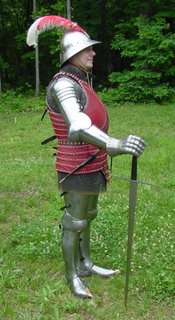
Even the best movies set in the Middle Ages don’t get the period entirely right. Sometimes the production designer doesn’t have the resources or expertise to do the costuming or other details properly, as in the low budget The Seventh Seal and The Navigator: A Medieval Odyssey. Sometimes the film is less about the period than something else. The Seventh Seal was set in the fourteenth century, but Bergman was primarily using the setting to show the sort of existential doubt and crisis of faith a Lutheran pastor’s son might feel in the second half of the twentieth century, with an allegorical personification of death substituting for unfilmable internal conflict. The 1964 Becket was mostly a way to talk about French collaboration during World War II without poking the recent wounds too directly.
Our sense of what is natural, stylish, or flattering is different from theirs, and this often shows up in the recreation of hairstyles and costume details, either unconsciously or because the production designer was afraid the audience wouldn’t accept or understand an accurate recreation. In an extreme case like A Knight’s Tale, the production designer deliberately modernizes the clothing and even soundtrack to make it more accessible to a modern audience even while retaining some properly medieval story elements. The movies can still be worth watching, but you need to be aware of their limitations as a recreation of the historical past.
And then, even if the director has been given an adequate budget, and isn't trying to use the Middle Ages as a way to talk about something else, and hasn't transposed elements of the past to make them more accessible to a modern audience, another challenge remains.
Movies are not made to lose money. Successful movies, like other drama, tell a narrative that makes sense to the audience, and create a plausible narrative arc that ends at the end of the movie with the audience feeling that they have achieved some sense of resolution or release.
Real history, on the other hand, is full of awkward digressions from a plausible narrative arc that ends at with the audience feeling that they have achieved some sense of resolution or release. A successful director will divert your attention from these, or omit them, or sweep them under the rug.
Shakespeare treated history the same way. If you had to choose between historical truth and effective drama, truth would lose.
Showing posts with label Medieval Movies. Show all posts
Showing posts with label Medieval Movies. Show all posts
Saturday, September 07, 2013

Tuesday, November 01, 2011
Alternate Universe Shakespeare
A friend has described Anonymous as an Alternate Universe FanFic, and right good fun if you take it in that spirit.
And here's the thing. Shakespeare's Histories were also set in an alternate universe from our own. He ruthlessly fudged chronology and character when it made a better story. He used biased sources for his background research.
And as Poul Anderson noted and built a novel around, the past of Shakespeare's Histories was more technologically advanced than our own. In Shakespeare, the Rome of Julius Caesar had mechanical clocks and the knights that fought at Shrewsbury in 1403 were armed with pistols as well as swords.
Explicit alternate history can be a very appropriate and effective way to present Shakespeare's histories. Ian McKellen's 1995 Richard III, set in an alternate history 1930s England, is an excellent example of how well this can work.
And here's the thing. Shakespeare's Histories were also set in an alternate universe from our own. He ruthlessly fudged chronology and character when it made a better story. He used biased sources for his background research.
And as Poul Anderson noted and built a novel around, the past of Shakespeare's Histories was more technologically advanced than our own. In Shakespeare, the Rome of Julius Caesar had mechanical clocks and the knights that fought at Shrewsbury in 1403 were armed with pistols as well as swords.
Explicit alternate history can be a very appropriate and effective way to present Shakespeare's histories. Ian McKellen's 1995 Richard III, set in an alternate history 1930s England, is an excellent example of how well this can work.
Saturday, May 28, 2011
The Viking
This 1928 film is a festival of anachronism and overacting, from the distinctly not 10th century castle to Sigurd's Bronze Age armor to the low cut corselet that shows off Helga's creamy decolletage. Also, there are a lot of amazingly badly tailored furs.
Young Alwin Skywalker is so brooding and pouty that you can just know that he's going to to eventually turn to the dark side, call himself Lord Veidr, and start wearing black armor, cape and Sutton Hoo helmet.
Richard Alexander, who played Sigurd, went on to wear other silly helmets, possibly from the same prop closet, as Prince Barin in the Flash Gordon serials.
The film was made at an interesting point of technological transition: a full length film with early technicolor and a soundtrack but no recorded dialog.
More Bronze Age viking goodness:
Leif Erikson has something of a Derek Smalls look going on here.
Helga nearly puts Leif Erikson's eye out with one of her horns at about 9:28
Monday, January 03, 2011
Sunday, May 30, 2010
Robin Hood (2010)
Steve Muhlberger's review pretty much agrees with my own impressions. The recreated world seems very real and richly detailed even though an informed viewer can spot anachronisms. A lot of the action is set against sweeping panoramas of medieval landscape and seascape. This is a movie that benefits from a big screen.
Eleanor of Aquitaine, William Marshal and Richard are portrayed well and with reasonable fidelity to their historical character. It's great to see the Marshal finally get a major role on the big screen. (His portrayal in Lion in Winter was spot on in showing his competence and value to the crown, but he didn't get a lot of lines) Bad King John is complexly bad. Isabella of Angoulême, John's hot jailbait second queen, has a more interesting role than I expected.
I can forgive most of the anachronisms as driven by dramatic or practical reasons rather than carelessness. The visored or open faced sallets sometimes worn are from a later era, but convey knightly status and allow characters' faces to be revealed or concealed as needed. Glazed windows are anachronistic, but it looks like Ridley Scott found an existing building to shoot in, and removing the windows for the shoot would have been an expensive process.
Although ramped landing ships were used in this era, the landing craft in the film look too much like WWII Higgins boats. Recreating the big galleys actually used would have been tremendously costly, let alone training the extras to carry out the difficult stern first beaching.
The anachronisms and ahistorical moments were not intrusive enough to stop me from enjoying the film a great deal.
Eleanor of Aquitaine, William Marshal and Richard are portrayed well and with reasonable fidelity to their historical character. It's great to see the Marshal finally get a major role on the big screen. (His portrayal in Lion in Winter was spot on in showing his competence and value to the crown, but he didn't get a lot of lines) Bad King John is complexly bad. Isabella of Angoulême, John's hot jailbait second queen, has a more interesting role than I expected.
I can forgive most of the anachronisms as driven by dramatic or practical reasons rather than carelessness. The visored or open faced sallets sometimes worn are from a later era, but convey knightly status and allow characters' faces to be revealed or concealed as needed. Glazed windows are anachronistic, but it looks like Ridley Scott found an existing building to shoot in, and removing the windows for the shoot would have been an expensive process.
Although ramped landing ships were used in this era, the landing craft in the film look too much like WWII Higgins boats. Recreating the big galleys actually used would have been tremendously costly, let alone training the extras to carry out the difficult stern first beaching.
The anachronisms and ahistorical moments were not intrusive enough to stop me from enjoying the film a great deal.
Wednesday, May 26, 2010
Marian: Warrior Princess
Modern viewers who think that the kick-ass Maid Marian in Ridley Scott's Robin Hood is just revisionist modern feminism might be interested in the ballad Robin Hood and Maid Marian
The surviving version is thought to date from the 17th century.
The surviving version is thought to date from the 17th century.
Sunday, May 23, 2010
Thursday, April 01, 2010
An Exciting Day for Medievalists
Scholars have discovered another MS of the text in Harleian 3542, The Man that Wol. The new find includes a glossary, clearly explaining the meaning of hawke, rennyng quarter, rownde, cantel and other terms previously obscure.
In a related development, a German text has been discovered explaining the uncaptioned earlier portion of the Codex Wallerstein.
Finally, Mel Gibson has announced a new directors' cut of Braveheart, which will include a CGI rendering of Stirling Bridge added to the Battle of Stirling Bridge. Also, all scenes featuring Princess Isabelle will be reshot. She will be played by Mairi Ella Challen and all her scenes will take place in France, where her father will mention negotiations for her future marriage when she's twelve. Prince Edward's scenes may be reshot as well, and Ricky Martin is being considered for the role.
What an eventful day April 1st has been!
In a related development, a German text has been discovered explaining the uncaptioned earlier portion of the Codex Wallerstein.
Finally, Mel Gibson has announced a new directors' cut of Braveheart, which will include a CGI rendering of Stirling Bridge added to the Battle of Stirling Bridge. Also, all scenes featuring Princess Isabelle will be reshot. She will be played by Mairi Ella Challen and all her scenes will take place in France, where her father will mention negotiations for her future marriage when she's twelve. Prince Edward's scenes may be reshot as well, and Ricky Martin is being considered for the role.
What an eventful day April 1st has been!
Tuesday, May 19, 2009
The Middle-Aged Middle Ages
Steve Muhlberger has posted an appreciation of Robin and Marian.
I'd say that it's matched by Goldman's other film on a similar theme, The Lion in Winter, in which a creaky Henry II deals with aging, his estranged wife, bickering adult children and other midlife issues.
One of the minor joys of that movie is William Marshal as a secondary character. He's the one who knows that you should always be waiting outside in the corridor with a drawn sword any time you send the guards into a room to fetch Richard.
I probably should not say that this is a movie about middle-aged people for middle-aged people, but it is, and I mean it as a compliment. I certainly can't think of a better historical movie of this sort.
I'd say that it's matched by Goldman's other film on a similar theme, The Lion in Winter, in which a creaky Henry II deals with aging, his estranged wife, bickering adult children and other midlife issues.
One of the minor joys of that movie is William Marshal as a secondary character. He's the one who knows that you should always be waiting outside in the corridor with a drawn sword any time you send the guards into a room to fetch Richard.
Friday, April 25, 2008
Gawain and the Green Knight in Pop Culture
Jeff Sypeck includes some links to an award winning Irish animated version as well as a performance by paper bag puppets. The last is funnier to think about than watch.
Tuesday, April 08, 2008
William Wallasky
Over in the comments at Megan McArdle, Braveheart was suggested as suitable viewing for Libertarian Movie Night. It is to laugh.
Da, Gibson does scream Freeeeeeedom, even if he delivers line better in Chicken Run. But really, Braveheart is patriotic epic of defense of motherland from foreigners that come to rape our women and mince about in crushed velvet. Is about collectivist virtues of people united shoulder to shoulder against invader, except for traitorous splittists who are justly liquidated through nighttime visit from patriotic security forces in necessary breaking of eggs to make omelets. Is about heroic guidance of Great Leader, who wisely teaches laboring class to use pointed sticks against decadent feudalists, a tactic they were unable to deduce for themelves because only Great Leader can think of such a thing. Is about revolutionary overthrow of foreign authoritarian overlord and replacement by Scottish authoritarian overlord, which is of course wonderful improvement. Is about putting inconvenient historical events down the memory hole. Is movie that could have been made by Eisenstein for Lochnessfilm if he had had color stock and less talent.
Da, Gibson does scream Freeeeeeedom, even if he delivers line better in Chicken Run. But really, Braveheart is patriotic epic of defense of motherland from foreigners that come to rape our women and mince about in crushed velvet. Is about collectivist virtues of people united shoulder to shoulder against invader, except for traitorous splittists who are justly liquidated through nighttime visit from patriotic security forces in necessary breaking of eggs to make omelets. Is about heroic guidance of Great Leader, who wisely teaches laboring class to use pointed sticks against decadent feudalists, a tactic they were unable to deduce for themelves because only Great Leader can think of such a thing. Is about revolutionary overthrow of foreign authoritarian overlord and replacement by Scottish authoritarian overlord, which is of course wonderful improvement. Is about putting inconvenient historical events down the memory hole. Is movie that could have been made by Eisenstein for Lochnessfilm if he had had color stock and less talent.
Saturday, December 29, 2007
Robert Bresson’s Lancelot of the Lake (Lancelot du Lac, 1974)
Bresson’s 1974 film is now available on DVD in the US from New Yorker Video. This is a difficult and powerful film. Visually, he tends to use tightly framed close ups: a joust is portrayed with shots of banners and the galloping horses’ feet. Similar scenes are repeated. Key events are often unshown, and revealed only through their aftermath or portents.
Like Kubrick’s 2001, it can be a baffling and frustrating experience if you don’t already know the story, and his style may not be to everyone’s taste. The Death of King Arthur (La Mort le Roi Artu) seems to have been Bresson’s starting point: if you’ve read that the narrative of the film is quite clear. However, I think the ellipses are deliberate. Real human beings don’t know where they fit into a neat narrative: the characters in the film are confused and doubtful, riding through dark woods, ignorant of their fate, looking for portents.
The film shows the characters’ belief in the reality of the supernatural world. Early in the film an old woman tells a child: “the person whose footsteps I hear but do not see will die within the year.” We hear horse’s hoofs, and the child looks up to see a knight; Lancelot. Later Lancelot is missing after a tournament. After a storm pieces of his banner lie on the ground before his tent: the other knights immediately conclude he is dead. They are thinking like medieval people, not like moderns in costume.
This ties back to Bresson’s presentation of the story in selective scenes and shots. From rational, non-mystical viewpoint the portents are there as well. Early on we are shown enough of the character of Lancelot, the queen and Mordred, and of the factions and disunity in the court, to infer where the story will end up, just as we can infer from three riderless horses fleeing through a wood that something very unpleasant is happening to some knights further in. But when we see only fragments of the world, it’s easy enough to mistake the signs and portents of our fate: the knights have misread the omen of Lancelot’s banner, and Lancelot misjudges his ability to break off from his relationship with the queen, reconcile with his enemies and surmount his challenges through personal prowess.
Like Malory, the film is rife with anachronism. The body armor generally follows the style of the 16th c., the helmets and crests are roughly those of the 15th c., or 14th c. visors on 15th c. skulls. I suspect that this, like the lack of mail gussets and collars, the mail-fingered gauntlets and the many backless greaves, was forced by budgetary limitations. The decision to dress the non-noble characters like Breton peasants from some time in the past century or so seems deliberate, perhaps to break the story loose from its medieval moorings a bit and emphasize the more universal elements of the tale.
There are some very gory sequences, beginning with the opening scenes in which the Grail Quest has turned into a bloody chevauchee. It’s hard to see them in a quite the same way today: they are far too close to similar sequences in Monty Python and the Holy Grail, released the following year.
This is a film of contradictions: gritty and mystical, in which aspiration struggles with human failing. It’s not so much a revisionist script as a return to the roots of the story: the flawed characters, bickering nobles and bloody combats are not so far from the spirit of the 13th c. romance that inspired it.
Like Kubrick’s 2001, it can be a baffling and frustrating experience if you don’t already know the story, and his style may not be to everyone’s taste. The Death of King Arthur (La Mort le Roi Artu) seems to have been Bresson’s starting point: if you’ve read that the narrative of the film is quite clear. However, I think the ellipses are deliberate. Real human beings don’t know where they fit into a neat narrative: the characters in the film are confused and doubtful, riding through dark woods, ignorant of their fate, looking for portents.
The film shows the characters’ belief in the reality of the supernatural world. Early in the film an old woman tells a child: “the person whose footsteps I hear but do not see will die within the year.” We hear horse’s hoofs, and the child looks up to see a knight; Lancelot. Later Lancelot is missing after a tournament. After a storm pieces of his banner lie on the ground before his tent: the other knights immediately conclude he is dead. They are thinking like medieval people, not like moderns in costume.
This ties back to Bresson’s presentation of the story in selective scenes and shots. From rational, non-mystical viewpoint the portents are there as well. Early on we are shown enough of the character of Lancelot, the queen and Mordred, and of the factions and disunity in the court, to infer where the story will end up, just as we can infer from three riderless horses fleeing through a wood that something very unpleasant is happening to some knights further in. But when we see only fragments of the world, it’s easy enough to mistake the signs and portents of our fate: the knights have misread the omen of Lancelot’s banner, and Lancelot misjudges his ability to break off from his relationship with the queen, reconcile with his enemies and surmount his challenges through personal prowess.
Like Malory, the film is rife with anachronism. The body armor generally follows the style of the 16th c., the helmets and crests are roughly those of the 15th c., or 14th c. visors on 15th c. skulls. I suspect that this, like the lack of mail gussets and collars, the mail-fingered gauntlets and the many backless greaves, was forced by budgetary limitations. The decision to dress the non-noble characters like Breton peasants from some time in the past century or so seems deliberate, perhaps to break the story loose from its medieval moorings a bit and emphasize the more universal elements of the tale.
There are some very gory sequences, beginning with the opening scenes in which the Grail Quest has turned into a bloody chevauchee. It’s hard to see them in a quite the same way today: they are far too close to similar sequences in Monty Python and the Holy Grail, released the following year.
This is a film of contradictions: gritty and mystical, in which aspiration struggles with human failing. It’s not so much a revisionist script as a return to the roots of the story: the flawed characters, bickering nobles and bloody combats are not so far from the spirit of the 13th c. romance that inspired it.
Wednesday, November 21, 2007
"...the high heels symbolize the very act of symbolism..."
Grendel's Mom grows high heels out of her feet.
She is portrayed by a CGI version of an actress who previously portrayed a live action version of a well known tomb raiding CGI character. Arrrrrgh. The recursiveness. It burns.
Hwaet! She comes, the babesome beastie!
Grendel’s mother goes to greet him
Strutting silky on the spike-heels
She forced forth from flickering footsies
Clever trick! How does she do that?
Clicking in the clammy cavern
Pouty lips like puffy pillows
What could be more medieval?
Many things that I might mention.
Mark that distant muted moaning?
Like a wain-wheel spinning swiftly?
That’s the tune of Teacher Tolkien
Turning top-like in his barrow
She is portrayed by a CGI version of an actress who previously portrayed a live action version of a well known tomb raiding CGI character. Arrrrrgh. The recursiveness. It burns.
Hwaet! She comes, the babesome beastie!
Grendel’s mother goes to greet him
Strutting silky on the spike-heels
She forced forth from flickering footsies
Clever trick! How does she do that?
Clicking in the clammy cavern
Pouty lips like puffy pillows
What could be more medieval?
Many things that I might mention.
Mark that distant muted moaning?
Like a wain-wheel spinning swiftly?
That’s the tune of Teacher Tolkien
Turning top-like in his barrow
Saturday, November 25, 2006
Henry V x II
When young Kenneth Branagh directed himself as Hal in Henry V, he invited comparison with young Laurence Olivier’s 1944 film. Let’s compare.
The play explicitly breaks the fourth wall with the prologue’s apology for the gap between the stage performance and the historical reality. Olivier uses this as springboard both for a loving recreation of the original Globe theatre and a chance to comment on how actors create and inhabit the roles they portray on the stage. We see Olivier first as an Elizabethan actor clearing his throat surrounded by a flurry of backstage chaos, next as the same actor portraying Henry V before an Elizabethan audience, and then as Henry V himself.
This is a tough act to follow, and Branagh wisely chooses a different tack. Derek Jacobi, always in a long dark 20th century coat and scarf, reappears as prologue and chorus to provide narration when required.
Olivier’s version edits out many of the darker elements in Shakespeare’s text. Branagh retains much more of the dark side of Henry and his play, although he too omits some of the grimmest elements, in particular the slaughter of the French prisoners.
Although Oliver had some respectable actors, Branagh assembled a stronger cast overall, with Ian Holm splendid as Fluellen, a radiant Emma Thompson as Princess Katherine, Paul Scofield as Charles VI, Brian Blessed as Exeter, Judi Dench as Mistress Quickly and Robbie Coltrane as Falstaff.
Both Branagh and Olivier owe a noticeable debt to better directors. Olivier features a mounted duel between the constable and Henry that owes a visible debt to a similar scene in Alexander Nevsky, and Branagh’s vision of Agincourt owes much to Seven Samurai.
Olivier repeatedly frames scenes and uses stylized backdrops to recreate the look of images from illuminations in the Tres Riches Heures de Duc de Berry. There’s a clear homage to the February page, although without exposed genitalia.
Branagh clearly ended up with a lower budget for armor. His English men-at-arms are grossly underarmored, and the Exeter, the Englishman with the most complete harness, wears an anachronistic and misshapen monstrosity. Even the French show the usual film reluctance to wear helmets. Olivier does better, but many of his are clearly not wearing a hard cuirass or breastplate beneath their jupons, or showing the characteristic pouter pigeon profile of the era. Recreating medieval armor is expensive, especially when you need to convey a reasonable impression of an army, and given a finite budget I don’t see a lot of places where Branagh could have found savings to do better without sacrificing other elements of the production. This isn’t Braveheart, where resources were lavished on a gratuitous and ahistorical assault on York. The charge of the French cavalry, which was a splendid and expensive tracking shot in the Olivier version, is dealt with quite economically in the Branagh version: a series of reaction shots of wide-eyed English looking offscreen as hoofbeats drum louder and louder on the soundtrack.
Branagh does portray the English heraldry accurately and effectively. The similar heraldic designs repeated on coat armor convey to the educated viewer how many of the English commanders were blood relatives to the king.
Both films err in showing the English men-at-arms fighting on horseback: dismounting all the men-at-arms to fight on foot was a key English tactic at this and most other battles of the war. Both films show men at arms wearing a separate plate neck defense that wrapped around the bottom edge of the helmet and allowed it to freely rotate within it. This is a misunderstanding of what frontal depictions in contemporary brasses were showing: a plate or plates attached directly to the helmet.
Olivier’s other historical lapses include the infamously wrong hoisting of French knights onto their horses with derricks and English bowmen leaping out of trees in the grand tradition of Errol Flynn’s Robin Hood. He also shows a number of round shields on the field. This may not be entirely wrong: this image from the period seems to show round shields born by two of the foreground men at arms. It is, however, unusual and atypical. It’s difficult to shake the impression that whoever was responsible for the costumes discovered he had several dozen round targes available and found it expedient to decorate them with Agincourt era heraldry. Mail coifs that close at the base of the throat and gap widely below are another annoyance to the purist.
Olivier includes a brief shot of the advancing French reflected in standing water, and after the first encounter pans to show muddy carnage behind the front line, but much of the other combat happens on a green, pastoral and unmuddy battlefield.
Branagh errs in the other direction, showing the battle as total chaos. The different accounts of Agincourt agree that the English men-at-arms kept good order thoughout the battle: this was a key ingredient in their victory.
Branagh only lightly evokes the bowl haircuts of the early 15th c. Olivier is more faithful to the look of the era in this and other ways. In general, Branagh often settled for a rough approximation of the dress, hairstyles and equipment of the period while Olivier came a lot closer to getting the same details right.
Branagh brings wonderful immediacy to Henry V. Courting Katherine, he asks if she can love him. Neither speaks the language of the other well, and when Katherine responds for the third time in the conversation with a baffled “I cannot tell” Branagh’s Hal snaps back with: “Can any of your neighbors tell, Kate? I’ll ask them” When I first heard this, I took for a sarcastic ad-lib added by Branagh, but no, it’s the way Shakespeare wrote it. Branagh’s delivery makes it work as natural dialog.
“..Notwithstanding the poor and untempered effect of my visage. Now beshrew my father’s ambition! He was thinking of civil wars when he got me…” complains Hal to Katherine. Branagh, who does not have a conventionally pretty mug, makes the line work well. Young Olivier, who was not in any sense an ugly man, couldn’t, and didn’t try.
Olivier plays the English clerics for low comedy. Branagh portrays them as deadly serious political players.
Olivier portrays the French nobility as ineffectual and foppish twits. In Branagh’s version they are, with the exception of the Dauphin, more dangerous opponents, but disunited. This is better drama and closer to Shakespeare’s text: a victory is enhanced when it is won over strong opponents rather than weak ones. Charles VI in Olivier’s version is a twitching mental defective. Historically he was, on and off, but Shakespeare chose to show him in a lucid phase, and Scofield’s portrayal is less distracting and closer to the text.
The play explicitly breaks the fourth wall with the prologue’s apology for the gap between the stage performance and the historical reality. Olivier uses this as springboard both for a loving recreation of the original Globe theatre and a chance to comment on how actors create and inhabit the roles they portray on the stage. We see Olivier first as an Elizabethan actor clearing his throat surrounded by a flurry of backstage chaos, next as the same actor portraying Henry V before an Elizabethan audience, and then as Henry V himself.
This is a tough act to follow, and Branagh wisely chooses a different tack. Derek Jacobi, always in a long dark 20th century coat and scarf, reappears as prologue and chorus to provide narration when required.
Olivier’s version edits out many of the darker elements in Shakespeare’s text. Branagh retains much more of the dark side of Henry and his play, although he too omits some of the grimmest elements, in particular the slaughter of the French prisoners.
Although Oliver had some respectable actors, Branagh assembled a stronger cast overall, with Ian Holm splendid as Fluellen, a radiant Emma Thompson as Princess Katherine, Paul Scofield as Charles VI, Brian Blessed as Exeter, Judi Dench as Mistress Quickly and Robbie Coltrane as Falstaff.
Both Branagh and Olivier owe a noticeable debt to better directors. Olivier features a mounted duel between the constable and Henry that owes a visible debt to a similar scene in Alexander Nevsky, and Branagh’s vision of Agincourt owes much to Seven Samurai.
Olivier repeatedly frames scenes and uses stylized backdrops to recreate the look of images from illuminations in the Tres Riches Heures de Duc de Berry. There’s a clear homage to the February page, although without exposed genitalia.
Branagh clearly ended up with a lower budget for armor. His English men-at-arms are grossly underarmored, and the Exeter, the Englishman with the most complete harness, wears an anachronistic and misshapen monstrosity. Even the French show the usual film reluctance to wear helmets. Olivier does better, but many of his are clearly not wearing a hard cuirass or breastplate beneath their jupons, or showing the characteristic pouter pigeon profile of the era. Recreating medieval armor is expensive, especially when you need to convey a reasonable impression of an army, and given a finite budget I don’t see a lot of places where Branagh could have found savings to do better without sacrificing other elements of the production. This isn’t Braveheart, where resources were lavished on a gratuitous and ahistorical assault on York. The charge of the French cavalry, which was a splendid and expensive tracking shot in the Olivier version, is dealt with quite economically in the Branagh version: a series of reaction shots of wide-eyed English looking offscreen as hoofbeats drum louder and louder on the soundtrack.
Branagh does portray the English heraldry accurately and effectively. The similar heraldic designs repeated on coat armor convey to the educated viewer how many of the English commanders were blood relatives to the king.
Both films err in showing the English men-at-arms fighting on horseback: dismounting all the men-at-arms to fight on foot was a key English tactic at this and most other battles of the war. Both films show men at arms wearing a separate plate neck defense that wrapped around the bottom edge of the helmet and allowed it to freely rotate within it. This is a misunderstanding of what frontal depictions in contemporary brasses were showing: a plate or plates attached directly to the helmet.
Olivier’s other historical lapses include the infamously wrong hoisting of French knights onto their horses with derricks and English bowmen leaping out of trees in the grand tradition of Errol Flynn’s Robin Hood. He also shows a number of round shields on the field. This may not be entirely wrong: this image from the period seems to show round shields born by two of the foreground men at arms. It is, however, unusual and atypical. It’s difficult to shake the impression that whoever was responsible for the costumes discovered he had several dozen round targes available and found it expedient to decorate them with Agincourt era heraldry. Mail coifs that close at the base of the throat and gap widely below are another annoyance to the purist.
Olivier includes a brief shot of the advancing French reflected in standing water, and after the first encounter pans to show muddy carnage behind the front line, but much of the other combat happens on a green, pastoral and unmuddy battlefield.
Branagh errs in the other direction, showing the battle as total chaos. The different accounts of Agincourt agree that the English men-at-arms kept good order thoughout the battle: this was a key ingredient in their victory.
Branagh only lightly evokes the bowl haircuts of the early 15th c. Olivier is more faithful to the look of the era in this and other ways. In general, Branagh often settled for a rough approximation of the dress, hairstyles and equipment of the period while Olivier came a lot closer to getting the same details right.
Branagh brings wonderful immediacy to Henry V. Courting Katherine, he asks if she can love him. Neither speaks the language of the other well, and when Katherine responds for the third time in the conversation with a baffled “I cannot tell” Branagh’s Hal snaps back with: “Can any of your neighbors tell, Kate? I’ll ask them” When I first heard this, I took for a sarcastic ad-lib added by Branagh, but no, it’s the way Shakespeare wrote it. Branagh’s delivery makes it work as natural dialog.
“..Notwithstanding the poor and untempered effect of my visage. Now beshrew my father’s ambition! He was thinking of civil wars when he got me…” complains Hal to Katherine. Branagh, who does not have a conventionally pretty mug, makes the line work well. Young Olivier, who was not in any sense an ugly man, couldn’t, and didn’t try.
Olivier plays the English clerics for low comedy. Branagh portrays them as deadly serious political players.
Olivier portrays the French nobility as ineffectual and foppish twits. In Branagh’s version they are, with the exception of the Dauphin, more dangerous opponents, but disunited. This is better drama and closer to Shakespeare’s text: a victory is enhanced when it is won over strong opponents rather than weak ones. Charles VI in Olivier’s version is a twitching mental defective. Historically he was, on and off, but Shakespeare chose to show him in a lucid phase, and Scofield’s portrayal is less distracting and closer to the text.
Saturday, September 30, 2006
Social Cues in Historical Movies
In the 1954 film Sabrina, Humphrey Bogart and William Holden portray two brothers from a wealthy family. One is a nose-to-the-grindstone businessman, the other a feckless playboy. A few subtle details, such as the angle of Bogart's hat brim, help convey their relative roles and character to the audience. These cues were clear enough to the film's original viewers, and still reasonably understandable.
For a film set 600 years ago, how practical is it to convey similar cues to a modern audience? A few medievalists might know that one style of sleeve denotes a respectable lady, and another that the wearer is a prostitute, but only a tiny minority of a modern audience could be expected to know this sort of detail.
If this information isn't conveyed then the modern audience is missing some important information about the relationship between the characters. What to do?
Ian McKellen's 1995 Richard III represents one solution. Setting the medieval story in a 1930s alternate reality transposes it into a society more comprehensible to modern viewers. The Woodvilles are portrayed as Americans, capturing their status as isolated outsiders in a way that the Olivier version missed. The interfamilial horror of Richard's coup is also underlined and the social relationship between Richard and his henchmen made more accessible.
But transposing a story to another era also has a downside. Shakespeare's Richard III may have manipulated popular opinion to gain power, but he wasn't a fascist. Fitting him into a fascist template is false to the actual Richard III, who belonged to a different era and thought differently.
The director of Knight's Tale followed a related strategy. One of the key plot elements is a romance between a rising commoner who is passing himself off as a knight and Jocelyn, an aristocratic lady. How can the director make the social gulf between them as clear to the audience as it would be to the hero? How can the director convey, not merely "she has expensive clothes" but "one of her dresses costs enough to support an ordinary family for a year?" In the film, Jocelyn wears clothes that evoke a modern couture wearing jetsetter. In one scene she wears a hat that might remind the viewer of one worn by Audrey Hepburn. In another she wears a strategically sheer dress that has more in common with modern high fashion than the Middle Ages. Her hair is the sort of expensive confection that can only be achieved with professional help, and perhaps not at all before the invention of styling mousse.
What she wears isn't necessarily much like what a woman of her rank would actually have worn in the 14th century. But it does convey a sense of expensively conspicuous consumption to the typical modern audience, and probably does a better job of doing so than literally correct costume and hairstyles would.
For a film set 600 years ago, how practical is it to convey similar cues to a modern audience? A few medievalists might know that one style of sleeve denotes a respectable lady, and another that the wearer is a prostitute, but only a tiny minority of a modern audience could be expected to know this sort of detail.
If this information isn't conveyed then the modern audience is missing some important information about the relationship between the characters. What to do?
Ian McKellen's 1995 Richard III represents one solution. Setting the medieval story in a 1930s alternate reality transposes it into a society more comprehensible to modern viewers. The Woodvilles are portrayed as Americans, capturing their status as isolated outsiders in a way that the Olivier version missed. The interfamilial horror of Richard's coup is also underlined and the social relationship between Richard and his henchmen made more accessible.
But transposing a story to another era also has a downside. Shakespeare's Richard III may have manipulated popular opinion to gain power, but he wasn't a fascist. Fitting him into a fascist template is false to the actual Richard III, who belonged to a different era and thought differently.
The director of Knight's Tale followed a related strategy. One of the key plot elements is a romance between a rising commoner who is passing himself off as a knight and Jocelyn, an aristocratic lady. How can the director make the social gulf between them as clear to the audience as it would be to the hero? How can the director convey, not merely "she has expensive clothes" but "one of her dresses costs enough to support an ordinary family for a year?" In the film, Jocelyn wears clothes that evoke a modern couture wearing jetsetter. In one scene she wears a hat that might remind the viewer of one worn by Audrey Hepburn. In another she wears a strategically sheer dress that has more in common with modern high fashion than the Middle Ages. Her hair is the sort of expensive confection that can only be achieved with professional help, and perhaps not at all before the invention of styling mousse.
What she wears isn't necessarily much like what a woman of her rank would actually have worn in the 14th century. But it does convey a sense of expensively conspicuous consumption to the typical modern audience, and probably does a better job of doing so than literally correct costume and hairstyles would.
Saturday, September 23, 2006
Knight's Tale
There's a lot that a purist could complain about in this movie, but I still like it. It has a bad case of historical clichés #4 (Real Men Don't Wear Dresses) and #5 (Bad Hair). The armor is mostly 16th c. in a story set in the 14th, and the tourney circuit portrayed in the film was more characteristic of the 12th century. 14th century squires are portrayed as peasants rather than the gentlemen they were. There's a plot hole in the final joust you could drive a Hussite war-wagon through. And yet...
I'm willing to cut the movie a lot of slack on the historical accuracy side because it doesn't pretend to be. When the opening tournament features the sound of air horns, fans doing the wave and "We Will Rock You" as background music, the viewer has fair warning that the movie is not going to be a literal recreation of the 14th century. Fair warning is good.
Having frankly admitted that it isn't necessarily going to be faithful to the actual Middle Ages, the film proceeds to provide nuggets of medieval goodness. William Thatcher (Heath Ledger), squire to the inconveniently dead Sir Hector, decides that he nonetheless has a shot at making it on the tourney circuit. He and his companions shortly encounter young Geoffrey Chaucer (Paul Bettany). "Perhaps you've heard of me? Book of the Duchess?...well fair enough, it was an allegory.." Bettany's wonderfully mournful crestfallen expression as it becomes clear that his listener's have not read the Book of the Duchesse was worth the price of admission for me.
The Chaucer subplot proceeds to wind in some characters from the Canterbury Tales and an explanation of the true background to "Chaucer's Complaint to His Purse" This sets up the conceit that the action nominally set in the 1370s thus justifies the high proportion of '70s music in the soundtrack.
Thatcher, pursuing his beloved, the aristocratic Jocelyn, is taken aback to discover that to win her love he must not simply do his best in the tournament, but go against his natural inclination and do his worst on her bidding. I'm happy to see a direct steal from Chrétien de Troyes on this, and the movie actually seems to have a fairly good take on the dynamics of courtly love. "I demand poetry, and when I want it, and I want it now." says Jocelyn, stamping her feet.
In spite of being something of a temporal tossed salad, the movie frequently tosses in highly plausible medieval artifacts. I had joyful moments of saying to myself "Hey! I recognize that aquamanile!"
And the recognition of the social value of a discovered or invented genealogy is an authentic medieval touch. This happens twice in the film. The first time it is clearly fraudulent. The second is nicely ambiguous: at a key point another tremendously convenient genealogy is revealed. Do the powers that be truly believe it, or is it a fiction that they wink at to achieve their ends without directly challenging social norms?
The jousting is splendidly kinetic and, as Jocelyn says, "abrupt", although I cringed a bit at the inadequate neck protection of some of the jousters.
Finally, I think Jocelyn's highly anachronistic hair and clothing are part of a deliberate and legitimate strategy for conveying important information to the audience. But that's fodder for another post.
I'm willing to cut the movie a lot of slack on the historical accuracy side because it doesn't pretend to be. When the opening tournament features the sound of air horns, fans doing the wave and "We Will Rock You" as background music, the viewer has fair warning that the movie is not going to be a literal recreation of the 14th century. Fair warning is good.
Having frankly admitted that it isn't necessarily going to be faithful to the actual Middle Ages, the film proceeds to provide nuggets of medieval goodness. William Thatcher (Heath Ledger), squire to the inconveniently dead Sir Hector, decides that he nonetheless has a shot at making it on the tourney circuit. He and his companions shortly encounter young Geoffrey Chaucer (Paul Bettany). "Perhaps you've heard of me? Book of the Duchess?...well fair enough, it was an allegory.." Bettany's wonderfully mournful crestfallen expression as it becomes clear that his listener's have not read the Book of the Duchesse was worth the price of admission for me.
The Chaucer subplot proceeds to wind in some characters from the Canterbury Tales and an explanation of the true background to "Chaucer's Complaint to His Purse" This sets up the conceit that the action nominally set in the 1370s thus justifies the high proportion of '70s music in the soundtrack.
Thatcher, pursuing his beloved, the aristocratic Jocelyn, is taken aback to discover that to win her love he must not simply do his best in the tournament, but go against his natural inclination and do his worst on her bidding. I'm happy to see a direct steal from Chrétien de Troyes on this, and the movie actually seems to have a fairly good take on the dynamics of courtly love. "I demand poetry, and when I want it, and I want it now." says Jocelyn, stamping her feet.
In spite of being something of a temporal tossed salad, the movie frequently tosses in highly plausible medieval artifacts. I had joyful moments of saying to myself "Hey! I recognize that aquamanile!"
And the recognition of the social value of a discovered or invented genealogy is an authentic medieval touch. This happens twice in the film. The first time it is clearly fraudulent. The second is nicely ambiguous: at a key point another tremendously convenient genealogy is revealed. Do the powers that be truly believe it, or is it a fiction that they wink at to achieve their ends without directly challenging social norms?
The jousting is splendidly kinetic and, as Jocelyn says, "abrupt", although I cringed a bit at the inadequate neck protection of some of the jousters.
Finally, I think Jocelyn's highly anachronistic hair and clothing are part of a deliberate and legitimate strategy for conveying important information to the audience. But that's fodder for another post.
Thursday, July 20, 2006
Braveheart Outtake
Edward I: "Yes, heh, we must find a way to, cough, bring these rebellious Scots to heel..."
(other cast members look at ceiling, since Patrick McGoohan is the most prominent Celt in the whole bloody movie, and he's playing King Edward...)
E: "Yes, I believe it is time to revive the ancient IUS PRIMA NOCTUAE!"
(Edward whips a small owl from beneath his cloak. Other cast members start back in alarm)
E: "Yes, heh, that will bring north the sort of men we need, eh? Anyone got a mouse? Hmmm, anyone?"
(Remainder of the cast back slowly away, muttering "A mouse, right, thought I saw one in the kitchen", etc. etc. Prince Edward and friend are scrupulously careful to avoid open windows on the way out.....)
(other cast members look at ceiling, since Patrick McGoohan is the most prominent Celt in the whole bloody movie, and he's playing King Edward...)
E: "Yes, I believe it is time to revive the ancient IUS PRIMA NOCTUAE!"
(Edward whips a small owl from beneath his cloak. Other cast members start back in alarm)
E: "Yes, heh, that will bring north the sort of men we need, eh? Anyone got a mouse? Hmmm, anyone?"
(Remainder of the cast back slowly away, muttering "A mouse, right, thought I saw one in the kitchen", etc. etc. Prince Edward and friend are scrupulously careful to avoid open windows on the way out.....)
Wednesday, June 21, 2006
Authentically Medieval Ahistorical Tripe
It turns out that a lot of the historical travesties in Braveheart aren't actually Hollywood inventions. Wallace's romance with babesome English royalty? Straight out of Blind Harry's 15th c. poem. Mass hanging of Scottish nobles in a barn based on misunderstanding of earlier account? Blind Harry. Nonexistent assault on York? Blind Harry. Undocumented encounter between the Bruce and Wallace at Falkirk? Blind Harry.
However, Gibson's team still get the blame for the anachronistic blue face paint that makes the Scots look like homicidal smurfs. And filming the battle of Stirling Bridge without the bridge because it got in the way. Which is a lot like filming storming Omaha Beach in Omaha because it's more convenient.
However, Gibson's team still get the blame for the anachronistic blue face paint that makes the Scots look like homicidal smurfs. And filming the battle of Stirling Bridge without the bridge because it got in the way. Which is a lot like filming storming Omaha Beach in Omaha because it's more convenient.
Monday, June 12, 2006
Mel Gibson's Historical Offenses, Continued
In addition to Classic Cliches # 1, 1a, 2, 3, 3a, 6, 6a, 6b, 7 & 9 in Braveheart:
Edward I was a hard man, quite capable of having those he considered rebels executed with deliberate cruelty. On the other hand, he did much to improve England's laws and government, and was a loving husband. There is no evidence he threw his son's boyfriend out a window, although it might have saved time if he had. See below.
As a soldier, Edward was generally a skilled tactician, with a high regard for the value of infantry. His actual tactic against Wallace (after an unsuccessful cavalry charge, launched contrary to his wishes by a sub-commander, was recalled) consisted of keeping his troops out of melee, bombarding the Scots with arrows until holes began to open in their formation, and only then sending in the heavy cavalry. Worked like a charm.
Edward's son, later Edward II, may or not have been a homosexual. His marriage produced several children, but he certainly had a number of male favorites who exercised excessive influence on him. The most famous, Piers Gaveston, was evidently not fatally thrown out a window by Edward I, since he survived into the next reign. He was ultimately executed by disgruntled barons. Edward II was a large, vigorous man, who more closely resembled Mel Gibson than the wimp that played Edward in the movie.
The wife of Edward II was about eight at the time of the events depicted in Braveheart, and living in France, which would have limited her opportunities for romantic entanglements with William Wallace. She would eventually prove to be adulterous and murderous, and was eventually removed from public life by her son.
William Wallace was not a Romantic Highlander, but came from and operated around Glasgow. As the son of a knight, he was probably rather higher up the social food chain than depicted in the movie.
There is surprisingly little evidence that even Romantic Highlanders were wearing kilts as early as William Wallace’s lifetime.
He was apparently betrayed to English, but there is no evidence that Robert the Bruce was involved in any way.
The battle of Stirling Bridge was so named because there was a bridge involved that played a critical role in the outcome of the battle.
And why is it that the only major actor in the movie that's actually Celtic is playing the King of England?
Edward I was a hard man, quite capable of having those he considered rebels executed with deliberate cruelty. On the other hand, he did much to improve England's laws and government, and was a loving husband. There is no evidence he threw his son's boyfriend out a window, although it might have saved time if he had. See below.
As a soldier, Edward was generally a skilled tactician, with a high regard for the value of infantry. His actual tactic against Wallace (after an unsuccessful cavalry charge, launched contrary to his wishes by a sub-commander, was recalled) consisted of keeping his troops out of melee, bombarding the Scots with arrows until holes began to open in their formation, and only then sending in the heavy cavalry. Worked like a charm.
Edward's son, later Edward II, may or not have been a homosexual. His marriage produced several children, but he certainly had a number of male favorites who exercised excessive influence on him. The most famous, Piers Gaveston, was evidently not fatally thrown out a window by Edward I, since he survived into the next reign. He was ultimately executed by disgruntled barons. Edward II was a large, vigorous man, who more closely resembled Mel Gibson than the wimp that played Edward in the movie.
The wife of Edward II was about eight at the time of the events depicted in Braveheart, and living in France, which would have limited her opportunities for romantic entanglements with William Wallace. She would eventually prove to be adulterous and murderous, and was eventually removed from public life by her son.
William Wallace was not a Romantic Highlander, but came from and operated around Glasgow. As the son of a knight, he was probably rather higher up the social food chain than depicted in the movie.
There is surprisingly little evidence that even Romantic Highlanders were wearing kilts as early as William Wallace’s lifetime.
He was apparently betrayed to English, but there is no evidence that Robert the Bruce was involved in any way.
The battle of Stirling Bridge was so named because there was a bridge involved that played a critical role in the outcome of the battle.
And why is it that the only major actor in the movie that's actually Celtic is playing the King of England?
Saturday, June 10, 2006
Classic Cliches for the Medieval Historical Movie
#1. There Is No Problem That Cannot Be Solved by the Application of a Sufficient Quantity of Pyrotechnics. Movie special effects departments are good at making things burst into flame or explode. If an automobile goes off a cliff, expect it to burst into flames without fail. If a siege weapon throws a missile, expect it to be a flaming one.
Thus the classic cliche of the historical movie, the fire arrow. While these weapons had some utility against flammable structure, they weren't actually very good antipersonnel weapons. If you have an arrow sticking out of your neck, the fact that you are also suffering a nasty burn is a secondary consideration. Wrapping bulky flammable material around an arrowhead is bad for air resistance, accuracy, range and penetration, and pausing to light the arrow slows the rate of fire. In clicheland, none of this matters, since fire arrows look good on the screen, especially if the battle is fought at night.
In the real world for most of history, fighting at night was something generals tried to avoid, since your troops were likely to get pointed to the wrong direction and start killing their friends. If you did fight at night, you wanted a stealthy sneak attack that avoided things that might spoil the surprise and make you an obvious target, like carrying flaming torches.
Timeline brought the cliche to a new level: a night attack with flaming arrows, siege engines and cannons throwing photogenic incendiaries, soldiers carrying torches, and a flaming moat. Why attackers don't just wait for the moat to burn out is not explained.
"We'll give them an unpleasant surprise" laughs Cardboard Villain #1 "NIGHT ARROWS." His archers fire a barrage of ordinary, non-flaming arrows. "AAARGH! NIGHT ARROWS" scream the terrified French opponents.
Flaming arrows are a useful resource for any director that has run out of plot or characterization
#1a; Medieval Napalm. Cheap and ubiquitous petroleum distillates are a commonplace of the modern world. Just pour a can of gasoline on the ground, strike a match, and WHHUMPP! Not so in the premodern world. Try this experiment: pour some vegetable oil on the ground and try to set it alight and see how far you get. There was some use of naphtha and naphtha based incendiaries, but they weren't easy to get, and more common in the Middle East than elsewhere.
In the counterfactual universe of Braveheart, William Wallace has easy access to large quantities of gasoline. At the battle of Falkirk, he apparently has a tanker truck parked behind the lines, so that he can wet down a broad stretch of the front-line as a death trap for the enemy. It is then set alight by flaming arrows, to set the enemy stuntmen on fire so that they can run around screaming while the flammable stunt clothing blazes merrily over their Nomex jumpsuits. Wiliam Wallace can also generally get his hands on fire starter whenever he wants to burn English soldiers to death in a cottage.
#2. Heroes Don't Wear Helmets. Against real world edged weapons, a helmet is your first buy and best value. Your head is right on top of your body where it is easy to hit, and a blow to the head will give you a bad day in a hurry. For the Hollywood hero, a helmet is an encumbrance to be discarded as soon as possible, so that the hero's face can be more easily seen and recognized. Unless it is desirable to wait until later to suddenly reveal that the armored figure is female, evil or somebody who we have already met.
#3 Men of Iron, Armor of Cardboard. Armor is surprisingly useless against most forms of attacks. Whenever the plot requires, arrows and sword thrusts will punch through armor with ease. This is related to:
3a. Braveheart Brigandine: This consists of metal plates riveted beneath a leather covering with a gap between the plates. This as flexible and easy to make, and virtually useless as protection, because any thrust will slide along the plate until it reaches the gap, slides into it, and kills the wearer. Its most perverse variant is the Braveheart Pajama Bottom of War: trousers with metal plates riveted to them with *large* gaps between them so the wearer can move. These gaps allow William Wallace to chop the wearer's legs off with ease.
3b. Studded Armor. Leather armor with decorative studs. This is designed to look like brigantine or similar armor to someone who doesn't have a very good idea what brigantine looks like. The studs offer approximately the same protective value as loose change in the wearer's pocket. However, the combination of metal studs and leather is very popular in bad historical movies, as well as the kind of bar where the patrons like that sort of thing.
#4. Real Men Don't Wear Dresses. Costume designers often fear that actual male medieval clothing looks like a dress and will confound the gender expectations of their audience. Medieval tunics and robes can end up morphed into short jackets, smoking jackets (Knight's Tale) and dusters (Timeline). Hosen tends to turn into pants (Knight's Tale) and trousers (Branagh Henry V)
#5. Bad Hair. The modern filmmaker is really reluctant to put their characters, and particularly protagonists, in hairstyles they think their audience will find unflattering. Thus the unmedieval bangs in Timeline and the '30s mustaches in the Errol Flynn Robin Hood. Olivier's Henry V and The Warlord show rare courage in putting their heroes in appropriate haircuts that look unflattering to many modern eyes.
#6. The Antagonists are Eeeeevil. Particularly if the protagonists are killing large number of the antagonists, having completely evil bad guys helps avoid any nasty moral ambiguity to the body count. Cardboard Cliche Villains don't hesitate to promiscuously slaughter random civilians (Timeline), rape and kill women (Braveheart), not necessarily in that order (The Messenger) or toss babies into the fire (Alexander Nevsky)
6a. And Yucky. Cardboard Villains can be unattractive in other ways, to make them even lesss sympathetic. The Edward II in Bravheart is a weak and mincing effeminate. The historical Edward II was physically strong, well formed and vigorous, whatever his moral faults. The Commodus in Gladiator was a dark, puffy faced dissolute. His historical model was an athletic blond. Alternatively, the Cardboard Villains can have bad teeth or other deformities. (The Messenger)
6b. Droit de Seigneur, the legal right to deflower unwilling virgins would have been a great way to be a Cardboard Villain if the institution had actually existed in the Middle Ages
#7. Protagonists can do no wrong. If a historical protagonist has actually made a belt from the skin of an opponent, or carried out a campaign of burning and pillage aimed at civilians, this will not appear in the movie (Braveheart)
#8. Amazing Portable Siege Weapons. Enormous multiton siege weapons can always be deployed from somewhere else over medieval roads to where they are needed in whatever time is required by the plot (Timeline)
#9 Random Melee. Some modern fight choreographers like to show the chaos of battle by scattering fighters of both sides randomly about the field in a series of mostly single combats. (Braveheart, Branagh Henry V, etc, etc, etc.). If you have gotten yourself into this kind of situation on a medieval battlefield, you, your companions, and/or commander are incompetent and will probably be dead in a few minutes. If you're doing it right, you are standing in good formation with an ally on your left and your right, and you won't break formation until your enemy is fleeing in rout, if then. Alexander Nevsky is one of the few movies that comes close to getting this right.
Thus the classic cliche of the historical movie, the fire arrow. While these weapons had some utility against flammable structure, they weren't actually very good antipersonnel weapons. If you have an arrow sticking out of your neck, the fact that you are also suffering a nasty burn is a secondary consideration. Wrapping bulky flammable material around an arrowhead is bad for air resistance, accuracy, range and penetration, and pausing to light the arrow slows the rate of fire. In clicheland, none of this matters, since fire arrows look good on the screen, especially if the battle is fought at night.
In the real world for most of history, fighting at night was something generals tried to avoid, since your troops were likely to get pointed to the wrong direction and start killing their friends. If you did fight at night, you wanted a stealthy sneak attack that avoided things that might spoil the surprise and make you an obvious target, like carrying flaming torches.
Timeline brought the cliche to a new level: a night attack with flaming arrows, siege engines and cannons throwing photogenic incendiaries, soldiers carrying torches, and a flaming moat. Why attackers don't just wait for the moat to burn out is not explained.
"We'll give them an unpleasant surprise" laughs Cardboard Villain #1 "NIGHT ARROWS." His archers fire a barrage of ordinary, non-flaming arrows. "AAARGH! NIGHT ARROWS" scream the terrified French opponents.
Flaming arrows are a useful resource for any director that has run out of plot or characterization
#1a; Medieval Napalm. Cheap and ubiquitous petroleum distillates are a commonplace of the modern world. Just pour a can of gasoline on the ground, strike a match, and WHHUMPP! Not so in the premodern world. Try this experiment: pour some vegetable oil on the ground and try to set it alight and see how far you get. There was some use of naphtha and naphtha based incendiaries, but they weren't easy to get, and more common in the Middle East than elsewhere.
In the counterfactual universe of Braveheart, William Wallace has easy access to large quantities of gasoline. At the battle of Falkirk, he apparently has a tanker truck parked behind the lines, so that he can wet down a broad stretch of the front-line as a death trap for the enemy. It is then set alight by flaming arrows, to set the enemy stuntmen on fire so that they can run around screaming while the flammable stunt clothing blazes merrily over their Nomex jumpsuits. Wiliam Wallace can also generally get his hands on fire starter whenever he wants to burn English soldiers to death in a cottage.
#2. Heroes Don't Wear Helmets. Against real world edged weapons, a helmet is your first buy and best value. Your head is right on top of your body where it is easy to hit, and a blow to the head will give you a bad day in a hurry. For the Hollywood hero, a helmet is an encumbrance to be discarded as soon as possible, so that the hero's face can be more easily seen and recognized. Unless it is desirable to wait until later to suddenly reveal that the armored figure is female, evil or somebody who we have already met.
#3 Men of Iron, Armor of Cardboard. Armor is surprisingly useless against most forms of attacks. Whenever the plot requires, arrows and sword thrusts will punch through armor with ease. This is related to:
3a. Braveheart Brigandine: This consists of metal plates riveted beneath a leather covering with a gap between the plates. This as flexible and easy to make, and virtually useless as protection, because any thrust will slide along the plate until it reaches the gap, slides into it, and kills the wearer. Its most perverse variant is the Braveheart Pajama Bottom of War: trousers with metal plates riveted to them with *large* gaps between them so the wearer can move. These gaps allow William Wallace to chop the wearer's legs off with ease.
3b. Studded Armor. Leather armor with decorative studs. This is designed to look like brigantine or similar armor to someone who doesn't have a very good idea what brigantine looks like. The studs offer approximately the same protective value as loose change in the wearer's pocket. However, the combination of metal studs and leather is very popular in bad historical movies, as well as the kind of bar where the patrons like that sort of thing.
#4. Real Men Don't Wear Dresses. Costume designers often fear that actual male medieval clothing looks like a dress and will confound the gender expectations of their audience. Medieval tunics and robes can end up morphed into short jackets, smoking jackets (Knight's Tale) and dusters (Timeline). Hosen tends to turn into pants (Knight's Tale) and trousers (Branagh Henry V)
#5. Bad Hair. The modern filmmaker is really reluctant to put their characters, and particularly protagonists, in hairstyles they think their audience will find unflattering. Thus the unmedieval bangs in Timeline and the '30s mustaches in the Errol Flynn Robin Hood. Olivier's Henry V and The Warlord show rare courage in putting their heroes in appropriate haircuts that look unflattering to many modern eyes.
#6. The Antagonists are Eeeeevil. Particularly if the protagonists are killing large number of the antagonists, having completely evil bad guys helps avoid any nasty moral ambiguity to the body count. Cardboard Cliche Villains don't hesitate to promiscuously slaughter random civilians (Timeline), rape and kill women (Braveheart), not necessarily in that order (The Messenger) or toss babies into the fire (Alexander Nevsky)
6a. And Yucky. Cardboard Villains can be unattractive in other ways, to make them even lesss sympathetic. The Edward II in Bravheart is a weak and mincing effeminate. The historical Edward II was physically strong, well formed and vigorous, whatever his moral faults. The Commodus in Gladiator was a dark, puffy faced dissolute. His historical model was an athletic blond. Alternatively, the Cardboard Villains can have bad teeth or other deformities. (The Messenger)
6b. Droit de Seigneur, the legal right to deflower unwilling virgins would have been a great way to be a Cardboard Villain if the institution had actually existed in the Middle Ages
#7. Protagonists can do no wrong. If a historical protagonist has actually made a belt from the skin of an opponent, or carried out a campaign of burning and pillage aimed at civilians, this will not appear in the movie (Braveheart)
#8. Amazing Portable Siege Weapons. Enormous multiton siege weapons can always be deployed from somewhere else over medieval roads to where they are needed in whatever time is required by the plot (Timeline)
#9 Random Melee. Some modern fight choreographers like to show the chaos of battle by scattering fighters of both sides randomly about the field in a series of mostly single combats. (Braveheart, Branagh Henry V, etc, etc, etc.). If you have gotten yourself into this kind of situation on a medieval battlefield, you, your companions, and/or commander are incompetent and will probably be dead in a few minutes. If you're doing it right, you are standing in good formation with an ally on your left and your right, and you won't break formation until your enemy is fleeing in rout, if then. Alexander Nevsky is one of the few movies that comes close to getting this right.
Subscribe to:
Posts (Atom)