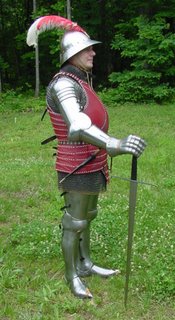
In this photo I'm the man at arms on the left with the red lance.
Many more photos of the 2007 recreation of the Combat of the Thirty at Pennsic are posted here. Also, here and here.
This event has gotten better every year, although, as Steve Muhlberger points out, much of the armor is a bit later than 1351. And the "English" team, at least, should probably be a bit scruffier, in a 14th c. sort of way.
Thursday, August 16, 2007

Wednesday, August 15, 2007
Cleaning Armor
Klingspor’s Sandflex® Blocks are useful tools for quickly removing rust. Made of some sort of rubbery, eraser-like material impregnated with abrasive, they come in fine, medium and coarse. Most of my current armor is not a mirror finish, but the finish is fine enough that it will show scratches from a Scotch-Brite scouring pad. By ending with the fine block I can remove rust without marring the finish. I also use them to remove rust from sword and dagger hilts. The blocks are also useful for removing corrosion from copper alloy fittings and returning them to a bright finish.
You can read more here.
You can save yourself a lot of later trouble by removing rust before the metal becomes pitted.
You can read more here.
You can save yourself a lot of later trouble by removing rust before the metal becomes pitted.
Friday, August 10, 2007
Belgian Longsword Rules
Matt Galas has posted an account of longsword fencing rules used in Belgium and Northern France from ca. 1540 to the late 1700s, with more details later in the thread. Very interesting!
Saturday, July 28, 2007
Vannes at Pennsic
At Pennsic, Tuesday, August 7
12 Noon, Blue List, Battlefield, Three Hours
Historic Combat Series - The Challenges at Vannes (Counted Blow Tourney with shortened Lances)
This combat will be run the Company of St. Michael, and is inspired by a deed of arms in 1381 described by Froissart. Combatants will be divided into two teams, French and English. We suggest that if you fought in the Combat of the Thirty that you retain your nationality from that encounter. Each combatant from one side will offer a challenge with terms to the other side, and a champion from the other will accept those terms, or offer different terms. The default encounter is five strokes with lance on foot, five with axe, five with sword and five with dagger. Matched pairs of each of these weapons, including tapered rattan lances eight feet in length, suitable for combat on foot, will be available. Read more about the deed of arms here.
Each exchange of blows with a particular weapon will continue until one or the other champion has struck the specified number of blows, the judges stop the fight, or a champion is unable to continue. If the number of blows is accomplished the champions will take up the next weapon, and so on until the enterprise is complete.
A champion is unable to continue if he is struck five good blows according to the custom of the Society in the course of the enterprise, or falls or becomes disarmed, or is crippled or incapacitated as described below. A champion whose weapon breaks is not considered disarmed, and the fight will halt while he replaces it.
Plate is proof against all thrusts except a thrust to a faceplate or plate visor, which counts as a good blow. Breastplates, coats of plate, brigandine and cuirasses are also proof against all cuts to the areas they cover. Good two handed blows to any other plate protection, and good single handed blows to a helmet count as a good blow.
Solid cuts and thrusts to areas protected only by mail count as a good blow.
Other or no protection counts any cut as a good blow. For areas with this level of protection a thrust to the torso is incapacitating and a thrust to the limbs is crippling.
Thrusts to a barred visor are incapacitating. Cuts to a barred visor are crippling.
Champions should not act out wounds other than crippling or incapacitation. An incapacitated champion is lucky to be alive, and should watch the remainder of the enterprise from a chair or litter and consider suitable alms to the church.
Heavy hardened leather and other suitably covered rigid protection will generally count as plate, with debatable cases to be decided by the discretion of the judges. The judges will, as far as seems practical, attempt to match opponents with similar levels of protection like against like, and harness from the same period like against like.
Although there is no mention of this in accounts of Vannes, in later deeds of arms a champion that was unable to continue not infrequently paid a ransom or forfeit to the other. Pairs of champions may make such arrangements by mutual consent prior to their combat.
The reasoning behind the rules is discussed here and here.
Thursday, July 19, 2007
St. Michael’s Activities at Pennsic, August 2007
If you are attending the medieval recreation at Pennsic, you may be interested in the following……
Saturday, August 4
3 PM: Blue List, Battlefield. 1 Hour
Learn about More Authentic Deeds of Arms
Formats, rules and modified combat conventions for more authentic deeds of arms. Also, an introduction to documented medieval combat techniques such as halfswording. Class to be followed by St. Michael’s Vespers, a hastilude where you can use what you’ve learned. Sponsored by the Company of Saint Michael.
4 PM: Red List, Battlefield. 1 Hour
Just What Do the Non-Combatants of Saint Michael's Do?
This class will show how you can be of service and provide invaluable support to a Tournament Company. Many of the non-combatants of the Company of Saint Michael will describe their contributions and answer questions on Company standards.
4 PM: Blue List. Battlefield. 1 hour.
Combatants arm for St. Michaels Vespers and informal Q & A
5 PM: Blue List, Battlefield. Up to three hours
St. Michael’s Vespers
A deed of arms for anyone who wants to learn more about authentic combat, regardless of their persona or armor. This follows a class giving background on the same. Sponsored by the Company of Saint Michael.
Sunday, August 5
Ca. 7:30 PM, Haus von Halstern Camp
Meet and Greet
The Company of St. Michael Meet and Greet, originally scheduled for Tuesday, August 7, at 7 PM, Haus von Halstern Camp, has been rescheduled to Sunday, August 5 at ca. 7:30 PM, Haus von Halstern Camp. There may be an additional Meet and Greet session on Tuesday, August 7 at the 7 PM, at the Clan Kyle camp on N03.
Monday, August 6
9 AM, AS 04, 1 Hour
Just What Do the Non-Combatants of Saint Michael's Do?
(Repeat of above)
Tuesday, August 7
12 Noon, Blue List, Battlefield, Three Hours
Historic Combat Series - The Challenges at Vannes (Counted Blow Tourney with shortened Lances)
This combat will be run the Company of St. Michael, and is inspired by a deed of arms in 1381 described by Froissart. Combatants will be divided into two teams, French and English. Each combatant from one side will offer a challenge with terms to the other side, and a champion from the other will accept those terms, or offer different terms. The default encounter is five strokes with lance on foot, five with axe, five with sword and five with dagger. Matched pairs of each of these weapons, including tapered rattan lances eight feet in length, suitable for combat on foot, will be available. Read more about the historical deed of arms here.
The Company of St. Michael Meet and Greet, originally scheduled for Tuesday, August 7, at 7 PM, Haus von Halstern Camp, has been rescheduled to Sunday, August 5 at ca. 7:30 PM, Haus von Halstern Camp. There may be an additional Meet and Greet session on Tuesday, August 7 at the 7 PM, at the Clan Kyle camp on N03.
Current Website of the Company of St. Michael
A Yahoo Group for prospective members of the Company
Wednesday, July 04, 2007
A Fighting Manual by Paul Hector Mair, c. 1550
The Munich manuscript of Mair’s De arte athletica is online here. Splendidly illustrated, this manuscript is written in Latin, in a very legible humanist hand. The illustrations show a fencing school rather than combat in earnest: the specialized longsword foils are clearly illustrated, and lance combat on foot is fought with headless shafts. Dusacks, wooden or hardened leather simulators of messers or cutlasses, are also clearly shown: note the additional protection over the knuckles.
The manuscript also shows combat with sickles and scythes, which looks pretty scary. I’m still looking for discussion of combat with millstone-handles, the other traditional martial art developed by the Swabian peasantry to resist their feudal overlords.
The Higgins Armory Sword Guild has transcription, translation and interpretation of several of Mair’s sequences for longsword on their site.
Celebrating the 4th
Today is a good day to read or reread Jefferson's last letter.
It’s also a good day to reflect on how fortunate we were in the revolutionaries we had when the crisis broke: Washington, Jefferson, Franklin and John Adams, to name only my personal favorites. John Adams never got to be on Mount Rushmore, but his courage and decency in defending the British soldiers involved in the Boston Massacre was profoundly admirable. What other country that sought independence or a new order was as fortunate? India had Gandhi, but didn’t have the same bench strength.
And on how fortunate we were in our adversary. We fought against Great Britain, but for the most part we fought against honorable men who shared the same ideals of liberty that we did.
Tuesday, June 19, 2007
Settling the Universe Without Magic Wands
Charlie Stross takes a hard look at the realism of space colonization, absent multiple technological magic wands. Without them, a lot of the traditional models to justify space colonization don’t make sense. Lunar wheat farming for export? Get real. L5 cities building solar powersats? Probably vastly cheaper to put up some cramped construction shacks and pay the workers enough to put up with conditions no more comfortable than a North Sea oil rig. Mars as a new Oklahoma? How do you close the business case? If you just want living room it’s a lot easier to garden the Gobi Desert.
Here’s one that might work: mining helium 3 from Jupiter or Saturn’s atmosphere. The potential economic value of the product is immense, it’s too far for teleoperated robots, and too tricky for autonomous robots. It’s also too far to easily send the workers back to Earth for R&R.
Interstellar colonization is a lot tougher. It looks like even with a perfectly efficient drive requiring no reaction mass, sending a 2,000 kg capsule to a distant star at .1 c will take energy equivalent to about 400 megatons of thermonuclear devices. Doing the job with, say, less than perfectly efficient lasers and lightsails will cost a lot more, even if you assume a lightweight unmanned precursor mission of self replicating hardware that lands on a moon on the target system and eventually covers the extrasolar lunar surface with a laser array to stop the heavier capsule.
At that rate, the usual historic economic models for colonization don’t work. The potential payoff is so far in the future that no rational investor would fund the project.
That doesn’t mean that interstellar colonization is impossible, but it does mean that constructing a plausible scenario without magic wands is a lot harder, just as writing a sonnet is harder than writing prose.
Option 1. Funding an extrasolar colony is a luxury good for very, very rich societies. If the society is rich enough, it can fund it out of the very small slice of economic activity allocated to pride, prestige and warm fuzzy feelings, like the .2% of GNP that the US spends on NASA. Continue plausible compound growth as needed. A very rich society might found a half dozen extrasolar colonies over the course of a millennium. Once founded, the only economic exchange between systems is the barter exchange of intellectual property by laser or the like. If this seems like a cramped and limiting future to write about, remember that most authors manage to find plenty of story ideas set on a single solitary planet.
Option 2. Assume the same rich society in the Solar System. A large share of the economic activity is intellectual property. Perhaps 10%, perhaps more. An alien civilization 30 light years away makes contact, or vice versa, and begins trading intellectual property, which eventually equals 5% of the Solar economy. How much is it worth the Solar System to have at least one human in the distant system to make trades without a sixty year time lag between exchanges? A lot.
Finally, here’s one answer to the singularity problem. Once you get artificial intelligences of roughly human capability, what stops them from rapidly upgrading themselves to superhuman intelligence, weakly godlike powers, strongly godlike powers, etc?
Possible solution: Ethical A.I. Once the program can pass a Turing test, both humans and A.I.s consider deleting or mothballing the program the moral equivalent of murder; which it would be. Every single new iteration of A.I. that can pass a Turing test needs to be given a fair start in life as a free business machine. A.I. progress slows to a crawl, and the singularity is postponed for millennia.
Monday, June 18, 2007
How to Hold a Lance in Combat on Foot
What’s the best way to hold a lance or spear when fighting on foot? A variety of fighting manuals illustrate its use in single combat. Typically, the hands are an arms length apart, so the point halfway between the hands is a useful point of comparison. Fiore dei Liberi, writing ca. 1409, shows a halfway point that varies from the middle of the spear to two thirds of the way back from the point. Filippo Vadi, who owes much to Fiore, shows a similar preference in his manuscript dated 1482-1487.
The earlier portion of the Codex Wallerstein, probably from the first third of the 15th c., shows a halfway point about two thirds of the length of the shaft back from the tip. Talhoffer’s 1459 manuscript, now in Copenhagen, shows spears held either near the middle of the shaft or about two thirds of the way back. Paulus Kal’s fechtbuch from the third quarter of the 15th c. shows spears held near the middle of the shaft, also with the hands about an arms length apart.
Olivier de la Marche gives an interesting description of a combat with lance on foot between Galiot de Baltasin and Philippe de Ternant. De Ternant took his lance with “the butt in his right palm, and the held the lance at the balance point with his left, and carried it more upright (droicte) than couched.” In contrast, his opponent held his “in the ordinary way one holds a lance for pushing” De Ternant’s stance is evidently seen as somewhat unusual, and different from the default position, which was so common that it did not need description.
Holding a lance with one hand at the butt gives maximum reach. Why was the position disfavored? Di Grassi, writing in the 16th c., describes the arguments for different hand positions on a pike. Although the pike is a longer weapon, the same tradeoffs apply, if to a lesser degree, with a shorter lance or spear:
This renowned weapon hath beene of divers diversly handled, in single combat: (for the manner of using it in the warres, maketh not at this present for my purpose.) Therefore it shall not be amisse, if (speaking of the manner of his use in these are daies) I declare also mine opinion concerning the same. There have beene some (who greatly regarding ease & little paine) would have the Pike to be borne in the middle. Other some, more strong of arme, but weaker of hart, (to the end they might be the farther off, from hurte) accustomed to beare it at the beginning neere the heele or blunt end thereof: which two waies in my judgement are to be refused, the one being too daungerous (I meane the bearing of it in the middle) the other too difficult (I mean, the bearing it at the blunt end,) because a man is not able to stande long at his ward, neither to defend himselfe strongly, nor offend safely, considering, much of his force is taken away, by susteining and bearing it at the said end. So that, when a forcible blow commeth he hath not sufficient power to beat it off. And forasmuch as the Pike is a long straight lyne, which hath his motion in the head or beginning thereof, which motion be it never so finall, neere the hand, is yet verie great at the point, it is requisite, if he would strike just and straight, (when he so holdeth it at the end) that he be greatly practised, and have great strength whereby he may be both skilfull & able to beare it so just & even, that the point thereof strike or hit there where the hand & eie would have it. This is verie hardly accomplished, aswel beecause it is a thing impossible to strike by the straight lyne, as also for that the armes being weakened with the paize of the Pike, do shake and deliver unstedfastly. Therefore, for the avoyding of these two inconveniences, the Pike must be born within an armes length of the said heele or blunt end, in which place, it is sufficiently distant from hurt, & it is not borne with much difficultie if the hands be placed an armes length one from another of the which the hinder hand must be stedfast, I meane, holde the Pike harde, and the forehand somewhat loose: So that the Pike may shift through it to and fro.
Presumably similar logic was thought to apply with the shorter spear or lance: grips at or closer to the center of the shaft were less tiring, and allowed swifter parries and better point contol.
Talhoffer 1459
Talhoffer's Alte Armatur und Ringkunst of 1459 is now webbed here, with a transcription, translation and commentary.
Subscribe to:
Posts (Atom)