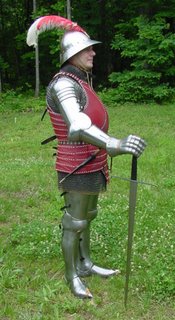
Over in the comments at Megan McArdle, Braveheart was suggested as suitable viewing for Libertarian Movie Night. It is to laugh.
Da, Gibson does scream Freeeeeeedom, even if he delivers line better in Chicken Run. But really, Braveheart is patriotic epic of defense of motherland from foreigners that come to rape our women and mince about in crushed velvet. Is about collectivist virtues of people united shoulder to shoulder against invader, except for traitorous splittists who are justly liquidated through nighttime visit from patriotic security forces in necessary breaking of eggs to make omelets. Is about heroic guidance of Great Leader, who wisely teaches laboring class to use pointed sticks against decadent feudalists, a tactic they were unable to deduce for themelves because only Great Leader can think of such a thing. Is about revolutionary overthrow of foreign authoritarian overlord and replacement by Scottish authoritarian overlord, which is of course wonderful improvement. Is about putting inconvenient historical events down the memory hole. Is movie that could have been made by Eisenstein for Lochnessfilm if he had had color stock and less talent.
Tuesday, April 08, 2008

How on earth do you find these things?
A friend asks how I find things like 17th century archery rules. Good question. In this case I started with a local Boy Scout troop that wanted to include medieval diversions in a series of upcoming events. I realized that I didn’t know much about how archery was practiced as a sport in the Middle Ages
I knew that Robert Ascham wrote about archery in the 16th century, and found a copy of his Toxophilus on line. He mentioned butts, pricks and rovers as contemporary forms of sport archery, without giving much detail on the rules. I did a google search on those terms plus archer. That eventually led me to Roberts, T. The English Bowman or: Tracts on Archery, to which is added the second part of The Bowmans Glory London 1801, among other sources. Roberts wrote when the 18th century was living memory. That wasn’t the middle ages, but it was a lot closer to it than the 21st.
Roberts described archery rules based on Aime for the Finsbury Archers, “rules annexed to Shotterel and Durfey’s Poem on Archery”, and the traditions of the Finsbury Archers. Searching on full view in Google Books, I found that the The Shotterel poem was published in 1667, and Ayme for the Finsburie Archers was published in various editions with different spellings of the title from 1594 to 1737. I could not find the text for either of those rules in Google Books, but did find those for the Aime for the Archers for St George’s Field, published in 1664.
I then was able to find a used reprint of the 1628 Ayme for the Finsburie Archers through Amazon.
A few general observations:
In trying to recreate the Middle Ages, the 17th and 18th c. are useful places to look for hints if you can't find the information in a medieval source. It’s not perfect, but a lot better than using your enormous 21st c. brain to attempt to deduce things you don’t know from first principles. Diderot’s Encyclopedie was a great help to me in trying to recreate medieval scabbards, for example.
Google Books is a really powerful tool for material which has been digitized. There’s a surprising amount that has been.
However, print on dead trees and pulped rags is still your friend.
Lengthening copyright terms are a net obstacle to the diffusion of human knowledge, and I say this as a copyright holder. 95 years from publication is plenty, and a lot easier to figure out than 70 years after death. Obviously, Disney would like to hold rights to the Mouse until the sun is a cold dark cinder, but it’s bad law for the rest of us. Write your legislator.
Sunday, April 06, 2008
Works on the Medieval Tournament at Google Books
These include Analogues of Chaucer's Canterbury Pilgrimage, with itemized expenses for the Asteley/Boyle combat of 1442, a French account of the Pas de Bergere and a Spanish account of the Passo Honoroso.
Friday, April 04, 2008
Aime for the Archers of St. George's Fields
Hannis, Richard Aime for the Archers of St. George's Fields, London 1664. Excerpted in Urban, Sylvanus, The Gentleman’s Magazine and Historical Chronicle, London 1832
Rules to be observed and practiced by all those that exercise shooting in the Long Bow
1. For finding your mark it must be within every man's reach.
2. For whites or blacks you must have but one in a game, unless they be all content; and if you shoot at any loose white, and it be stricken out of sight, it is no mark.
3. For the height of stakes, although the wood be above the pin, yet you are to measure at the pin, if there be any, because it is put in for that purpose.
4. Shooting at a bush or black, whatever you find highest in it (being within the compass of the mark) you are to take that for the height.
5. If in measuring a shoot the difference be too small it cannot be described, then that competitor shall win the shoot that is best at the next mark.
6. If in measuring a shoot the mark be stirred out of its place, he loseth the shoot that removed it.
7. If at coming to your mark you claim two or more, and the opposite side draw their arrows, you can have no more then you first claimed, although your partner when he comes challengeth more.
8. If you name one mark and shoot at another, you are to lose your shoot, and the others are to follow at the mark named.
9. If your arrow break, you may measure at the nearest piece that hath wood and head, or wood and feather.
10. If you have any mishap, as nocking amiss, if you can reach your arrow with your bow you may shoot again; if it flee further, it is a shoot.
11. In shooting at rovers you must stand no further from your mark than you can reach with half your bow: but at pricks you are permitted to stand two bows before your mark, and as much behind it as you please.
Thursday, April 03, 2008
14th c. Arms Control
By Statute of 12 Rich. II., 1388, the practice of archery is again commanded, but it is there combined with a prohibition against the bearing of arms in the time of peace by the unauthorized populace:—
"Cap. vi. It is accorded and assented that no Servant of Husbandry, or Labourer, nor Servant or Artificer, nor of Victualler, shall from henceforth bear any Baselard, Sword nor Dagger, upon forfeiture of the same, but in the time of war for defence of the realm of England, and that by the surveying of the Arrayors for the time being, or travailing by the country with their Master, or in their Master's message; But such Servants and Labourers shall have Bows and Arrows, and use the same the Sundays and Holydays, and leave all playing at tennis or foot-ball, and other games called coits, dice, casting of the stone, kailes, and other such importune games. And that the Sheriffs, Mayors, Bailiffs and Constables, shall have power to arrest, and shall arrest, all doers against this Statute, and seise the said Baselards, Swords and Daggers, and keep them till the Sessions of the Justices of Peace, and the same present before the same Justices in their Sessions, together with the names of them that did bear the same. And it is not the King's mind that any prejudice be done to the franchises of Lords, touching the forfeitures due to them."
Hewitt, John Ancient Armour and Weapons in Europe Vol. 2 London 1860 pp 23-24
Tuesday, April 01, 2008
SCA Mission Statement
The SCA has put out proposed mission and business statements:
Mission statement: The Society for Creative Anachronism, Inc. (SCA) is an international organization devoted to the research and re-creation of pre-seventeenth century life, encouraging its participants to employ a knowledge of history to enrich their lives and the lives of others through events, demonstrations, and other educational venues.
Business statement: As a 501.c.3 corporation the Society for Creative Anachronism, Inc. (SCA) provides the necessary business structure for the operation of its official branches, for the coordination of centralized policies and practices, and for the dissemination of information to its international constituency of participants.
Value statement: As an organization the Society for Creative Anachronism (SCA) values the principles of chivalry, honor, personal integrity, and artistry idealized in pre-Seventeenth century culture and society.
I like this version better.
Mission statement: The Society for Creative Anachronism, Inc. (SCA) is an international organization devoted to providing a context where participants can recreate different aspects of pre-seventeenth century life.
Business statement: As a 501.c.3 corporation the Society for Creative Anachronism, Inc. (SCA) provides the necessary business structure for the operation of its official branches, for the coordination of centralized policies and practices, and for the dissemination of information to its international constituency of participants.
Value statement: The Society for Creative Anachronism (SCA) values the opportunity to recreate different aspects of pre-Seventeenth century life by doing. It is more interested in embodying positive ideals like chivalry and honor than the less desirable features of the era.
April 1 is the last day to comment.
A Letter from Louis XI to Richard Duke of Gloucester
In 1480 Richard, Duke of Gloucester received at least one bombard as a gift from Louis XI of France. The bombard was probably an obsolescent or obsolete weapon by French standards, but Richard’s letter of grateful thanks has survived. The following document, apparently an early draft of a letter from Louis concerning the gift sheds further light on the matter, as well as tantalizing hints to the relative efficiency of the medieval horse collar, still a question of some historical debate
MEMO
From: Louis XI
To: My very tresnoble, trespuissant et tresexcellent cousin, the Duke of (Piers, insert the name of whichever beefeating fratricidal maniac is most dangerous this week. And make sure it's a live one. There is no point at all in bribing dead English dukes, even if it is hard to keep track these days. See to it)
Date: April 1, 1480
Re: Gonnes
Cher cousin.
My tresnoble cousin, etc., etc. I am sending you under separate cover, xvii bombardes (Piers, it may be xvi, thought I heard muffled explosion from the artillary park last week, check inventory.). Although I understand that English military opinion still inclines towards the pointed stick and muscle power school of technology, I believe you will find them useful.
You will find that each weighs 2,000 English pounds, and may easily and reliably be drawn by a team of (illegible) horses under ordinary conditions. You will of course, want to use the standard horse collar. We've been experimenting with some harness designs based on an old Roman relief, but for some reason the poor horses wheeze, turn blue, and fall over whenever we try to get them to haul a decent load with it. (And of course, by a decent load I mean anything upwards of (illegible) English pounds). Enguerrand the drover says it's something to do with "constraint".
One word of advice. The gunners do tend to dawdle over reloading if not closely supervised. I am told that the best way to insure a high rate of fire is to stand next to the breech and encourage the gonners from there.
Glad to hear you liked the pillowcases.
ooooxxxx
LXI/pd
Thursday, March 27, 2008
Chest in Camps 1338-1425

From Agnolo Gaddi’s Dream of the Emperor Heraclius at Santa Croce (1385-87)
Illustrations in the Romance of Alexander (Bodley 264), c. 1338-44; 83v, 124r, 184r, and 198v
Preparations for a tournament; scene with horses and pavilions. Roman du Roy Meliadus de Leonnoys BL Add. 12228, f.150.
Hannibal and the spies, Ab urbe condita (BNF Fr. 261, fol. 25), first quarter of the 15th century
Many of these chests are without feet, which would be liable to damage as you dragged them in and out of wagons or carts. However, having the bottom of the chest lie on damp ground is also undesirable, and some of these have low feet, although they aren’t easy to see in the tiny illuminations: look carefully at Romance of Alexander 198v and the chest on the left in 124v, and the chest furthest inside the tent in Meliadus. Chests with high feet would also consume valuable volume in the carts used by an army on the march.
Saturday, March 22, 2008
Froissart, Monstrelet and the Battle of Otterburn Online
The Johnes translations of Froissart and Monstrelet are available in digital form at Google books. Johnes did the only complete translation in modern English of either. His translations are stilted and less than entirely dependable, but they’re what we have if you want an unabridged modern version.
If you can read French, you can go to Gallica.
Extracts from Lord Berners’ Tudor translation are available here, including the Battle of Otterburn
Robert White’s History of the Battle of Otterburn contains extracts from contemporary chronicles of the battle.
There is also an extract from Fordun’s account of the battle here.
Wednesday, March 19, 2008
Humbleton Hill, 1402
Here is a useful account of the battle of Humbleton or Homildon Hill in 1402, with substantial material from Thomas Walsingham (d. c. 1422) giving the English view of the battle, and from Walter Bower’s Scotichronicon, written in the 1440s, more than a generation after the battle, describing the combat from a Scottish viewpoint.
Giving due allowance for the biases in the different accounts, this is what I think actually happened. A Scots army under the Earl of Douglas was returning from a raid into Northumbria when it found a large English army blocking its way home. The English army was about 50% larger. The Scots army took up a defensive position on the slopes of Humbleton hill. The English initially deployed across the road back to Scotland, but then put archers on “a hill facing the Scots”
In the ensuing firefight, the Scots were at a considerable disadvantage. Not only was their force outnumbered, but English armies tended to include a large proportion of archers: Scottish armies tended to have fewer. Further, English archers had a very high reputation for individual strength and skill: Scots archers less so. Walsingham reports that the Scottish archers fled from the storm of arrows. Bower, without mentioning Scottish archers, says that the Scots were smothered by a rain of arrows, and many were killed and wounded. Presumably the Scots archers and other lightly armored troops suffered most of the casualties.
As the most vulnerable Scots began to duck and retreat from the English arrows, a fraction of the Scottish men-at-arms charged the English. Bower claims that a hundred knights charged the English, “contended intrepidly with a thousand English” and were all slain, but “not without great slaughter of the English”.
Walsingham, on the other hand, reports that no English “lord or knight received a blow from the enemy” and that they “remained idle spectators of the battle”.
The two accounts aren’t necessarily contradictory. It’s plausible that the bravest Scottish men-at-arms made a mounted charge against the English archers. Some of the Scots would have been wounded or dismounted, but enough probably survived to charge home: that was the normal pattern of attacks by fully armored men at arms against English bowmen. At Agincourt the archers were protected by stakes, but this tactical innovation does not seem to have been used at the earlier battle.
Once the Scots closed to handstrokes, the survivors were confronted with a group of English archers that outnumbered them substantially: by ten to one or more, according to Bower. Further, the Scots would have been disordered by casualties suffered as they closed. Under these conditions a man at arms in superior harness could be overwhelmed by a host of individually inferior opponents. If the Scottish knights fought stubbornly, as Bower reports, they could have inflicted significant casualties on the lightly protected archers before they were themselves overwhelmed.
Unsurprisingly, both Chroniclers omit information that would create a less favorable impression of their side’s performance. Bower doesn’t mention what sort of troops the Scottish knights attacked: “great slaughter” inflicted on lightly armed archers is less impressive than do the same to men-at-arms. Walsingham passes over casualties suffered by the English archers in hand to hand combat
Subscribe to:
Posts (Atom)