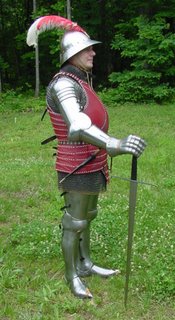
Steve Muhlberger describes a recreation of a William Marshal style tournament within the context of the SCA
here.
I would suggest some modifications. First, let those who are “disarmed” hold their weapons reversed to make their status clear. Second, let their be only two teams rather than four, but let each team be composed of at least two retinues, (Which were also called routes or
conrois, and might be translated as troops)
Although each retinue wants its own team to win, since it increases their chance of taking ransoms, their primary loyalty is to each other first and the whole team second.
Let the ransoms be settled in token coinage: let us call the smallest coin a florin. This might be part of a charity or find-raising drive. For example, for a toys-for-tots tournament, each toy donated is exchanged for two florins. Alternatively, cash donations could be converted into florins at a fixed rate. If not intended as a fund-raiser, each entrant in the tourney might be issued an initial stake of coins, with the option of purchasing more if they run low. In either case, the florins would not be redeemable for cash.
Here is a Yahoo group “to discuss techniques of recreation of period coinage and SCA coinage practices.”
Here is a source for reproduction medieval coins in base metal.
Suppose the standard ransom is two florins and twice that for a knight. Half of each fighter’s initial stake goes into the retinue treasury. The treasury receives half of the ransoms gained by members of the retinue and pays half of their ransoms. At the end of the tourney any funds in the retinue treasury are redistributed to the members of the retinue.
At each of the two refuges let there be an exchequer table, with all the retinues of one team and their individual members listed on one side, and those of the other team on the other. At refuge A, where team A takes their captives, the initial stake of each individual and retinue of Team B starts on Team B’s side of the table, and vice versa at refuge B. As ransoms are paid they are shifted from debtor to creditor.
It may happen that the same person is both captor and captured several times, so periodically a messenger should be sent with Team A’s winnings and an accounting of which retinues and individuals gained them to replenish their accounts at Refuge B, and vice versa.
Note that under these rules it isn’t sensible to fight to the bitter end when your team is going down to defeat: it’s better for a retinue or individual to retreat to their safe zone if they can.
The fighting can ebb and flow over the course of the day, depending on the fortunes of war and the exhaustion of the combatants. The marshal in charge should be alert to the desirability of calling truces if too many fighters are lying panting in the neutral ground with their helmets off, so that the fighting can continue later with both sides refreshed and at full strength. Likewise, he should judge with care when it might be best to end the combat for the day so that there are still a reasonable number of fighters on the field and the tourney does not end in anti-climax.
After the fighting is done the participants can gather to reckon their gains and losses. There are a number of ways you can let the victors spend their winnings and return the coinage to the event’s host for reuse in later events of this sort: games of chance to increase or lose their winnings, refreshments or special dishes at the feast for themselves and their chosen companions, minstrels and musicians and heralds to celebrate their prowess and open handed largess. At one such event we set up a merchant’s table, stocked with spices, fabrics and other goods that the contestants could purchase with their coins, choosing in the order of the size of their purse.
To recreate the feel of a 12th century tournament requires a large field with ample room to maneuver. The recreations hosted by Steve Muhlberger ranged over something like 15 acres, which feels about right. The recreation also works best with large numbers of combatants. I ran one of these with about eight combatants on each side, and felt the experience would have been greatly enhanced by larger numbers. 12th century accounts describe tourneys with hundreds of knights on each side, and it would be a joy and delight to see such a deed of arms recreated on that scale.
These tourneys were mounted combats. If you are trying to recreate them on foot, you
may want to insist that all blows must be stuck while the striker is in motion. Then again, you may not.
Recreating a 12th c. mounted tournament without horses will require compromises. Understand that if you are attempting such a recreation with rules to make it more like mounted combat, you may end up in Monty Python territory. With coconuts. The success of rules to mimic the characteristics of mounted combat depends very much on the willingness and ability of your participants to suspend disbelief.
Update: Steve Muhlberger, who has run a lot more of these than I have, has some valuable observations in the comments below. He makes a strong argument for at least four different refuges. I dislike the idea of more than two teams fighting every team for itself as a matter of historical recreation, but perhaps a separate refuge for each retinue might serve the same purpose