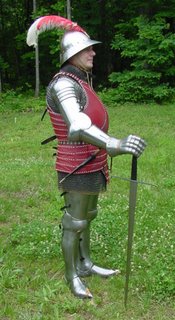
In spite of the efficiency of contemporary armor, shields were used more often in armored combat on foot than you might suppose, but not necessarily in the way you might expect, particularly if your expectations are conditioned by the SCA’s standard recreation of medieval combat. Their use is recorded in this combat of seven against seven in 1402 and Habourdin vs. de Bearn in 1449. Techniques for their use are illustrated in both the Codex Wallerstein and the Gladiatoria Fechtbuch.
In those sources they were primarily used as a defense against thrown spear before the champions came to close quarters. They were also strapped or handled so they could give partial protection while the user wielded a spear or sword for two handed thrusts. Once no longer useful for these purposes the shield would be either thrown at an opponent or simply discarded.
I am currently working on a pair of the sort depicted in the Codex Wallestein, and will make every effort to have them finished in time for Pennsic 2009 and the Company of St. Michael’s recreation of the pas de la Belle Pelerine. The Habourdin vs de Bearn combat was a continuation of the historical pas de la Belle Pelerine, granted after de Bearn fell ill on route to the pas and arrived after the appointed time had expired.
Tuesday, July 21, 2009

Friday, July 17, 2009
Cutting Pikes
Here is di Grassi on using halberds, bills and partisans to cut pikes in battle.
But because these weapons for the most part are exercised, and used to enter through divers Pikes & other weapons, and to breake and disorder the battell raye, to which ende, and purpose, if it be used, then that manner of mannaging and handling is verie onvenient which is practised now adaies, and thus it is. The Partesan, Holberd, and Bill (but not the Javelin, being in this case nothing effectuall because it hath small force in the edge) must be borne in the middle of the staffe, with the heele thereof before, and verie lowe, and the point neere a mans head. And with the said heele, or halfe staffe underneath, from the handle downwardes, he must warde and beat off the pointes and thrustes of the Pikes and other weapons, and having made waie, must enter with the encrease of a pace of the hinder foote, and in the same instant, let fall his weapon as forcibly as he maie, and strike with the edge athward the Pikes. This kinde of blowe is so strong (being delivered as it ought, considering it commeth from above downwardes, and the weapon of it selfe is verie heavie) that it will cut asunder not onely Pikes, but also any other forcible impediment.
Tuesday, July 14, 2009
Shield Construction
The shield of the Black Prince
Chamberlin, John M. V , trans. “The Shield of the Black Prince,“ Der mittelalterliche Reiterschild. Kohlmorgen, Jan. Karfunkel Verlag. 2002.
Mills, Dorothy and Sir James Mann. Edward The Black Prince: A Short History and The Funeral Achievements. J.A. Jennings LTD: Canterbury. 1975.
Note that Steane, above notes that although there is now no trace of a label on the shield, a drawing c. 1600 shows one.
Jousting Targe of John of Gaunt
Illustrated in Dugdale, page 90
The shield of Henry V
Back:
Front:
Gravett, Christopher and Graham Turner English Medieval Knight 1400-1500 Oxford : Osprey Military, 2001.
* Joanne of Navarre was Henry V's stepmother
An Early 15th Century Targe at the Met
15th c. "Vous ou la Mort" Shield
Hewitt, John Ancient armour and weapons in Europe from the iron period of the Northern nations to the end of the thirteenth[-seventeenth] century. Oxford, 1855-1860
Here is a modern examination of the shield.
15th century shield at the Musée National du Moyen Âge, also known as the Musee Cluny. Later damage gives a good view of the different layers and the beveled edge of the wood.
A German jousting targe, ca. 1450
Targe, mid 15th c. 3.7 kg
Jousting Shield, c. 1485 4.7 kg
Jousting Shield, ca. 1490. Linden wood. 21 cm thick
Jousting targes faced with stag horn, 1443-1510
Karen Larsdatter's linkspage on painted shields
Wood
The linden or lime wood frequently described as a shield material in Anglo-Saxon and Scandinavian literature and found in several surviving medieval shields is commonly called basswood in North America.
The yellow poplar or tulip polar commonly sold as lumber in North America is an entirely different tree from the European poplar. Although both are soft, light and easily carved, yellow poplar may not be as well suited for the purpose.
Linden and poplar are both light and easily worked, and Taillevent refers to "light wood (like that from which one makes pavises)" Wood that was strong in relation to its weight was also obviously desirable. Relatively soft wood was clearly acceptable: the medieval wooden shield was very much a multi-layer composite getting much of its strength from an outer layer of linen, leather and/or parchment glued to its surface.
Here is Theophilus on making panels:
OF THE TABLETS OF ALTARS AND DOORS, AND OF THE GLUE OF CHEESE.
The tablets of altars, or of doors, are first carefully fitted together with the joining instrument which carpenters or vat makers use; they are then joined with the glue of cheese, which is made in this manner. Soft cheese is cut very small, and is washed with warm water in a small mortar with a pestle, until, being frequently poured in, the water comes away pure. Then this cheese, compressed by the hand, is put into cold water until it hardens. After this it is very finely ground, with another piece of wood, upon a smooth wooden table, and in this state it is again placed in the mortar, and is carefully ground with the pestle, water mixed with quick lime being added, until it is made as thick as lees. The tablets of altars fastened together with this glue, after they are dry, so adhere together, that neither heat nor humidity are able to disjoin them. They should afterwards be smoothed with a planing iron, which, curved and sharp inside, has two handles, so that it may be drawn by both hands, (with which doors and shields are shaved,) until they are made perfectly smooth. They are then covered with the untanned skin of a horse, or ass, which is soaked in water; as soon as the hairs have been scraped off, some water is squeezed from it, and thus moist, it is superposed with the curd glue.
Theophilus. An essay upon various arts, tr., with notes, by R. Hendrie London 1847
The choice of glue is important. Glue of cheese, better known to modern readers as casein, hardens by chemical reaction rather than evaporation of a solvent.
The problem with using evaporation based glues like modern carpenter's wood glue is that the damp canvas, parchment or rawhide shrinks as it dries. While it is still damp it prevents the evaporation based glue beneath if from hardening, and the fabric or hide can then pull away from concave surfaces.
Casein has largely been replaced by other glues in modern use, but is still used as an artist's medium.
..made of poplar wood glued on both sides with layers of linen, on the front with paper finished with gesso. The applied heraldic charges are made with boiled leather shaped in high relief fixed by small tacks. It is painted and gilded; the fields are punched over with numerous small crosses.Steane, John The archaeology of the medieval English monarchy 1999
The Black Prince’s Shield is 73cm tall and about 60.5cm wide. The shield body is made from 15mm thick poplar and is slightly concave. It is made from two separate boards connected together. The wood core is covered with several sheets of canvas. Over the canvas is a top coat of paper(!), which in turn is topped with leather. The leather forms the top coat, and is held on with shield mounts and with brass nails. On the front side of the shield are the Arms of England and France: Right top and left bottom, on a blue field golden fleurs-de-lis; and left top and right bottom on a red field, three gold leopards stacked over each other.
The arms are built up of molded leather relief, then gessoed and gilded. The claws, eyes and tongues of the leopards are additionally painted. The background of the arms is painted. The individual quarters were originally separated by appliquéd turned cords. All of the blue and red fields are stippled with numerous small punched crosses. On the French quarters they are diagonal, and on the English quarters arranged horizontally. The back of the shield is covered with canvas and painted green.
There are no remains of the hand or arm straps, or of the guige. Only four holes in the shield indicate the points where these must once have been fastened. According to the reconstructed version made at the Tower of London the shield only had one hand and one arm strap.
Chamberlin, John M. V , trans. “The Shield of the Black Prince,“ Der mittelalterliche Reiterschild. Kohlmorgen, Jan. Karfunkel Verlag. 2002.
The shield is made of poplar, covered with successive layers of white canvas, plaster, paper and leather. To the leather surfaces of the front are applied the quarterly charges of fleurs-de-lis and leopards, boldly modeled in leather in high relief, and affixed by small brads. Traces of gilding and of red colour on the tongues of the leopards can still be seen. The ground of the four squares is punched with a spotted diaper to enrich the effect. The cruciform punch marks have been ingeniously slanted at different angles in the quarters of France and England respectively to give variety. Curiously enough there is no trace of the label of cadency ever having been on the shield. The back of the shield is covered with canvas originally painted green or blue, of which faint trances remain. Any hand-straps (or “enarmes”) which it may have had are gone, but holes show where they may have been fixed. The two loops near the top were probably placed there for attaching the shield above the tomb. The only other comparable English shield is that associated with the monument of King Henry V in Westminster Abbey. In this case the charges on the front have vanished completely, but the velvet pad at the back for the hand and wrist have survived.
Mills, Dorothy and Sir James Mann. Edward The Black Prince: A Short History and The Funeral Achievements. J.A. Jennings LTD: Canterbury. 1975.
Note that Steane, above notes that although there is now no trace of a label on the shield, a drawing c. 1600 shows one.
Jousting Targe of John of Gaunt
Illustrated in Dugdale, page 90
Bolton, in his " Elements of Armories," states that the first named article "is very convex towards the bearer, whether by warping through age or as so made. It hath in dimension more than three quarters of a yard in length, and above half a yard of breadth. Next to the body is a canvas glued to a board; upon that board are broad thin axicles, slices or plates of horn nailed fast, and again over them twenty and six pieces of the like, all meeting or centreing about a round plate of the same in the navel of the shield, and over all is a leather closed fast to them with glue, or other holding stuff, upon which his armories were painted; but now they, with the leather itself, have very lately and very lewdly been utterly spoiled."Two 14th century shields from Sweden
The shield of Henry V
Back:
Three layers of coarse linen are covered with a padding of hair felt, then two linen layers and finally silk brocade. The arm pad is of crimson velvet with the arms of Navarre (for Henry’s Queen) in silk.*
Front:
The front is covered in the remains of four layers of linen and gesso, originally painted.
Gravett, Christopher and Graham Turner English Medieval Knight 1400-1500 Oxford : Osprey Military, 2001.
* Joanne of Navarre was Henry V's stepmother
An Early 15th Century Targe at the Met
15th c. "Vous ou la Mort" Shield
KNIGHTLY Shield formerly in the Schutz family at Shotover House, Oxfordshire, now in the collection of the Rev. J. Wilson, D.D., President of Trinity College, Oxford. This very curious relic of the fifteenth century is formed of wood, lined with leather and faced with canvas, on which is laid a gesso to receive the painting and gilding. Its section longitudinally is concave on the face ; transversely it is convex. At the upper corner is a notch (or bouche) for reception of the lance-shaft. The height is 2 ft. 8 in., the breadth 1 ft. 1 in.: the inside has two rings for suspension round the neck of the champion. In its decoration, the whole face of the shield has been first gilt, and the design then painted upon the gilding, the steppling in the background being crimson, and the colours here and there heightened with gold. The lady's dress is pale yellow, the pattern of flowers and leaves, brownish crimson picked in with gold, the border of ermine.
Hewitt, John Ancient armour and weapons in Europe from the iron period of the Northern nations to the end of the thirteenth[-seventeenth] century. Oxford, 1855-1860
Here is a modern examination of the shield.
15th century shield at the Musée National du Moyen Âge, also known as the Musee Cluny. Later damage gives a good view of the different layers and the beveled edge of the wood.
A German jousting targe, ca. 1450
Targe, mid 15th c. 3.7 kg
Jousting Shield, c. 1485 4.7 kg
Jousting Shield, ca. 1490. Linden wood. 21 cm thick
Jousting targes faced with stag horn, 1443-1510
Karen Larsdatter's linkspage on painted shields
Wood
The linden or lime wood frequently described as a shield material in Anglo-Saxon and Scandinavian literature and found in several surviving medieval shields is commonly called basswood in North America.
The yellow poplar or tulip polar commonly sold as lumber in North America is an entirely different tree from the European poplar. Although both are soft, light and easily carved, yellow poplar may not be as well suited for the purpose.
Linden and poplar are both light and easily worked, and Taillevent refers to "light wood (like that from which one makes pavises)" Wood that was strong in relation to its weight was also obviously desirable. Relatively soft wood was clearly acceptable: the medieval wooden shield was very much a multi-layer composite getting much of its strength from an outer layer of linen, leather and/or parchment glued to its surface.
Here is Theophilus on making panels:
OF THE TABLETS OF ALTARS AND DOORS, AND OF THE GLUE OF CHEESE.
The tablets of altars, or of doors, are first carefully fitted together with the joining instrument which carpenters or vat makers use; they are then joined with the glue of cheese, which is made in this manner. Soft cheese is cut very small, and is washed with warm water in a small mortar with a pestle, until, being frequently poured in, the water comes away pure. Then this cheese, compressed by the hand, is put into cold water until it hardens. After this it is very finely ground, with another piece of wood, upon a smooth wooden table, and in this state it is again placed in the mortar, and is carefully ground with the pestle, water mixed with quick lime being added, until it is made as thick as lees. The tablets of altars fastened together with this glue, after they are dry, so adhere together, that neither heat nor humidity are able to disjoin them. They should afterwards be smoothed with a planing iron, which, curved and sharp inside, has two handles, so that it may be drawn by both hands, (with which doors and shields are shaved,) until they are made perfectly smooth. They are then covered with the untanned skin of a horse, or ass, which is soaked in water; as soon as the hairs have been scraped off, some water is squeezed from it, and thus moist, it is superposed with the curd glue.
Theophilus. An essay upon various arts, tr., with notes, by R. Hendrie London 1847
The choice of glue is important. Glue of cheese, better known to modern readers as casein, hardens by chemical reaction rather than evaporation of a solvent.
The problem with using evaporation based glues like modern carpenter's wood glue is that the damp canvas, parchment or rawhide shrinks as it dries. While it is still damp it prevents the evaporation based glue beneath if from hardening, and the fabric or hide can then pull away from concave surfaces.
Casein has largely been replaced by other glues in modern use, but is still used as an artist's medium.
Sunday, July 12, 2009
Friday, July 10, 2009
Weapons Used at the Combat of the Thirty
Here are the weapons mentioned in this account, with the number of times mentioned:
Lance or Spear:8
Sword:7
Steel Mallet (martel, mail):4 (a particular weapon is described as weighing 25 lbs.)
Dagger:3
War-axe (hache):2
Fauchart, fussart, fauchons:2 "with a cutting edge on one side and a hook on the other"
Shields are mentioned four times.
The fauchart sounds a lot like a weapon that's shown both in Queen Mary's Psalter and the Holkham Bible. In the Holkham Bible it is wielded with both hands by the figure on the lower left.
Here is the original French. The dissertation also has a useful who's who of the individuals present.
Monday, July 06, 2009
A Recreation of the Pas de la Belle Pelerine
To be held at Pennsic in the Green List, August 3rd, 2009 from 2-5 PM, hosted by the Company of S. Michael
The servants of the Belle Pelerine will hold a passage of arms, meeting all comers in single combat for a push or throw with lance or spear followed by an agreed number of blows with axe or sword. If the comer touches the shield of Lancelot, if either champion falls or is unable to continue they will give a brooch, gem or jewel of whatever value they wish to their opponent's lady. If they touch the shield of Palamedes they are not so bound. Weapons will be provided if needed. Also, there will be group combats with rebated weapons as often and as long as the ladies wish.
The Letter of the Belle Pelerine (the Beautiful Pilgrim)
Summary: a knight rescues a lady beset by brigands. She is on pilgrimage but fears to continue without escort. The knight offers to accompany her, but must acquit himself of a deed of arms first. The beautiful pilgrim asks for valiant knights and others of martial prowess to challenge her rescuer so that he may be freed to protect her on her pious journey.
To all excellent, high and powerful princes and princesses, barons, lords, ladies and gentle knights, who, in their grace, come to read these letters, my recommendations and kind greetings. I, who am called by many the Belle Pelerine, had occasion to become informed of high festivals in the city of Rome. I made preparations to take the road to go there. Because of my weakness, and because I was scarcely accustomed to endure great pains, I went forward by short journeys, doing my devotions at those holy places that could be found on my route. As I made my way in this manner fortune lead me near the sea, near the borders of a high and nearly impenetrable forest, within which pillagers and robbers of the sea were lying in wait, and they came with wild ferocity against me and my companions.
And I certainly believe that we all would have been slain or taken prisoner had it not happened that a knight riding nearby heard the noise and came hastily against the robbers, and by his free generosity delivered me and my company from their hands. And sorely tried by the affray, I fell to the ground as though struck down.
Then the knight lifted me up and took me sweetly in his arms, saying “My dear lady, you have nothing to fear. Take heart and be comforted, by God’s mercy you have been delivered from your enemies. If it please you I will lead you to a good town and a secure place nearby”.
And when he had said this, and I had recovered myself a little and was able to speak I thanked him from my heart for the great courtesy and kindness he had done me.
And I began to think seriously about the peril and danger I was in, considering the way I had yet to go was long, narrow and perilous, and equally that to return to my country with my pilgrimage uncompleted would be grievous and very displeasing. Weeping, I said sir knight, today I am the most troubled gentlewoman in the world, and I don’t know what to do”
And when he heard that he sweetly told me that if he could offer me any counsel, or do anything that the body of a knight could honorably accomplish, he would spare nothing to do it. When I heard him speak so freely and make such graceful offers I disclosed my affairs to him, and how I had come from my country to do pilgrimage, and how I still had a long way to go on a perilous road, and saw the great peril and danger in returning to my country, and how I had no certain safe conduct. I hoped he could supply that, for the love of God and for the pity that all gentle knights ought to have for ladies in distress. And by his courtesy to escort and guide me during my pilgrimage, which as I have said I had great devotion to perform.
The knight thought a bit and he answered “My dear lady I have no wish to refuse you but there is something I must do first and that done, if it please God I will not fail you. I would be shamed and dishonored if I failed to go the whole way with you, guarding and defending you against anything that might occur. My dear lady, I must warn you that in truth I have undertaken a vow, by my faith, which I may not put aside, for first I must accomplish a deed of arms. This is to guard a passage near the tower of Beau-Jardin on the road between Calais and St. Omer in Picardy in the diocese of Thereimance, which was once called the place of Beau-Jardin and is now called the Green List. Which passage I have the intention to guard and will guard if it please God on the Monday the third of August from two by the clock until five, to deliver all gentlemen and knights come of a noble line of a deed of arms declared in certain chapters which shall follow. And, my very dear lady, if it is your pleasure to rest in this country after the travail which you have suffered, I will be ready, once my enterprise is accomplished, to undertake to lead and conduct you wherever you wish and do you all the honor that I may, as I wish to do what pleases you well.”
And at that, when I had heard the sweet words of that knight and thought of the great danger that I had been in. And how, if I had no good safe conduct, I could not avoid great danger. And I, considering that the response of that knight was courteous and his offers gracious I thanked him humbly and remained at his convenience.
And so, very excellent, very high and very powerful princes and princesses, barons, lords, ladies, and gentle knights, I the aforesaid pilgrim am now in a strange country in great trouble and displeasure and greatly wishing to do my pilgrimage. And I will not be able to do without the aid of that knight who has undertaken to lead me on my voyage unless he is able to accomplish his deed of arms.
And so I address myself to your good grace and beg you in all humility as a gentle woman who is in perplexity, and can do nothing without your nobility and franchise. In kindness to the ladies may it please you to give leave and license, and what is more, encouragement to the noble knights of your courts, countries and lordships, by their courtesy, to shorten my voyage by delivering that knight of his enterprise of arms, according to the chapters which will follow.
And also to you, valiant knights, I sweetly beg, for the honor of your ladies, that it please you to do so, and in doing this you will win honor and true renown. And you will always be held in prayers to God and I will pass on your good renown and that of all knights who wish to take pains to acquire it, and I will make known their noble and valiant courage and the love and honor which they bear for their ladies. And that knight requires and also will assure you that nothing will be done in this enterprise out of hate, envy or ill will for anyone and hopes that no one would think the contrary. But instead this is done to occupy themselves and to assay the noble estate of chivalry. The deed will also be done to have the acquaintance and knowledge of good and valiant knights from foreign lands in hopes to know better their valor.
And at present the knights does not wish to be named. but to put aside any doubt or questions that he is unable to perform such occasion I certify in truth that he is drawn of a noble line and of a powerful house and without villainous reproach and that he will be found in this place arrayed on the day declared in the chapters to do and accomplish that said enterprise if it please God. And finally I pray to the high and powerful prince the count d’Estamps that by his good grace it will please him to put the seal of his arms on these present letters and on the chapters of the said enterprise of arms which I shall further declare.
Chapters of the enterprise of arms of the knight who has undertaken to escort the noble lady who they call the Beautiful Pilgrim
First, the said knight, by the good will, leave and license of the very high, very powerful prince and his very redoubted master, my lord the duke of Burgundy, Brabant and Lembourg, will be present in person, the third day of August, in a passage or place near the tower of Beau-Jardin, on the road between Calais and Saint-Omer, in Picardy in the diocese of Teruanne, once called the Tower of Beau-Jardin and now called the Green List. And with God’s help he will guard that passage or place from the hour of two by the clock until five. And by that place will be hung a shield, argent with three bends gules, signifying the shield that was born in his time by the valiant knight Lancelot of the Lake, who was loyal and happy in arms. And near that shield will be a pollaxe and a sword, and a horn such as huntsmen are accustomed to carry in the chase.
Item: and near that shield will be another of checky sable and argent with two Saracens’ swords crossed gules which are the arms of the good knight Palamedes who always sought in his time to acquire a lady bearing arms and searching for adventures and near that shield there will be a pollaxe and a sword.
Item : Near that the said knight will have a pavilion set up where there will be at that time a king of arms or herald accompanied by pursuivants of arms who will do their office in the way afterwards declared.
Item: to better declare the present enterprise of arms of the said knight his intention is that all knights, gentlemen of names arms without villainous reproach who have the desire and wish to do arms, except for the subjects and servants of my lord of Burgundy if it is their good pleasure to touch one of the two shields that is to say the white shield with the three bends gules and the axe or sword or both or the shield checky of argent and sable and the axe or sword or both they will be held to furnish to the knight of the pilgrim the arms which will be afterwards declared and they will not be able to accomplish them in one or the other manner if they have not first touched one of the two shields aforesaid.
Item: to put aside the doubts of those knights coming from distant countries that they might not be satisfied in their enterprise if there is a great number of knights who have touched one of the two shields, the one who has touched first will have first place in the arms and consequently the others according to the order in which they have touched the shields according to the report of the king of arms and herald which will put down in writing the name of the knight and when he has touched the shield.
Item: so that the comers need not fear that a solitary knight might be vanquished or prevented by unforseen difficulties from satisfying them before they can accomplish their enterprise, the knight of the enterprise will be accompanied by certain companions calling themselves pilgrims arrayed and prepared to defend the passage.
Item: and if there is any knight of the condition aforesaid desiring to do arms and to accomplish the enterprise and adventure and wishes to touch one of the shields on the day of the Passage of Arms he may come to the place and sound the horn between the hours of two and five by the clock at which sound there will come the king of arms or herald who will demand the name of the knight and the time at which he has come and afterwards he will say “Very noble knight, I and my companion are ordered by my master who has undertaken the escort of the Belle Dame Pelerine who God give honor and joy, to warn and inform you and other noble knights of what they must do if they touch the shields of the enterprise which you see here.”
“In truth no knight may be received to do the arms which pertain to the shield argent with bends gules if he does not have a lady or demoiselle in love who by her grace has retained him as a servant.”
“However, any other knights may undertake and accomplish the arms that pertain to the shield checky argent and sable.”
Item: no lord or knight may perform the arms pertaining to both shields, but must choose one or the other.
Item: and if a knight has sounded a horn and touched the axe he will be held to encounter the knight of the dame pelerine for the following arms: to meet on foot for a throw or push of the lance, whichever better pleases the knight of the dame pelerine and following that to fight with a pollaxe until xvii strokes are struck and set on by one of the two knights. And the said knight of the Dame Pelerine shall provide the lances and axes to do this, both alike, of which the foreign knight will have his choice.
Item: If it happens, which God forbid that either of the knights doing these arms is carried to earth, touching it with hand or knee, or is disarmed or otherwise unable to continue, before the number of strokes is performed in that case the arms will be held to be accomplished and another knight will be allowed to commence his deed if it please him.
Item: And if he touches the sword he will be bound to do the arms which follows; which is to say to come together on foot for a throw of the lance such as the knight of the Beautiful Pilgrim will give and will bear to that place, two alike, of which the foreign knight will take his choice. And after that throw they will fight with the sword, of which the knight of the enterprise will also provide two alike, so that xix strokes are done and accomplished and if either in fighting is carried to earth or disarmed or otherwise unable to continue the arms will be held to have been accomplished as aforesaid.
Item, any champion who has undertaken the arms of Lancelot’s shield and is carried to earth or otherwise unable to continue will be bound to give to his opponent to give to his lady a brooch, ring, jewel or gem.
Item: In fighting neither of the knights may lay hands on the other but only fight with weapons under pain of being blamed and dishonored.
Item: If there are any princes dukes or counts or their children who are not yet knights that would be pleased to come and give succor to the said dame pelerine for the honor of their ladies in consideration of the high lineage and they will be received as though they were knights. And further, any other gentlemen without reproach who are not yet knights but who please the ladies by their nobility and high resolve shall be likewise accepted to perform their enterprise.
Item, there will be in that place certain ladies willing to accept noble knights and gentlemen as their servant who wish to undertake the shield of Lancelot. And further, if there is a champion that is unable to provide the token required if they are unable to complete the arms of the shield of Lancelot, the ladies of their grace will provide it.
Item: If there are any knights squires or gentlemen besides those which have touched one of the two shields or who have completed their enterprise, who would have the pleasure of exercising themselves in arms, they will find in that place during that time a certain number of gentlemen who will be equipped to furnish those who wish and require for the love of their lady group combat in the field or across the barrier, with rebated weapons of six feet in length or less. And these combats will occur as often and for as long as it please the ladies.
Item: there shall be a rich prize provided for the champion that shows the greatest prowess, and for the one that makes the bravest, noblest and most courteous entry upon the field.
Item: If there is any difficulty doubt or obscurity concerning the content of the present chapters of the said enterprise of arms, the aforesaid knight who has undertaken the escort of the dame pelerine retains the right to interpret and clarify the same.
And at the humble and instant supplications of my pilgrim aforesaid, the very excellent and very powerful prince my lord the duke of Burgundy and of Brabant and my very redoubted lord has been declared to be the judge of these arms and the performance of the said enterprise and of his grace and goodness he has taken the charge of holding the place secure as well as all other duties pertain to a judge.
And if it happens because of the high and great affairs of my lord duke he is not able to be present in person he has declared that it shall be done as aforesaid and promised by the high and powerful prince the count of Charolais his son, or by any of my lords his nephews.
And we, John of Burgundy, count d’Estamps and lord of Dourdan at the request of the noble and honored lady the Beautiful Pilgrim, to honor all ladies and to give greater certainty to all the things written above, and likewise that no one may doubt that the knight that has undertaken to escort that beautiful pilgrim will be able to perform his duty in the present enterprise, if it please God to defend against any encumbrance or lawful bodily injury, we have affixed the seal of our arms this day, July the IVth in the year of grace MMIX.
Combat Conventions
The single combats will end as soon as one or the other has thrown an agreed number of blows, even if nobody is knocked down or disabled first.
Each combat between two champions will continue until the judges stop the fight, or a champion is unable to continue, or the agreed number of blows has been struck by one side or the other.
A champion is unable to continue if he is struck five good blows in the course of the combat, or falls or becomes disarmed, or is disabled as described below. A champion whose weapon breaks is not considered disarmed, and the fight will halt while he replaces it.
Effects of Blows
Two handed edge blows have no effect against plate or brigantine torso armor, and count as one good blow against the head or other protection.
A hit with a thrown lance or spear counts the same as a two handed edge blow. For the justification of the relative effectiveness of thrown weapons, see here.
Single handed edge blows have no effect against any plate but the helmet, and count as a good blow against the head or lesser protection elsewhere.
Thrusts have no effect against any plate except for plate helmet visors or faceplates, count as one good blow against these or mail, and a disabling blow against barred visors and lesser protection.
Heavy hardened leather and other suitably covered rigid protection will generally count as plate, with debatable cases to be decided by the discretion of the judges. The judges will, as far as seems practical, attempt to match opponents with similar levels of protection like against like, and harness from the same period like against like.
I suggest these rules for halfswording with two-handed swords, if both parties consent.
Do not act out blows, but call them out clearly. Except in group combat you need not keep track of the blows struck yourself: those guarding the list will do so for you.
The initial throw or push with lance or spear is not obligatory. Although the original chapters mention it, we know that in Olivier de la Marche's Chronicle the Swabian knight that attended fought only with the axe. Also, although the choice of throw or push with the lance at the shield of Lancelot is at the discretion of the knight of the Beautiful Pilgrim, he will not unreasonably refuse the request of a comer for one or the other.
Group Combats with Rebated Weapons
After any telling blow, retreat to your end of the lists, cry your cry, and return to the fray. Do not act out amputations. The weapons are no more than six feet long: a sword, pollaxe or short spear.
René’s rules assumed the combatants would batter each other with blunt weapons, and if a combatant was temporarily stunned his retainers would protect him until he recovered. Standard SCA rules in which the man struck pretended he was crippled or killed were not appropriate. After our first recreation we omitted the armored retainers who protected their master in René’s rules: under the adapted rules they didn’t have a lot to do or scope to enjoy themselves. (In the original, this was irrelevant: they were paid to do their job, not to have fun).
We often fight this over the barrier. Barriers didn’t become part of friendly deeds of arms until around 1500, rather later than René’s rules. However, barriers do allow good control of the melee with minimal need for marshaling. Sword and shield at the barrier tends to be an uninteresting fight, and I would discourage that choice if the combatant is able to use one of the other options.
Since we fight on foot we faced a fundamental choice. Should we use contemporary foot combat conventions while using as much of René’s format as made sense, or should we follow as many of his rules as possible even if they lose their purpose in the absence of horses? We eventually chose the first, and so allowed the typical weapons of foot combat. Thrusts were only rarely prohibited in contemporary foot combat so we allowed them.
You can learn more 15th century deeds of arms at here:
Some of the historical basis for the combat rules can be found here.
The Historical Pas
The letters of the beautiful pilgrim and the chapters of the enterprise are adapted from those for the original pas of 1449, found in Chronique de Mathieu d'Escouchy : 1444-1452. By Mathieu d' Escouchy, Gaston Louis Emmanuel du Fresne Beaucourt
Published by Mme Ve J. Renouard, 1863, beginning on page 244. The work is digitized here:
The principal changes I made are:
The original was held for a full month, beginning the 15th of July, 1449, at a place “presently called the Cross of the Pilgrim”
All who came to work for the lady’s deliverance were to receive a pilgrim’s staff of gold, garnished with a rich ruby, which the lady asked them to carry for a year in remembrance of her. Of course, they weren't expecting a lot of comers, because of the distances to be traveled, and they got even less than they expected.
The arms of Lancelot were blazoned as a white shield with a “band de veling vermeille” I could not find a definition of veling, and substituted the three bends traditionally attributed to Lancelot.
There were four different combats associated with the shields in the original. The shield of Lancelot had a lance, signifying 13 courses along the tilt with sharp lances, and an axe, signifying the sort of combat I assigned to it. The checky shield had two swords by it; the shorter signified one course with mounted lance and five with the sword. The longer signified combat on foot, first throwing a sword and then doing 19 strokes with another sword carried on their body. Each of these combats were scheduled for specific days of the week.
The knight who made the most good hits (le plus de belles attaintes) while running courses with the lance would be given a diamond by the lady; there was no other overall prize.
In the original only knights and the sons of great nobles were invited to touch the shields. Knights, squires and gentlemen who did not touch one of the shields could run 11 courses with sharp lances along the tilt.
In the original deed there was no forfeit for those who were carried to earth or disarmed, although this was a rule in several contemporary deeds of arms.
The following rule was added at the request of the ladies of the Company of St. Michael
"Item, there will be in that place certain ladies willing to accept noble knights and gentlemen as their servant who wish to undertake the shield of Lancelot. And further, if there is a champion that is unable to provide the token required if they are unable to complete the arms of the shield of Lancelot, the ladies of their grace will provide it."
In the announcement of the historical pas de la Belle Pelerine, the passage was described as being held by a single knight. Escouchy’s Chronique reports that many who were invited did not attend because they feared the single defender would be put out of action before they were able to take part. In fact, the knight of the Belle Pelerine was accompanied by six squires who were also prepared to defend the passage although they were only mentioned in passing in the announcement. To avoid a recurrence of this problem, the announcement of our recreation makes the support of the knight’s companions more explicit.
Hamilton vs. Caupance, ca. 1500
Sune thair efter come ane Dutche knyght in Scottland callit Schir Johne Clokbuis and desyrit fighting and iusting in Scottland witht the lordis and barrouns thairof, bot nane was sa apt and redy to fight witht him as was Schir Patrick Hammilltoun, beand then ane zoung man strang of body and abill to all thing, bot zeit for lack of exercioun he was not so weill practissit as neid war, thocht he lackit no hardiement strength nor curage in his proceidingis. Bot at the last quhene the Dutch man and hie was assembelit togither batht wpoun great horse, withtin the listis of Edinburgh wnder the castell wall, efter the sound of the trumpit ruschit rudlie togither and brak thair speiris on ilk syde wpoun wther; quhilk efterwart gat new speiris and recounterit freischelie againe. Bot Schir Patrickis horse wtterit witht him and wald on nowayis reconter his marrow, that it was force to the said Schir Patrick Hammelltoun to lyght on footte and gif this Dutchman battell; and thairfor quhene he was lichtit doune, cryit for ane tuo handit suord and bad this Dutchman lyght frome his horse and end out the matter, schawand to him ane horse is bot ane waik warand quhene men hes maist ado. Than quhene batht the knyghtis war lyghtit on fute they junitt pairtlie togither witht right awfull contienance; ewerie on strak maliciouslie at wther and faught lang togither witht wncertane wictorie, quhill at last Schir Patrick Hammilltoun ruschit manfullie wpoun the Dutchman and strak him wpoun his kneis. In the meane tyme the Dutchman being at the eird the king cast out his hatt out of the castell wondow and caussit the iudges and men of armes to sinder and red thame. Bot the harrottis and the trumpitis blew and cryit the wictor was Schir Patrick Hammilltounis. This Schir Patrick Hammilltoun was brother german to the Earle of Arrane and sister and brether bairnes to the kingis maiestie and was ane nobill and waliezeant man all his dayis.
Pitscottie, Historie, pp.234-235 Robert Lindsay of Pitscottie was writting in the late 16th c. "Schir John Clokbuis" seems to have been John Caupance, a French squire
Pitscottie, Historie, pp.234-235 Robert Lindsay of Pitscottie was writting in the late 16th c. "Schir John Clokbuis" seems to have been John Caupance, a French squire
Saturday, July 04, 2009
Tuesday, June 30, 2009
Chaucer Bobblehead

He in the waast is shape as wel as I; this were a popet in an arm tenbrace for any womman smal, and fair of face. He semeth elvyssh by his contenaunce, for unto no wight dooth he daliaunce.
Greenwood (now ABC/CLIO-Greenwood) had a batch of Chaucer bobbleheads produced to promote their All Things Chaucer. They are also the publishers of Daily Life in Chaucer's England, Second Edition and they were kind enough to send me one of their last remaining Chaucer bobbleheads.
Calooh! Callay! I gloat!
Friday, June 26, 2009
In My Parallel Universe V
A hypnotically graceful flying jellyfish and the majestic AirPenguin, also shown here.
The same company seems to have built a flying Air Ray.
I for one welcome our flying robotic penguin overlords.
The same company seems to have built a flying Air Ray.
I for one welcome our flying robotic penguin overlords.
Subscribe to:
Posts (Atom)