The Review of U.S. Human Space Flight Plans Committee led by former Lockheed Martin chief Norm Augustine turned in their final report October 22. They worked hard and had good, smart, dedicated people who did a good job. I don’t know how they were compensated, but it probably wasn’t enough. I’m profoundly grateful for their efforts.
They have some good recommendations. Many may not survive the political process: already representatives from places with major NASA spending are saying that it would be a terrible thing if anything was done that might result in less NASA spending where their constituents live.
And if we do the right thing there will be pain in various places. The Ares I launcher was more plausible when the that project began, but bringing it into operation will now cost a lot for a launcher that will at best fly only a few times: perhaps a dozen, perhaps less. US launchers already flying can carry similar payloads. They have convinced me that Ares I should be canceled. It will harder to convince voters who benefit directly from the survival of the program.
The committee makes a good argument that we will eventually return to our Moon, visit Near Earth Objects like asteroids and comets, the Martian moons Deimos and Phobos, and eventually Mars itself. Our Moon may not be the optimal first destination on the list.
Saturday, October 24, 2009

Why Very Long Copyright Durations Are a Bad Idea.
What these guys said.
You might think, as a creator of intellectual content, that I'm in favor of having my copyright last until the Sun is a cold darker cinder. I'm not. There are real costs to us as a Society to keeping content out of the public domain for too long. The free availability of public domain works created when copyright law was more sane is a great boon to me. I love Google Books
Here's my modest proposal. Continue to accept the terms of the Berne Convention, but require individuals to renew every thirty years after original publication to maintain their rights. And allow corporations to do the same, but charge them a fee large enough that they only renew works that still have significant economic value to them. Disney can afford it.
You might think, as a creator of intellectual content, that I'm in favor of having my copyright last until the Sun is a cold darker cinder. I'm not. There are real costs to us as a Society to keeping content out of the public domain for too long. The free availability of public domain works created when copyright law was more sane is a great boon to me. I love Google Books
Here's my modest proposal. Continue to accept the terms of the Berne Convention, but require individuals to renew every thirty years after original publication to maintain their rights. And allow corporations to do the same, but charge them a fee large enough that they only renew works that still have significant economic value to them. Disney can afford it.
Seven Reasons to Date a Medievalist
Unlocked Wordhoard lists compelling reasons to date a medievalist. Including, of course, our superior zombie apocalypse survival skills
Tuesday, October 20, 2009
Are We Wimps? Compared to Ancient Athenians?
Provocative anthropologist Peter McAllister says yes.
The evidence for this can only be the failure of the modern trireme reconstruction Olympias to reach the cruising speed implied by classical authors for ancient triremes.
If we knew that Olympias was a perfect reproduction of an ancient trireme, then the argument might be valid. We don't.
Olympias was a plausible first effort at reconstructing an ancient trireme. The men responsible for the reconstruction now believe they can do better, tweaking some key details to give the rowers more room for a longer stroke while still fitting the surviving evidence. This exactly the sort of thing that experimental archaeology can teach us.
Athens employed 30,000 rowers who could all exceed the achievements of modern oarsmen.
The evidence for this can only be the failure of the modern trireme reconstruction Olympias to reach the cruising speed implied by classical authors for ancient triremes.
If we knew that Olympias was a perfect reproduction of an ancient trireme, then the argument might be valid. We don't.
Olympias was a plausible first effort at reconstructing an ancient trireme. The men responsible for the reconstruction now believe they can do better, tweaking some key details to give the rowers more room for a longer stroke while still fitting the surviving evidence. This exactly the sort of thing that experimental archaeology can teach us.
Monday, October 19, 2009
Are We Wimps?
Are 21st c. men wimps compared to people "in the ancient past and even in the recent past"?. Peter McAllister, Australian anthropologist, says yes, in his book Manthropology and in this article in The Independent
Steve Muhlberger asks for informed commentary on the article while expressing some skepticism.
I won't say anything about the value of calculating the speed of prehistoric aboriginals from their fossilized trackways, except that it's probably pretty difficult without knowing with some precision how long the legs were of the person that left the footprints.
But this I can speak to:
This is lazy stupidity on multiple levels. A marathon is a foot race, and currently covers a bit more than 26 miles. "One-and-a-half marathons" would be nearly forty miles. At a run.
The Roman legions did not cover distance at a run. They marched. Marching is much less tiring.
That said, I don't know why McAllister thinks legions routinely covered forty miles a day. I'm baffled.
Assuming that McAllister never noticed that the Roman mile is shorter than the English mile only gets you part of the way there. An Iter Iustum, an ordinary day's march on good roads, might cover 15-17 miles.
Vegetius tells us that the Romans trained by marching ten Roman miles out and the same back (about 18 English miles) but they only did it three times a month. It was a conditioning exercise, not a daily routine.
Currently, US infantry on the march carries loads comparable to a Roman legionairy soldier.
Steve Muhlberger asks for informed commentary on the article while expressing some skepticism.
I won't say anything about the value of calculating the speed of prehistoric aboriginals from their fossilized trackways, except that it's probably pretty difficult without knowing with some precision how long the legs were of the person that left the footprints.
But this I can speak to:
Roman legions completed more than one-and-a-half marathons a day carrying more than half their body weight in equipment.
This is lazy stupidity on multiple levels. A marathon is a foot race, and currently covers a bit more than 26 miles. "One-and-a-half marathons" would be nearly forty miles. At a run.
The Roman legions did not cover distance at a run. They marched. Marching is much less tiring.
That said, I don't know why McAllister thinks legions routinely covered forty miles a day. I'm baffled.
Assuming that McAllister never noticed that the Roman mile is shorter than the English mile only gets you part of the way there. An Iter Iustum, an ordinary day's march on good roads, might cover 15-17 miles.
Vegetius tells us that the Romans trained by marching ten Roman miles out and the same back (about 18 English miles) but they only did it three times a month. It was a conditioning exercise, not a daily routine.
According to modern US Army doctrine, the average rate of march for trained infantry under favorable weather conditions is 2-1/2 mph over roads and 1 mph cross country. A normal foot march covers 20 miles per day.
Currently, US infantry on the march carries loads comparable to a Roman legionairy soldier.
Sunday, October 18, 2009
The Gladiatoria Fechtbuch
Medieval German fighting manuals can be frustrating. Typically you either have text without illustrations, or illustrations with minimal text (Talhoffer) or with no text at all (the earliest content in the Codex Wallerstein).
In the mid 15th c. Gladiatoria Fechtbuch , text and image often complement each other. The text explains that you should do thus and so, and the image presents the vital information that your left leg should be forward when you do it.
Hugh Knight has produced a translation of the text of the Gladiatoria Fechtbuch combined with a reproduction of the images. This work is a valuable resource for anyone who wants a better understanding of armored single combat in Germany in the middle of the 15th century.
Thirteen out of the 118 pages deal with unarmored combat, with long dueling shields, bucklers or staves. The rest discuss armored combat.
In the mid 15th c. Gladiatoria Fechtbuch , text and image often complement each other. The text explains that you should do thus and so, and the image presents the vital information that your left leg should be forward when you do it.
Hugh Knight has produced a translation of the text of the Gladiatoria Fechtbuch combined with a reproduction of the images. This work is a valuable resource for anyone who wants a better understanding of armored single combat in Germany in the middle of the 15th century.
Thirteen out of the 118 pages deal with unarmored combat, with long dueling shields, bucklers or staves. The rest discuss armored combat.
Combat with Spear and Targe
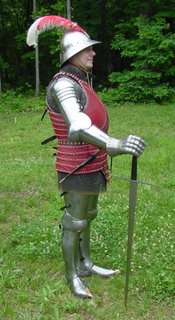
Here is a video of combat with Codex Wallerstein style targes and spear at our local SCA fighting practice. I built these for the pas de la Belle Pelerine at Pennsic 2009. I'm very pleased with the way these work: they give good protection for the armpit, shoulder and throat while allowing both hands to wield the spear.
Saturday, October 17, 2009
Two Awesome Space Launch Visuals
A Delta IV Heavy lifts off. The camera lens that took this photo did not survive.
Progress M-03M launches in early morning darkness and climbs into sunlight. At about three minutes into the video you can see the four detached booster stages sparkling as they tumble.
Here's a somewhat longer version showing more footage from different cameras.
Here is the trail of the launcher seen from the side from a viewpoint in Kromtau, Northwest Kazakhstanin, where surprised and baffled Australian miners film it on their phone.
Progress M-03M launches in early morning darkness and climbs into sunlight. At about three minutes into the video you can see the four detached booster stages sparkling as they tumble.
Here's a somewhat longer version showing more footage from different cameras.
Here is the trail of the launcher seen from the side from a viewpoint in Kromtau, Northwest Kazakhstanin, where surprised and baffled Australian miners film it on their phone.
More Photos from the Pas de la Belle Pelerine
More photos from the recreation of the pas de la Belle Pelerine at Pennsic 2009 by Tasha.
An additional photo from Jan.
An additional photo from Jan.
Wednesday, October 14, 2009
Colonial Pennsylvania Plantation's Medieval Event, October 17-18
This event in Media, PA has been canceled due to weather. Medieval living history goodness would have included La Belle Compagnie and yours truly. It has been rescheduled for November 13-15. La Belle Compagnie will be unable to attend on the rescheduled date.
Update: the rescheduled event has also been canceled due to weather
Update: the rescheduled event has also been canceled due to weather
Subscribe to:
Posts (Atom)