Friday, June 03, 2011

Cassini Mission
CASSINI MISSION from cabbas on Vimeo.
Sequential still photos from Cassini edited into a breathtaking short film by Chris Abbas.
More on the video here.
Wednesday, June 01, 2011
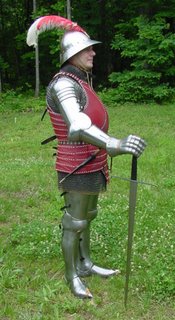
Fighting on Foot in the Lists With Spear or Lance
This happened fairly often. There were three main ways this could occur.
1. Thrusting or pushing, lance against lance. The push was a high impact attack, often delivered at a good pace, that could knock a man to the ground. Typically, the lance fight was part of a sequence of combats with different weapons. Examples:
Vannes, 1381
Challenge by Michel D'Orris 1400
Galiot de Baltasin and Phillipe de Ternant Fight on Foot with Lances, 1446
Ayre, Picardy 1494
Challenge of Lady May, Greenwich 1506
Paris 1515 Challenge by the Dauphin in honor of the marriage of the French King “First six foins with hand spears, and after that eight strokes to the most advantage if the spears so long held, and after that twelve strokes with sword” also casting spear and target followed with two-handed sword
Noseroy 1519 “two against two, with strokes of the lance, turning the large end of the said lance; and afterwards they were to fight with sword in one hand, as long as my lords the judges ordered them to.” The next day of combat “each one threw a stroke of the partisan and afterwards they fought with the two handed sword as long as it pleased my lords the judges.” Combat with axes at the barriers was originally planned but apparently not actually fought.
2. Both parties were expected to throw their lances at their opponent, and then continue the fight with other weapons:
Victory of Seven French against Seven English in a Private Combat 1402
D’Ollumen vs. de la Haye 1415
Alvaro Continge vs. Clugnet de Brabant 1415
Maillotin de Bours vs. Hector de Flavy, 1431
A Combat between Sir John de Mello and the Lord de Chargny, 1435
Merlé vs de Chargny 1435
Habourdin vs. de Bearn ca. 1449
Greenwich May 1510 Casting spear and target followed by twelve strokes with a two handed sword
Paris 1515 Challenge by the Dauphin in honor of the marriage of the French King “First six foins with hand spears, and after that eight strokes to the most advantage if the spears so long held, and after that twelve strokes with sword” also casting spear and target followed with two-handed sword
Noseroy 1519 “two against two, with strokes of the lance, turning the large end of the said lance; and afterwards they were to fight with sword in one hand, as long as my lords the judges ordered them to.” The next day of combat “each one threw a stroke of the partisan and afterwards they fought with the two handed sword as long as it pleased my lords the judges.” Combat with axes at the barriers was originally planned but apparently not actually fought.
3. Both parties enter the field each armed with a lance and other weapons to use as they see fit. They can throw the lance or keep it to push and thrust with as long as they can. This was much more common in judicial duels than combats by consent. This scenario was often discussed in German fighting manuals.
Combat between Sir John Anneslie and Thomas Katrington, squire, 1380
How Sir Jacques de Lalaing did arms in Scotland; and of many other particulars in the house of Burgundy. (1449)
Baaa
Animated mutating sheep.
Hoisted from the comments:
children wept, women screamed, and grown men fainted.
It's like I said. Animated. Mutating. Sheep. Don't say you weren't warned.
Tuesday, May 31, 2011
Very Large Telescope Shows You a Very Large Universe
Hat tip to Popular Science:
There’s very little we can write to preface the imagery below, so we’ll just set the scene and get out of the way. The video below was captured by Stephane Guisard and Jose Francisco Salgado at the European Southern Observatory’s Very Large Telescope (VLT) in Chile’s Atacama Desert. And it might make you cry.
What makes this time lapse particularly amazing--because we’ve all seen plenty of time lapse videos of the night sky--is the four telescopes in the foreground. Watching these instruments work against a black background would be endlessly fascinating on its own. Unfortunately you won’t be able to pay them too much attention. Because damn, what a sky.
Watch it on full screen.
This edited version shows the Earth rotating against a fixed sky.
Monday, May 30, 2011
Saturday, May 28, 2011
Merit and Opportunity
An interesting post from Greg Mankiw.
What this means is that if you are a college admissions officer trying to identify the students who will do best in college, as measured by grades, you would give positive rather than negative weight on family income. I am not proposing that they should do this, as colleges have many goals when putting together a class. But it does seem that the hypothesis implicit in Leonhardt's article is not supported by the data.
The Viking
This 1928 film is a festival of anachronism and overacting, from the distinctly not 10th century castle to Sigurd's Bronze Age armor to the low cut corselet that shows off Helga's creamy decolletage. Also, there are a lot of amazingly badly tailored furs.
Young Alwin Skywalker is so brooding and pouty that you can just know that he's going to to eventually turn to the dark side, call himself Lord Veidr, and start wearing black armor, cape and Sutton Hoo helmet.
Richard Alexander, who played Sigurd, went on to wear other silly helmets, possibly from the same prop closet, as Prince Barin in the Flash Gordon serials.
The film was made at an interesting point of technological transition: a full length film with early technicolor and a soundtrack but no recorded dialog.
More Bronze Age viking goodness:
Leif Erikson has something of a Derek Smalls look going on here.
Helga nearly puts Leif Erikson's eye out with one of her horns at about 9:28
Living in the Future: A Tribute to Spirit
Miles O'Brien gives a eulogy to our robotic proxy. It was a good seven years, and more than anyone expected. Opportunity, one wheel crippled, soldiers on towards Endeavor Crater.
In other news, the president signed a bill into law with his robotic hand.
In other news, the president signed a bill into law with his robotic hand.
Private Residences with Defensive Earthworks
Some things never go out of style.
A few observations on these revivals of medieval style defenses.
Being able to rent a bulldozer instead of using a work gang of men with picks and shovels makes the private defensive earthwork affordable to the common man. Also, installing these in advance of construction would involve moving a lot less dirt, and you'd get a better view. On the other hand, in the twenty years between massive floods, you'd need to climb a lot of extra steps to get to your front door every day
Subscribe to:
Posts (Atom)