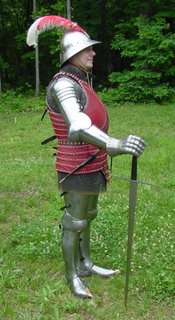
So. I am listening to a performance of the Highland ballad The Bonnie House of Airlie, which is sad and moving in a George R. R. Martin sort of way. There is sex and violence and bloodshed. The bit of historical grit in the pearl of the drama was a conflict in the 1640s when Archibald Campbell, Earl of Argyll, raided Airlie Castle, the home of James Ogilvy, Earl of Airlie.
But the earliest version preserved was a printed broadsheet from 1790, and Child collected oral versions in the 1870s.
And the surviving versions transmute the historical Ogilvy support of Charles I to support for "Charlie" who is "awa'", referring not to Charles I of England but the young pretender Charles Edward Stuart a century later.
The oral tradition is slippery and undependable. If the Song of Roland can't even get the enemy right....
Wednesday, May 28, 2014

Wednesday, May 21, 2014
Recreating More Historical Formats for Deeds of Arms and Combats in the SCA
When I first joined the Society for Creative Anachronism in 1975, the default tournament format was a double-elimination tournament tree based entirely on modern sports events. Each round ended with a clear winner, based on the somewhat stylized standard rules for Society combat at that time. All blows counted as light (ignored), "kills" (powerful enough to end the fight even against an armored opponent) and "wounds"(blows that incapacitated an arm or leg, while leaving the victim otherwise unimpaired.)
In the late 1980s, I started trying to understand how medieval deeds of arms were actually structured., and how medieval armored combats were won or lost. I wasn't the first to attempt this: I know that David Friedman tried to recreate combats for an agreed number of blows much earlier.
It took about two decades to work out more realistic sets of combat conventions that were still acceptable variants of SCA rattan combat, and formats for deeds of arms that better reflected how they were actually fought in the 12th-16th century.
Here is one set of combat conventions for armored combat from 2008. This focused on armored combat on foot in the late 14th and the 15th century, either singly or in small groups. We've used other conventions to recreate large melees in the 12th and 15th century, combat over the barriers in the 16th century, and recreate 16th century unarmored longsword sport combat with rattan weapons.
One key insight was figuring out that that in combats for a previously agreed number of blows, the sequence normally ended as soon as *either* champion had thrown that number. This avoided the unrealistic artifact of previous reconstructions when one fighter could hoard his last few blows until his opponent had thrown all of his, and then go on the offensive knowing that his opponent could do nothing but defend.
Another thing important thing I learned in the two decades after 1990 was that there were several different formats for consensual deeds of arms in the Middle Ages, and none of them were much like a modern double or single elimination tournament.
The third was that the classic default rules for SCA armored combat didn't recreate actual medieval armored combat well at all. Fortunately, the Society was willing to accept variant rules as acceptable variations for specific contests on a case-by-case basis.
The best and most authentic recreations of medieval combat and deeds of arms within the SCA have improved a lot since ca. 1990.
In the late 1980s, I started trying to understand how medieval deeds of arms were actually structured., and how medieval armored combats were won or lost. I wasn't the first to attempt this: I know that David Friedman tried to recreate combats for an agreed number of blows much earlier.
It took about two decades to work out more realistic sets of combat conventions that were still acceptable variants of SCA rattan combat, and formats for deeds of arms that better reflected how they were actually fought in the 12th-16th century.
Here is one set of combat conventions for armored combat from 2008. This focused on armored combat on foot in the late 14th and the 15th century, either singly or in small groups. We've used other conventions to recreate large melees in the 12th and 15th century, combat over the barriers in the 16th century, and recreate 16th century unarmored longsword sport combat with rattan weapons.
One key insight was figuring out that that in combats for a previously agreed number of blows, the sequence normally ended as soon as *either* champion had thrown that number. This avoided the unrealistic artifact of previous reconstructions when one fighter could hoard his last few blows until his opponent had thrown all of his, and then go on the offensive knowing that his opponent could do nothing but defend.
Another thing important thing I learned in the two decades after 1990 was that there were several different formats for consensual deeds of arms in the Middle Ages, and none of them were much like a modern double or single elimination tournament.
The third was that the classic default rules for SCA armored combat didn't recreate actual medieval armored combat well at all. Fortunately, the Society was willing to accept variant rules as acceptable variations for specific contests on a case-by-case basis.
The best and most authentic recreations of medieval combat and deeds of arms within the SCA have improved a lot since ca. 1990.
Saturday, May 17, 2014
Stone Canal
I just finished Ken Macleod's Stone Canal, and enjoyed its whimsey and grandiosity.
I think Macleod's political biases have led him to imagine, writing in the 20th century, a 21st century in which the most dangerous state threats to peace and freedom will be about 180 degrees from the reality of our current timeline.
Perhaps more problematic, his story is written with a very optimistic view of the near term potential for personality uploads and downloads, cloning, and nanotech. I don't think this will age well.
It reminds me of the Heinlein's optimistic view of rocket technology while writing in the mid 1950s. It seemed plausible, until you looked closer at the contemporary state of the art.
If, in my lifetime, we succeed in uploading a crude, low fidelity emulation of a human personality to a computer, that would be an amazing achievement. It would be a very big deal. Imagine a rover on Mars with brain that wasn't a robot, that wasn't quite human, but that was pretty close.
A near future in which we can reliably upload or download a complete human personality seems much less probable. Uploading a crude approximation of a human personality seems more probable, and could have interesting implications.
I think Macleod's political biases have led him to imagine, writing in the 20th century, a 21st century in which the most dangerous state threats to peace and freedom will be about 180 degrees from the reality of our current timeline.
Perhaps more problematic, his story is written with a very optimistic view of the near term potential for personality uploads and downloads, cloning, and nanotech. I don't think this will age well.
It reminds me of the Heinlein's optimistic view of rocket technology while writing in the mid 1950s. It seemed plausible, until you looked closer at the contemporary state of the art.
If, in my lifetime, we succeed in uploading a crude, low fidelity emulation of a human personality to a computer, that would be an amazing achievement. It would be a very big deal. Imagine a rover on Mars with brain that wasn't a robot, that wasn't quite human, but that was pretty close.
A near future in which we can reliably upload or download a complete human personality seems much less probable. Uploading a crude approximation of a human personality seems more probable, and could have interesting implications.
Sunday, May 04, 2014
Artists, Art and Politics
The nominations for the 2014 Hugo awards include in the best novelette category, one work by the memorably odious racist sexist homophobic author writing as Vox Day.
Is this a big problem? I think not.
First, very bad people can still produce good art. For example, Francois Villon, Caravaggio and Benvenuto Cellini. Love the art, hang the artist.
Second, if the artist's false worldview damages their art, that should count against their art as art. The racism in Gone With the Wind and Stalinism in Alexander Nevsky were odious, and both works would have been far better without them.
Third, I think that Vox Day writes poorly enough that his work can and will be rejected on its merits.
Is this a big problem? I think not.
First, very bad people can still produce good art. For example, Francois Villon, Caravaggio and Benvenuto Cellini. Love the art, hang the artist.
Second, if the artist's false worldview damages their art, that should count against their art as art. The racism in Gone With the Wind and Stalinism in Alexander Nevsky were odious, and both works would have been far better without them.
Third, I think that Vox Day writes poorly enough that his work can and will be rejected on its merits.
Friday, May 02, 2014
Virtuous Redistribution
The repeal of the Corn Laws in 1846 was one of the great policy changes of 19th century Britain. It had the effect of lowering the incomes of wealthy landowners and raising the real incomes of most other people by lowering the cost of grain. Since it allowed Britons to buy grain from the places where it was cheapest to grow and concentrate on producing the goods where Britain had a comparative advantage, it was good for the overall economy.
If we see inequality as a problem, we should concentrate on policies that similarly increase the pie at the same time we redistribute income.
My candidates:
Reduce copyright term to the Berne Convention minimum. Current law is an expensive and inefficient way to hand excessive monopoly rents to a relatively small number of individuals.
Reduce or eliminate entirely the number of patents granted for software: again, this is a very expensive way to grant monopoly rents.
Lower the cap on the mortgage interest deduction: it's regressive and distorts the housing market.
Cap the tax exclusion of employer provided health insurance: it's regressive and distorting. Better yet, replace it with a tax credit of the same total value.
Reduce and eventually eliminate agricultural subsidies and tariffs: they're regressive and distorting.
Charge market rates for all Federal mineral rights.
Reform immigration and zoning.
These are all policies that would be good for equality and good for the economy.
If we see inequality as a problem, we should concentrate on policies that similarly increase the pie at the same time we redistribute income.
My candidates:
Reduce copyright term to the Berne Convention minimum. Current law is an expensive and inefficient way to hand excessive monopoly rents to a relatively small number of individuals.
Reduce or eliminate entirely the number of patents granted for software: again, this is a very expensive way to grant monopoly rents.
Lower the cap on the mortgage interest deduction: it's regressive and distorts the housing market.
Cap the tax exclusion of employer provided health insurance: it's regressive and distorting. Better yet, replace it with a tax credit of the same total value.
Reduce and eventually eliminate agricultural subsidies and tariffs: they're regressive and distorting.
Charge market rates for all Federal mineral rights.
Reform immigration and zoning.
These are all policies that would be good for equality and good for the economy.
Thursday, May 01, 2014
An Experimental Archaeology Experience


The evening of April 26, 2014 I had my reconstruction of a medieval hoop-spread pavilion set up at Marietta Mansion in Glenn Dale MD for a military history timeline event. The ground was soggy and a thunderstorm blew through, late on the 26th or early on the 27th.
One member of our group was on site. He heard but did not see the tent fail. Examining the scene afterwards, it appears that the guy and wall stakes pulled out of the ground on the windward side, the tent center pole left the ground, and the tent blew downwind until checked by the remaining guy and wall stakes on the leeward side. The tent roof landed with the inside facing upwards. In the second and third photo above, you can see the circular mat in the background that was in the center of the pavilion before it was blown down. Aside from removing the tent pole the pavilion is where it landed.
An adjacent rope-spread pavilion of about the same size survived intact. I attribute the difference to the rope spread pavilion using at least twice as many guy ropes staked down over a broader footprint, the hoop spread pavilion perhaps being more vulnerable to updrafts, and my own failure to stake the tent down as deeply as possible.
I seem to have reproduced a not uncommon failure mode for this kind of tent.
Monday, April 21, 2014
Picketty and Rentier Dynasties
Thomas Picketty in his Capital in the Twenty-First Century seems to be arguing that if the real return on capital is greater than the real growth in the whole economy, then capital's share of the economy will inevitably rise.
I don't see how that follows. It would be true if all the owners of capital were all crazed misers that never spent any of the income from their capital and reinvested everything for the benefit of their future selves. But they aren't.
In fact, Picketty suggests a more sophisticated model. If the generations of a rentier dynasty love their offspring like they love themselves and care nothing about anyone else, they will save just enough to keep their income growing at the same rate as the general economy, and consume the rest.
However, this results in capital's share of the economy staying static rather than growing.
But! The wealthy don't always care only about their own heirs. Warren Buffet and Bill Gates are only the latest examples of philanthropists who concluded that there were some people who needed their money more than their children did. For an earlier example, see Andrew Carnegie.
Also, even when a benefactor decides to pass his estate entirely to his heirs, you have the issue of multiplying heirs. An estate of $1 billion could easily by divided among 10 heirs two generations later.
Also, dynastic fortunes can go downhill quickly if something bad happens to the founder's industry and the heirs can't diversify quickly. Looking at the gilded age robber barons, you see a lot of fortunes built on railroads, steel and coal. Not industries that have done well since then. But, for example, the Vanderbilts couldn't just dump all their shares in the New York Central to diversify: not only would this depress the value of their shares, but a controlling interest was worth more to them than a minority stake.
Tyler Cowen reviews Picketty here. He raises good points.
I don't see how that follows. It would be true if all the owners of capital were all crazed misers that never spent any of the income from their capital and reinvested everything for the benefit of their future selves. But they aren't.
In fact, Picketty suggests a more sophisticated model. If the generations of a rentier dynasty love their offspring like they love themselves and care nothing about anyone else, they will save just enough to keep their income growing at the same rate as the general economy, and consume the rest.
However, this results in capital's share of the economy staying static rather than growing.
But! The wealthy don't always care only about their own heirs. Warren Buffet and Bill Gates are only the latest examples of philanthropists who concluded that there were some people who needed their money more than their children did. For an earlier example, see Andrew Carnegie.
Also, even when a benefactor decides to pass his estate entirely to his heirs, you have the issue of multiplying heirs. An estate of $1 billion could easily by divided among 10 heirs two generations later.
Also, dynastic fortunes can go downhill quickly if something bad happens to the founder's industry and the heirs can't diversify quickly. Looking at the gilded age robber barons, you see a lot of fortunes built on railroads, steel and coal. Not industries that have done well since then. But, for example, the Vanderbilts couldn't just dump all their shares in the New York Central to diversify: not only would this depress the value of their shares, but a controlling interest was worth more to them than a minority stake.
Tyler Cowen reviews Picketty here. He raises good points.
Wednesday, April 16, 2014
The Puzzle of Federal Land in the West: Cui Bono?
The recent standoff between the scofflaw deadbeat rancher Cliven Bundy and the Bureau of Land Management over the question of whether he should graze his cattle on Federal land for free because, well because, highlights an interesting question: why does the Federal Government own so much land in the west?
The obvious simple answer is that the Federal Government is grinding the states beneath its iron heel. But obvious answers are often wrong. Congress gets to decide what happens to Federal land, and the states most affected are relatively low population states with disproportionate power in the Senate. We need a better answer.
We need to step back and look at ranchers like Bundy. Before 1936, they could graze on what became BLM land for free. The more public land, the better, for them.
By 1936, the ranchers had noticed that with everyone using the free Federal rangeland on a first-come-first-served basis, the land was overgrazed, so the best solution for the ranchers was to negotiate finite grazing rights, with grazing fees set at the lowest possible level. This was adopted.
From 1916 to 1976, it was possible to homestead 640 acres of grazing land if the homesteader made modest improvements of $1.25 an acre. Demand for these homesteads was depressed by free Federal forage before 1936 and below-market federal grazing fees after.
There have been repeated attempts to bring Federal grazing fees closer to market rates for similar private land, without success. Rates are a bit closer to market than ludicrously low fees of the 1930s, but far below what they would bring on a competitive market. Grazing lease prices set by other Federal and state agencies by competitive bidding or other market based methods were almost always higher, and often by quite a lot.
So. Who benefits from the current status quo of the Federal Government owning so much western land and leasing at current rates? Western ranchers.
John Hinderaker gives the game away a bit:
The rancher complaint then seems to be that that the Federal government is offering fewer leases at the subsidized rates that ranchers understandably prefer. The western ranchers, while flying the banner of rugged individualism, are addicted to the implicit subsidy of underpriced Federal leases.
But they feel squeezed because fewer of the underpriced and implicitly subsidized leases are available.
It's a variation on the complaint that the food is terrible and also the portions are too small.
I feel some sympathy for ranchers who bought private land in the last few decades, since by then the ability to exploit nearby underpriced Federal grazing leases was built into the price demanded by previous owners. Who then walked away with their gains.
Families that got in cheap in 1871 and have been milking the system ever since? Not so much.
The obvious simple answer is that the Federal Government is grinding the states beneath its iron heel. But obvious answers are often wrong. Congress gets to decide what happens to Federal land, and the states most affected are relatively low population states with disproportionate power in the Senate. We need a better answer.
We need to step back and look at ranchers like Bundy. Before 1936, they could graze on what became BLM land for free. The more public land, the better, for them.
By 1936, the ranchers had noticed that with everyone using the free Federal rangeland on a first-come-first-served basis, the land was overgrazed, so the best solution for the ranchers was to negotiate finite grazing rights, with grazing fees set at the lowest possible level. This was adopted.
From 1916 to 1976, it was possible to homestead 640 acres of grazing land if the homesteader made modest improvements of $1.25 an acre. Demand for these homesteads was depressed by free Federal forage before 1936 and below-market federal grazing fees after.
There have been repeated attempts to bring Federal grazing fees closer to market rates for similar private land, without success. Rates are a bit closer to market than ludicrously low fees of the 1930s, but far below what they would bring on a competitive market. Grazing lease prices set by other Federal and state agencies by competitive bidding or other market based methods were almost always higher, and often by quite a lot.
So. Who benefits from the current status quo of the Federal Government owning so much western land and leasing at current rates? Western ranchers.
John Hinderaker gives the game away a bit:
Over the last two or three decades, the Bureau has squeezed the ranchers in southern Nevada by limiting the acres on which their cattle can graze, reducing the number of cattle that can be on federal land, and charging grazing fees for the ever-diminishing privilege.But charging grazing fees is nothing new, and in fact the current, per-head fees for BLM land are lower than in 1981.
The rancher complaint then seems to be that that the Federal government is offering fewer leases at the subsidized rates that ranchers understandably prefer. The western ranchers, while flying the banner of rugged individualism, are addicted to the implicit subsidy of underpriced Federal leases.
But they feel squeezed because fewer of the underpriced and implicitly subsidized leases are available.
It's a variation on the complaint that the food is terrible and also the portions are too small.
I feel some sympathy for ranchers who bought private land in the last few decades, since by then the ability to exploit nearby underpriced Federal grazing leases was built into the price demanded by previous owners. Who then walked away with their gains.
Families that got in cheap in 1871 and have been milking the system ever since? Not so much.
Thursday, April 10, 2014
Medieval Return to Capital
From 1150-1350 English land returned about 10% of the purchase price each year in rent. After the plague, from 1350-1600 real returns were about 6%. Rented land was a relatively safe and easily managed investment. Other investments required a higher rate of return: the London orphan's court charged 10% interest for commercial loans to merchants with sound security. Building rents would also be higher because of depreciation.
Thrupp, Sylvia L. 1976. The merchant class of medieval London, 1300-1500. [Ann Arbor, Mich.]: University of Michigan Press. p. 107
Thrupp, Sylvia L. 1976. The merchant class of medieval London, 1300-1500. [Ann Arbor, Mich.]: University of Michigan Press. p. 107
Sunday, April 06, 2014
Prisoners and Booty from Agincourt
The related chronicles of Monstrelet, Le Fèvre, and Waurin claim that the English took 1,500 or 1,600 French prisoners at Agincourt, but like most medieval chroniclers their large numbers are unreliable. The St. Albans Chronicle has what I consider the most reliable count: a bit over 700 prisoners, and the dead numbering three dukes, five counts, the constable of France, the seneschal of Hainault, the master of the crossbowmen of the king of France, almost a hundred other lords, and 3,069 knights and squires, a number so exact that it may be an actual count. Berry Herald counted the dead at 4,000 knights and squires and 500-600 "other men of war". The English count would have missed French dead dragged away in the night after the battle by local peasantry or stripped by them and thus unrecognizable as persons of rank. The disproportionate number of gentle dead is understandable when we remember that the other ranks had by all accounts moved to the rear of the formations before they came to hand strokes, and, less heavily burdened, would have had a better chance of getting away once the fight was lost.
That's a lot of prisoners and booty: roughly one prisoner for every man-at-arms in the English army, and the kit of two dead or captured French men-at-arms for every three fighting men in the English army, archers included.
Beyond the gear that those they killed or captured, what else would they have looted? Gesta Henrici Quinti reports that the French abandoned "their wagons and other baggage carts, many of these loaded with provisions and missiles, spears and bows." Conspicuously absent is any mention of the valuables that must have been in the French tents at the start of the battle.
Once it was clear that the day was theirs the English first concern would have been to secure their prisoners before advancing to the French camp behind the rearguard. There would have been time for servants to throw the most valuable items into saddlebags. The French would have abandoned the wagons so some of them could escape on the draft horses.
The English took more booty than they could bear away. King Henry ordered that the men could only keep armor sufficient for their bodies: the rest was to be heaped in a barn or house and the building burned. For the 3/4 of the army that marched on foot there must have been a painful struggle between greed and exhaustion.
That's a lot of prisoners and booty: roughly one prisoner for every man-at-arms in the English army, and the kit of two dead or captured French men-at-arms for every three fighting men in the English army, archers included.
Beyond the gear that those they killed or captured, what else would they have looted? Gesta Henrici Quinti reports that the French abandoned "their wagons and other baggage carts, many of these loaded with provisions and missiles, spears and bows." Conspicuously absent is any mention of the valuables that must have been in the French tents at the start of the battle.
Once it was clear that the day was theirs the English first concern would have been to secure their prisoners before advancing to the French camp behind the rearguard. There would have been time for servants to throw the most valuable items into saddlebags. The French would have abandoned the wagons so some of them could escape on the draft horses.
The English took more booty than they could bear away. King Henry ordered that the men could only keep armor sufficient for their bodies: the rest was to be heaped in a barn or house and the building burned. For the 3/4 of the army that marched on foot there must have been a painful struggle between greed and exhaustion.
Subscribe to:
Posts (Atom)