We lost an Antares rocket and a Cygnus spacecraft, bound for ISS, last night. About twelve seconds off the pad something went wrong. There seems to have been rapid unscheduled disassembly at the aft end of the launcher, and then the rocket fell back to the ground and exploded.
Throwing hardware out of our gravity well is really, really hard, and this is a reminder. The energies required are immense, yet the builder is required to make the rocket as light as possible
But, we know this is hard. So the United States can also reach ISS with completely different hardware: SpaceX's Dragon spacecraft and Falcon launcher. Russia, the European Union and Japan all have their own spacecraft and launchers as well. Our bench strength is deep.
To watch the launch I stepped out on the patio with my phone to point the way to due south and my laptop to watch the launch until it climbed above the horizon. Space travel is still hard, but we do live in an age of marvels.
Wednesday, October 29, 2014

Saturday, October 25, 2014
The Great Docudramatist of the 16th Century
It is well to remember, in watching any of Shakespeare's histories, that he was always a playwright first. Whenever he had to choose between good drama and good history, drama would win. And he was working from Holinshed, at least one remove from the primary sources.
Shakespeare was in the business of writing seductive untruths for a living. Remember that when you watch his Henry V, or any of his histories.
Shakespeare was in the business of writing seductive untruths for a living. Remember that when you watch his Henry V, or any of his histories.
Warm Bodies
R and Julie are remarkably less stupid than their Shakespearean prototypes although R is a lot less articulate. Still, the road to true love is not smooth.
Monday, October 20, 2014
Reorganization at Harfleur: 1415
Anne Curry has noted that several retinues who lost men from illness during the siege of Harfleur in 1415 managed to find replacements for some of their losses before they marched away to fight at Agincourt. Where did these men come from?
Curry argues that either extra men crossed with the original force or reinforcements arrived later, but I think there is a better explanation.
We know that dysentery killed some leaders like the earl of Suffolk, and sent the duke of Clarence, the Earl Marshal and the earls of March and Arundel home as invalids.
Suffolk had a son and heir to take command, and the Earl Marshal and earl of March had trustworthy subordinates who preserved their retinues as ongoing units.
What happened to the Clarence and Arundel retinues after their leaders went home as invalids is unclear.
But it seems very plausible that some retinues lost enough of their upper command that they could no longer continue as independent contractors. This was particularly likely when the retinue was small, and some consisted of only a man at arms and three archers. The remaining fighting men would have sought and found employment in continuing units with vacancies.
The Frustrating Documentation of the Agincourt Campaign.
At first glance, it might seem that the English army in during the Agincourt Campaign is quite well documented. The Soldier in later Medieval England has 11,285 records for 1415.
But. In theory, every man at arms that fought at Agincourt should be listed three times: in a pre-departure muster, a post campaign accounting, and the Agincourt Roll copied by heralds in the late 16th and early 17th century. Since the herald weren't interested in common archers, the number per retinue is given but not their names in the Agincourt roll, so archers at the battle should be listed twice. Men invalided home should be listed both in the initial muster and a muster of invalids.
In practice, it is possible for the same man to be listed more often: some post campaign accounting also listed men who died at Harfleur or were sent home as invalids, distinguished in the list but not in the database They could have been on an invalid list as well. In addition, the Agincourt Roll double counts at least one retinue, that of Sir Henry Huse, both as part of a larger retinue and as an independent listing. It also lists the names of some men who died or were still sick at Harfleur, had been sent home, or were killed before the battle.
So there are less than half as many records as we would expect if all the documentation had survived. The Agincourt Roll is clearly incomplete: it conspicuously omits the Duke of York, who died in the battle, and his retinue, and only accounts for 2,496 archers in an army that at the lowest estimate had twice as many.
Thursday, October 16, 2014
Inversions
Iain M. Banks' Inversions is a covert Culture novel. Set on a quasi-medieval world, two of the characters are secretly from the technologically advanced Culture in which most of his other SF novels are set. They conceal their origins, but the clues are there.
The book is both artful and subtle. Like Lewis Carrol's Through the Looking Glass, inversions are a recurring theme. A mirror image is a reversed image. Like Carrol, Banks uses a game very like chess as an extended metaphor. The story is set in two opposed nations, told in alternating chapters. Like the pieces of a game of chess, we see symmetrical but opposite figures on both sides. In Haspidus, a king rules, in Tassesen a republican usurper. In Haspidus the king is assisted by the merciful and skilled Dr. Vossil, in Tassesen, the Protector is protected by an efficient black-clad assassin of assassins, of obscure origins, DeWar. Kindly Dr. Vossil leaves a trail of corpses in her wake, and the grim DeWar reveals a remarkably soft heart.
Banks rings the changes on inversion throughout the book: when must you be cruel to be kind? And look for how often a figure in the Haspidus narrative has an inverted counterpart in Tassasen.
Both of the parallel tales are told by unreliable narrators, and I think that is another theme of the book. Neither narrator knows more of the story than what they know from personal knowledge, so they are missing some important information that the reader knows, and they are reticent in sharing what they do know.
The teller of the Tassesen narrative explicitly hides their identity. Consider who could know the story they tell, personally or from reliable informants they would know.
This is one of my favorite Banks.
Descendant
This as a grim and mordant Iain M. Banks short story in The State of the Art which a man and his sentient spacesuit, both damaged, are forced down on a barren planet. Their best hope is a long forced march towards a base that may already have been destroyed.
It's a good example how the best SF can use speculative hardware and setting to write movingly about the human condition.
It's a good example how the best SF can use speculative hardware and setting to write movingly about the human condition.
Tuesday, October 14, 2014
Colonial Plantation's Medieval Event: October 2014

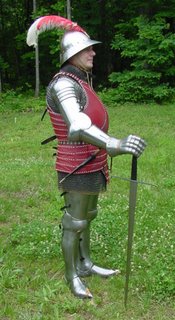
I brought the complete harness of an English man-at-arms ca. 1414, with both a grand bascinet and a kettle hat. I love it when the visitors ask "Why would you want to be able to wear more than one helmet?" Why, thank you for asking. And my sword ca 1385, and my grandfather's for comparison. And a rondel dagger, to demonstrate how acute points can curb your enthusiasm, even when you are wearing mail everywhere you don't wear plate.
I like to display my armor on a table, because you can easily pick up any particular piece and show how it works. Also, it's an authentic way to do it: you can see armor laid out in just this way in the 15th c. treatise on How a man schall be armyd. Also, if you have a tablecloth you can conceal less authentic kit below the table.
Ideally, I would have brought a longer table to display more of the armor at table height, but I was grateful for the shorter table borrowed from a friend.
For refreshment, I brought for drink a full pitcher of water and a beaker of water, and a modern bottle of wine decanted into a hand-blown bottle of wine and a pewter costrel. This was sufficient for the five hours ordained.
For meat I brought cold venison, a portion of a loaf of bread, apples, dried unsulphured apricots and pistachios. This was also sufficient.
Next time I do a tent less presentation, I must remember to bring my broad-brimmed hat to wear between visitors.
My neighbors on one side were portraying Irish in German service about 1521, based on Durer's water color of that year:


Saturday, October 11, 2014
Reproduction Bascinet with a Pomme: 1410-1414

Vane for a Pavilion

This vane was made from brass sheet by Robert MacPherson. The wooden knob it rests on is topped with a brass washer so that the vane may turn more easily. The pole below the vane, like the ball, were turned from wood and gilded.
The ball was originally topped with a silk pennoncel. After a total of a little over three weeks cumulative exposure to the weather, the original finish on the top of the ball showed significant wear. I surmise that the pennon when drooping in a low wind rubbed against the top of the ball. This will avoid that problem and also display much better in a calm.
The vane is based on a surviving weathervane at Etchingham.
Subscribe to:
Posts (Atom)