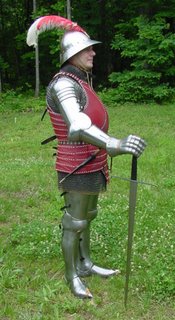
Of all the bowmen quite the best
Are those that span the arbalest
Strong and brave, upright and moral
And not in haste to pick a quarrel
Friday, February 27, 2015

Thursday, February 26, 2015
How Islamic is ISIL?
Suppose there was a group doing a remake of the Albigensian Crusade, justified by medieval Catholic doctrine, seizing territory, murdering civilians and burning people they considered heretics. Would it be useful for Netanyahu and Modi to describe them as Christian terrrorists?
Saturday, February 21, 2015
Why History Should Be Studied More
Clark had an interesting blog post at Popehat that make some good points about tribalism in politics, but it argues from a pretty defective understanding of history.
A thousand years ago, one of the culture war coalitions was about immigration, speaking Norse, and practicing paganism. In 1640, one was composed of opponents to absolute monarchy, (not to centralization as such, the issue was who ran the central government) and those opposed to more tolerance for Catholics, maypoles, or theater. In the antebellum United States, one coalition was in favor of slavery, lower tariffs, slavery, state's rights, slavery, slavery and slavery. The New Deal coalition for "the greater good" had strong support from Catholics and Southern Democrats. In the civil rights era, white Southern Democrats allied with conservative Republicans.
I can and do deny that there has been some meaningful polar division in Western politics for the past thousand years that can usefully defined for the entire period, and probably not the last 50 years either.
It's not just that the political poles drift. It's that the entire political compass wanders over the map, as some political bones of contention slip out of the Overton Window entirely, and others are warmly embraced by both sides.
For at least a thousand years there have been two factions in The West. The magnetic poles drift slowly, and no one compass points with perfect precision, but there is no denying the reality of the poles.
One pole tends (and note that word "tends") to be Protestant, centralized, "scientific", pushing for "the greater good", and "Blue" (as we say in the American language).
The other pole other tends (second disclaimer, same as the first) to be Catholic, decentralized, "traditional", tolerant of inequality, and "Red" (again, in Americanese).Now, it is true that political conflicts in the Anglosphere in the past thousand years have been between rival coalitions, and there is good reason for the coalition leaders to make whatever compromises are needed in their alliances to reach rough parity with the other side or better, but the idea that the bipolar coalitions can be meaningfully described as "Red" or "Blue" before the recent past is absurd.
A thousand years ago, one of the culture war coalitions was about immigration, speaking Norse, and practicing paganism. In 1640, one was composed of opponents to absolute monarchy, (not to centralization as such, the issue was who ran the central government) and those opposed to more tolerance for Catholics, maypoles, or theater. In the antebellum United States, one coalition was in favor of slavery, lower tariffs, slavery, state's rights, slavery, slavery and slavery. The New Deal coalition for "the greater good" had strong support from Catholics and Southern Democrats. In the civil rights era, white Southern Democrats allied with conservative Republicans.
I can and do deny that there has been some meaningful polar division in Western politics for the past thousand years that can usefully defined for the entire period, and probably not the last 50 years either.
It's not just that the political poles drift. It's that the entire political compass wanders over the map, as some political bones of contention slip out of the Overton Window entirely, and others are warmly embraced by both sides.
Sunday, February 15, 2015

Saturday, February 14, 2015
Before Ascham: Early Works on Archery
Livre du roy Modus et de la royne Racio, a mid 14th century book on hunting, contains a brief section on archery. The advice is specific to hunting: the author advises "his bow should be very weak and gentle, so that he may hold it drawn a reasonable space".
Le livre de la chasse was written by Gaston Phoebus, count of Foix, between 1387 and 1388. It discusses archery briefly, closely following Modus. George Agar Hansard offered a translation in his The book of archery.
Walrond''s translation contains several errors. What Walrond translates as "target shooting" is some variant of "au chapperon" in the original French, and shot at ranges of 300 or even 400 paces (about 240 or 330 yards). It is better translated as clout shooting in English. "Arrows are likewise made hollow, like balista arrows" should be "Arrows are likewise made hollow, like crossbow bolts".
He explains waxed arrows, trait cyre in the original, as where the feathers are "fastened with waxed silk". This probably an oversimplification.
Our best candidates for waxed arrows are the many arrows recovered from the Mary Rose, sunk in 1545. At the shaftment, where the fletchings would be attached, archaeologists have identified traces of wax, tallow, copper, and the imprints of thread that they believe to be silk.
I think that that a plausible reconstruction is that the fletchings were first tacked down with hot wax and then secured more permanently with thread wound first about the trimmed spine of the feather, spiral wound for the rest of the untrimmed fletching, and then wound about the trimmed spine at the rear of of the fletching.
A final application of hot wax and tallow to the shaftment would have further secured the thread and ensured that the thread was not disturbed as it slid down the bow. Copper acetate would have discouraged vermin from eating the tallow.
Walrond translates tacles in the original as sheaf arrows, but it seems more likely that he is simply using takel, a Middle English word for arrows as well as archery equipment more generally.
L’Art d’archerie gives us insight into European archery at least a generation before Ascham, and it shows how the author thought three different sorts of sports archery, butts, clout and flight, had different optimal gear, which were in turn distinguished from what was best for war. And the earlier texts show that optimal hunting gear differed from all of these.
Interestingly, the author of L’Art d’archerie claims the the English found glued fletchings truer than waxed. Perhaps eagerness to base all reconstructions of longbow arrows entirely on the Mary Rose is misplaced.
Le livre de la chasse was written by Gaston Phoebus, count of Foix, between 1387 and 1388. It discusses archery briefly, closely following Modus. George Agar Hansard offered a translation in his The book of archery.
"The sportsman's bow should be of yew, and measure twenty palms (five feet) from one notch to the other, and, when braced, have a hand's breadth between string and wood. The string must ever be of silk. The bow should be weak, because an archer over-bowed cannot take aim freely and with address; besides, such a bow may be held half-drawn a long time without fatigue, whilst the hunter stands in wait for the deer.
"The wood of a well-formed arrow measures eight handsful in length from the end of the nock to the barbs of the head, which will be exactly four fingers broad, from the point of one barb to the point of the other. It must be duly proportioned in every part, well filed and sharpened, and five fingers in length.
"When a deer is discovered approaching the archers, as soon as they hear the hounds are slipped, they ought to set their arrows on their bows, bringing the two arms into such a position as to be prepared to shoot. For, should the animal espy the men in motion whilst nocking their shafts, he will assuredly escape in another direction. Thus, a keen sportsman is ever cautiously on the alert, ready to let his arrow fly without the slightest motion, except that of drawing with the arms."
He then goes on to describe the different modes of shooting at game in every possible position, somewhat after the fashion of the text; and gives a remarkable reason why an archer should point his shaft in a rather slanting direction when the aim is at the stag's broadside, in preference to straight forwards. He says,-- "There is peril to him who shoots directly at the side, independently of great uncertainty of killing when the arrow does prove fatal, it sometimes passes through and through the beast, and may thus wound a companion on the opposite side. Such an accident I did myself see once happen to Messire Godfrey de Harcourt, who was pierced through one of his arms."L’Art d’archerie was printed around 1515. In 1901 Henri Gallice published the text of a manuscript of the work in his possession that he believed dated somewhat earlier, to the end of the 15th century. Henry Walrond published an English translation in 1903.
Walrond''s translation contains several errors. What Walrond translates as "target shooting" is some variant of "au chapperon" in the original French, and shot at ranges of 300 or even 400 paces (about 240 or 330 yards). It is better translated as clout shooting in English. "Arrows are likewise made hollow, like balista arrows" should be "Arrows are likewise made hollow, like crossbow bolts".
He explains waxed arrows, trait cyre in the original, as where the feathers are "fastened with waxed silk". This probably an oversimplification.
Our best candidates for waxed arrows are the many arrows recovered from the Mary Rose, sunk in 1545. At the shaftment, where the fletchings would be attached, archaeologists have identified traces of wax, tallow, copper, and the imprints of thread that they believe to be silk.
I think that that a plausible reconstruction is that the fletchings were first tacked down with hot wax and then secured more permanently with thread wound first about the trimmed spine of the feather, spiral wound for the rest of the untrimmed fletching, and then wound about the trimmed spine at the rear of of the fletching.
A final application of hot wax and tallow to the shaftment would have further secured the thread and ensured that the thread was not disturbed as it slid down the bow. Copper acetate would have discouraged vermin from eating the tallow.
Walrond translates tacles in the original as sheaf arrows, but it seems more likely that he is simply using takel, a Middle English word for arrows as well as archery equipment more generally.
L’Art d’archerie gives us insight into European archery at least a generation before Ascham, and it shows how the author thought three different sorts of sports archery, butts, clout and flight, had different optimal gear, which were in turn distinguished from what was best for war. And the earlier texts show that optimal hunting gear differed from all of these.
Interestingly, the author of L’Art d’archerie claims the the English found glued fletchings truer than waxed. Perhaps eagerness to base all reconstructions of longbow arrows entirely on the Mary Rose is misplaced.
Friday, February 06, 2015
An Archery Peerage
The London Archers continued to hold their yearly contests in. the month of September, in spite of the fact that henceforth there would be no use for the longbow in warfare. They formed a very fine corps, had they been of any use; meantime, the City has always loved a show, and a very fine show the Archers provided. Their captain was called the Duke of Shoreditch; the captains of the different Companies were called the Marquesses of Clerkenwell, Islington, Hoxton, and the Earl of Pancras, etc.; in the year 1583 they assembled at Merchant Taylors Hall to the number of 3000 all sumptuously apparelled, “nine hundred and forty-two having chains of gold about their necks.” They were escorted by whifflers and bowmen to the number of 4000, besides pages and footmen; and so marching through Broad Street, where the Duke of Shoreditch lived, they proceeded by Moorfields and Finsbury to Smithfield, where, after performing their evolutions, they shot at the target for glory.
Besant, Walter. 1904. London in the time of the Tudors. London: A. & C. Black p. 355
Here is a fuller account of the 1583 event from a contemporary. Besant has erred in describing the escorts as bowmen rather than bill-men.
I read this as the Elizabethan equivalent of a 21st century Superbowl halftime show. Behold the gaudy expensive excess, which we can well afford. The fact that we can afford it is part of the point. Are you not entertained?
Monday, February 02, 2015
A Chaucerian Bookshelf
The following works were written by authors who were adults when Chaucer was alive.
Boccaccio, Giovanni. Decameron. Harmondsworth: Penguin, 1972. Shares Chaucer’s diversity; indeed, Chaucer retells many of Boccaccio’s tales.
Bonet, Honoré. The Tree of Battles of Honoré Bonet. Transl. G. W. Coopland. Liverpool: University Press of Liverpool 1949. A learned clerk writes about law, justice, morality and violence, legitimate and otherwise.
Charny, Geoffroi de. The Book of Chivalry. Transl. Richard W. Kaeuper and Elspeth Kennedy. University Park: Pennsylvania State University Press, 1996. A knight writes about the ideals and obligations of knighthood.
Charny, Geoffroi de and Muhlberger, Steven. Charny's Men-at-Arms: Questions Concerning the Joust, Tournaments, and War. , Wheaton; Freelance Academy Press, 2014. Revealing questions from the famous knight about what does and does not conform to the law of arms, as seen by contemporary men at arms.
Froissart, Jean. Chronicles. Transl. Geoffrey Brereton. New York: Penguin 1978. A vivid and detailed contemporary chronicle; Froissart writes like an eyewitness even when he wasn’t, providing details that may not always be accurate but are always true to the author’s view of chivalric culture.
Kempe, Margery. The Book of Margery Kempe. Transl. Barry Windeatt. New York: Penguin 1988. Written after Chaucer’s lifetime by a woman who grew up during the late 1300s—this account of the author’s lifetime of spiritual exploration is one of few substantial medieval works to come from us from an English laywoman.
Langland, William. Piers the Plowman. Transl. J. F. Goodridge. New York: Penguin 1987. An allegorical exploration of contemporary society and morals, this was one of the most popular works in English during Chaucer’s lifetime.
Mandeville, John. Travels. Trans, C. W. R. D. Moseley. New York: Penguin 1983. Purporting to be the account of a fourteenth-century Englishman’s journeys, this book was also very popular in Chaucer’s day; it incorporates both fact and fantasy, and reflects popular ideas about the nature of the world.
Pizan, Christine de. The Book of Deeds of Arms and of Chivalry. Ed. and transl. Sumner and Charity Cannon Willard. University Park: Pennsylvania State University Press 1999. Christine updates the late Roman military manual of Vegetius and Bonet’s Tree of Battles with a great deal of practical contemporary advice such as the number of bowstrings and wheelbarrows to bring to a siege.
Christine de Pizan was probably the first woman to make her living as a professional writer.
Pizan, Christine de and Rosalind Brown-Grant. 2005. The book of the city of ladies. Penguin Books. 2005. Christine gives advice on good conduct to women of all ranks, from women of high rank to prostitutes and the wives of laborers.
Pizan, Christine de. The Book of the Duke of True Lovers Transl.Thelma S Feinster and Nadia Margolis New York, Persea Books 1991 A profoundly unromantic and subversive romance presenting the argument that most of what male courtly lovers say about serving their ladies is self serving "since the honor and profit remains with them and not at all with the lady!"
Power, Eileen, transl. The Goodman of Paris. Woodbridge: Boydell Press, 1928. A wealthy and aged Parisian writes moral and practical advice to his young wife regarding the management of her household.
Tolkien, J. R. R., transl. Sir Gawain and the Green Knight, Pearl, and Sir Orfeo. New York: Ballantine Books, 1975. Dating to the late fourteenth century, Sir Gawain is one of the finest examples of Middle English romance; it offers both chivalric adventure and sophisticated humor.
Wright, Thomas, transl. The Book of the Knight of La Tour-Landry. New York: Greenwood Press, 1969. A late fourteenth-century knight dispenses moral advice to his daughters illustrated by many anecdotes, some learned and classical, some lively and contemporary.
A shorter version of this list appears in:
Forgeng, Jeffrey L, and Will McLean. Daily Life in Chaucer's England. Westport, Conn: Greenwood Press, 2009. Print.
Saturday, January 31, 2015
Nine Men's and Thee Men's Morris
On how nine men's morris is played without dice
This nine men's morris is played in another way, without dice by skill. The players take all their pieces in their hands and they roll to determine who plays first. And he that is to play first has an advantage because in placing the pieces he always takes the first space he likes, the quicker to make a mill as we said and take one piece from his opponent each time or prepare how to trap him so that he does not have anywhere to go with any of his pieces.
And if perchance the first player should err in placing his pieces well, he is defeated because one piece remains to the other player and puts it wherever he can cause hindrance to the other and line up his pieces just as we said and thereby wins the game
And this game they call nine men's morris because the pieces with which it is played with are nine of each color. And this is the diagram of the millboard and of its pieces, and this is its explanation.
This is another alquerque of three
There is another alquerque game and they call it that of the three and they call it thus because it is played with six pieces, three of one color and three of another. In this one dice do not have a part and he who plays first wins if he should know how to play it well.
And the play of it is this: he who should more quickly place his pieces in a row wins.
And since the one who plays first should place his piece in the center of the millboard, and the other player will place his wherever he should wish.
And he who played first should place his second piece in such a manner that the other player is perforce to place his in a row he has placed. Then the first to play will have to play perforce lined up with those two enemy pieces and all his pieces will be placed. And if in this way he should have placed them so that wherever the other player puts his remaining piece he loses. And if the one how (sic) plays first should not play it like this, the other will be able to tie the game or defeat him.
And because of the tie and the markings where the pieces are placed tables and chess have a part there, because of the pieces with which it is played that resemble its pawns. And this is the diagram of the board and of the pieces.
Alphonso's alquerque of three differs from Three Men's Morris in that in the latter game players may continue to move pieces after all have been played.
"This document combines Sonja Musser Golladay's translation of the original text and Charles Knutson's facsimile copies of the original images. I originally prepared it as a teaching document to help me write a class on medieval games, but I have now posted it online for any and all who are interested to peruse and study as they wish."
This nine men's morris is played in another way, without dice by skill. The players take all their pieces in their hands and they roll to determine who plays first. And he that is to play first has an advantage because in placing the pieces he always takes the first space he likes, the quicker to make a mill as we said and take one piece from his opponent each time or prepare how to trap him so that he does not have anywhere to go with any of his pieces.
And if perchance the first player should err in placing his pieces well, he is defeated because one piece remains to the other player and puts it wherever he can cause hindrance to the other and line up his pieces just as we said and thereby wins the game
And this game they call nine men's morris because the pieces with which it is played with are nine of each color. And this is the diagram of the millboard and of its pieces, and this is its explanation.
This is another alquerque of three
There is another alquerque game and they call it that of the three and they call it thus because it is played with six pieces, three of one color and three of another. In this one dice do not have a part and he who plays first wins if he should know how to play it well.
And the play of it is this: he who should more quickly place his pieces in a row wins.
And since the one who plays first should place his piece in the center of the millboard, and the other player will place his wherever he should wish.
And he who played first should place his second piece in such a manner that the other player is perforce to place his in a row he has placed. Then the first to play will have to play perforce lined up with those two enemy pieces and all his pieces will be placed. And if in this way he should have placed them so that wherever the other player puts his remaining piece he loses. And if the one how (sic) plays first should not play it like this, the other will be able to tie the game or defeat him.
And because of the tie and the markings where the pieces are placed tables and chess have a part there, because of the pieces with which it is played that resemble its pawns. And this is the diagram of the board and of the pieces.
Musser Golladay, Sonja. 2007. Los libros de acedrex dados e tablas: historical, artistic and metaphysical dimensions of Alfonso X's Book of Games. Ann Arbor, Michigan, USA: UMI Dissertation Services, from ProQuest Co.
"This document combines Sonja Musser Golladay's translation of the original text and Charles Knutson's facsimile copies of the original images. I originally prepared it as a teaching document to help me write a class on medieval games, but I have now posted it online for any and all who are interested to peruse and study as they wish."
Thursday, January 29, 2015
Of evil orders or customs in our English Fence schools, & of the old or ancient teaching of weapons, & things very necessary to be continued for the avoiding of errors, and reviving and continuance of our ancient weapons, and most victorious fight again.
There is in my opinion in our fence schools an evil order or custom in these days used, the which, if it might stand with the liking of our Masters of Defence, I think it necessary to be left. For as long as it is used, it shall be hard to make a good scholar. That is this, at the single sword, sword and dagger, & sword and buckler, they forbid the thrust, & at the single rapier, and rapier & dagger, they forbid the blow. Either they are both together best, or the thrust altogether best, or the blow altogether best. If the thrust is best, why do we not use it at the single sword, sword & dagger, & sword & buckler? If the blow is best, why do we not use it at the single rapier, rapier & poniard? But knowing by the art of arms, that no fight is perfect without both blow and thrust, why do we not use and teach both blow and thrust?
But however this we daily see, that when two met in fight, whether they have skill or none, unless such as have tied themselves to that boyish, Italian, weak, imperfect fight, they both strike and thrust, and how shall he then do, that being much taught in school, that never learned to strike, nor how to defend a strong blow? And how shall he then do, that being brought up in a fencing school, that never learned to thrust with the single sword, sword and dagger, and sword and buckler, nor how at these weapons to break a thrust? Surely, I think a down right fellow, that never came in school, using such skill as nature yielded out of his courage, strength, and agility, with good downright blows and thrust among, as shall best frame in his hands, should put one of these imperfect scholars greatly to his shifts.
Besides, there are now in these days no grips, closes, wrestlings, striking with the hilts, daggers, or bucklers, used in fencing schools. Our plowmen will by nature will do these things with great strength & agility. But the schoolmen is altogether unacquainted with these things. He being fast tied to such school-play as he has learned, has lost thereby the benefit of nature, and the plowman is now by nature without art a far better man than he. Therefore in my opinion as long as we bar any manner of play in school, we shall hardly make a good scholar. There is no manner of teaching comparable to the old ancient teaching, that is, first their quarters, then their wards, blows, thrusts, and breaking of thrusts, then their closes and grips, striking with the hilts, daggers, bucklers, wrestlings, striking with the foot or knee in the cods, and all these are safely defended in learning perfectly of the grips(1). And this is the ancient teaching, and without this teaching, there shall never scholar be made able, do his uttermost, nor fight safe.
Again their swords in schools are too long by almost half a foot to uncross, without going back with the feet, within distance or perfectly to strike or thrust within the half or quarter sword. And in serving of the prince, when men do meet together in public fight, are utterly naught and unserviceable. The best length for perfect teaching of the true fight to be used and continued in fence schools, to accord with the true statures of all men, are these. The blade to be a yard and an inch for men of mean stature, and for men of tall statures, a yard and three or four inches, and no more(2). And I would have the rapier continued in schools, always ready for such as shall think themselves cunning, or shall have delight to play with that imperfect weapon. Provided always, that the schoolmaster or usher play with him with his short sword, plying him with all manner of fight according to the true art. This being continued the truth shall flourish, the lie shall be beaten down, and all nations not having the true science, shall come with all gladness to the valiant and most brave English masters of defence to learn the true fight for their defence.
Side notes:
1 In the wars there is no observation of Stocatas, Imbrocatas, times, nor answers.
2 Long weapons imperfect.
Paragraph breaks added.
Sunday, January 25, 2015
Credo
Credo in Deum Patrem Omnipotentem
Creatorem coeli et terrae
Et in Jesum Christum Filium eius unicum, dominum Nostrum
Qui conceptus est de Spiritu Sancto
Natus ex Maria Virgine
Passus sub Pontio Pilato,
Crucifixus Mortuus, et sepultus
Descendit ad inferna
Tertia die resurrexit a mortuis
Ascendit ad coelos
Sedet ad dexteram Dei Patris omnipotentis
Inde venturur judicare
Vivos et mortuos
Credo in Spiritum Sanctum,
Sanctam Ecclesiam Catholicam,
Sanctorum communionem
Remissionem peccatorum
Carnis ressurectionem
Et vitam aeternam.
Amen.
I beleve in God, Fader almyghty,
Makere of heven and erthe,
And in Ihesu Crist, his onely sone oure Lorde
That is concyved by the Holy Gost,
Born of the Mayden Marye
Suffred under Pounce Pylate,
Crucifyed, Ded, and beryed;
Descended to helle;
The thridde day he aros fro dethes
Styed [rose] up to hevene
Sitte on his Fader half [side]
Schal come to deme [judge] The quick and dede. I
beleue in the Holy Gost,
Holy Chirche, That is alle that schulle be saved,
And in communion of hem,
Remissioun of synnes,
Risyng of flesch,
And everlastynge lyf.
Amen.
Translation from Book to a Mother, ed. Adrian James McCarthy, Elizabethan and Renaissance Studies 92 (Salzburg: Institut für Anglistik und Amerikanistik, 1981), 1.
Subscribe to:
Posts (Atom)