Wednesday, December 31, 2008

Tuesday, December 30, 2008
Recreating Belgian Longsword Rules
This past summer, at Pennsic 2008, we recreated a tournament using Belgian longsword rules as part of an anthology of tournament styles at the Company of St. Michael’s Vespers.
We used rattan longswords and the ordinary minimum protection of SCA rattan combat. This was expedient, and although lighter protection and steel fencing longswords would have been closer to the original, this provided a quick and enjoyable way to explore the dynamics of the rules.
Since we were recreating unarmored combat, we counted blows at about half standard SCA calibration. We also disallowed thrusts to the face: this wasn’t explicit in the surviving rules, but it was for rapier rules used by the same groups and it seemed likely considering the limited protection worn.
Otherwise we used the following rules posted by Matt Galas.
Important note: One party is designated as the "King"; he has certain advantages (see below). His opponent is called the "Champion." If the Champion defeats the King, he becomes the new King, and has the corresponding handicap. The goal is to remain King until everyone has fenced; the last person remaining as King wins the tournament.
- Each bout consists of a single round.
- Both cut & thrust are allowed.
- Valid target area is above the belt and above the elbows (ie, no hands or forearms).
- No corps-a-corps is allowed; no grappling or pommel strikes.
- Only two-handed technique (no one-handed or half-sword).
- If you lose your weapon, you lose the bout. If you fall, the bout is played over.
- If the King hits the Champion a clean hit, he wins the bout, and remains King. (Go on to the next contestant.)
- If the Champion hits the King with a clean hit, the King still has one last chance to hit him (called an "after-stroke"). The King can take one step with his after-stroke. If he hits, he wins the bout. (This after-stroke must be delivered immediately, without delay, or it is lost.) If the Champion parries or evades the blow, then the Champion wins the bout, and becomes King.
- If there is a double hit, the highest hit wins (head wins over chest, etc.). If it's the King who has the highest hit, he wins. If it's the Champion, the King still gets his after-stroke (see rule above).
He adds that:
Some of the rule sets prescribe a certain number of "venues" (read: "rounds") that the guild brothers have to fight. Usually, the number is two for a new member, three for a guild member who has passed his initial tests. One rule set explicitly says that the venues cannot be played back to back, but must have at least one other person fighting a venue in between.
Because all of the participants were experienced, everyone was allowed three chances to enter the field. We chose the first King by drawing straws. If I was running a repeat event with the same group, I would have the King from the last tournament begin as King.
Although the limited target area created some artificiality relative to actual combat, the rules were in practice simple and elegant in recreating some of the dynamics of actual combat. The after-stroke rule strongly discouraged depending on attacks that might land first, but left you vulnerable to a dying blow. While in theory it might seem that a weaker fighter could be lucky and enter the field at the right time to defeat a tired but superior King in the last fight of the day, that wasn’t an issue for us, since the weaker fighters exhausted their venues faster than the better ones. Evidently the rules evolved over many years to achieve a good balance between simplicity and realism.
We used rattan longswords and the ordinary minimum protection of SCA rattan combat. This was expedient, and although lighter protection and steel fencing longswords would have been closer to the original, this provided a quick and enjoyable way to explore the dynamics of the rules.
Since we were recreating unarmored combat, we counted blows at about half standard SCA calibration. We also disallowed thrusts to the face: this wasn’t explicit in the surviving rules, but it was for rapier rules used by the same groups and it seemed likely considering the limited protection worn.
Otherwise we used the following rules posted by Matt Galas.
Important note: One party is designated as the "King"; he has certain advantages (see below). His opponent is called the "Champion." If the Champion defeats the King, he becomes the new King, and has the corresponding handicap. The goal is to remain King until everyone has fenced; the last person remaining as King wins the tournament.
- Each bout consists of a single round.
- Both cut & thrust are allowed.
- Valid target area is above the belt and above the elbows (ie, no hands or forearms).
- No corps-a-corps is allowed; no grappling or pommel strikes.
- Only two-handed technique (no one-handed or half-sword).
- If you lose your weapon, you lose the bout. If you fall, the bout is played over.
- If the King hits the Champion a clean hit, he wins the bout, and remains King. (Go on to the next contestant.)
- If the Champion hits the King with a clean hit, the King still has one last chance to hit him (called an "after-stroke"). The King can take one step with his after-stroke. If he hits, he wins the bout. (This after-stroke must be delivered immediately, without delay, or it is lost.) If the Champion parries or evades the blow, then the Champion wins the bout, and becomes King.
- If there is a double hit, the highest hit wins (head wins over chest, etc.). If it's the King who has the highest hit, he wins. If it's the Champion, the King still gets his after-stroke (see rule above).
He adds that:
Some of the rule sets prescribe a certain number of "venues" (read: "rounds") that the guild brothers have to fight. Usually, the number is two for a new member, three for a guild member who has passed his initial tests. One rule set explicitly says that the venues cannot be played back to back, but must have at least one other person fighting a venue in between.
Because all of the participants were experienced, everyone was allowed three chances to enter the field. We chose the first King by drawing straws. If I was running a repeat event with the same group, I would have the King from the last tournament begin as King.
Although the limited target area created some artificiality relative to actual combat, the rules were in practice simple and elegant in recreating some of the dynamics of actual combat. The after-stroke rule strongly discouraged depending on attacks that might land first, but left you vulnerable to a dying blow. While in theory it might seem that a weaker fighter could be lucky and enter the field at the right time to defeat a tired but superior King in the last fight of the day, that wasn’t an issue for us, since the weaker fighters exhausted their venues faster than the better ones. Evidently the rules evolved over many years to achieve a good balance between simplicity and realism.
TREATISE OF WORSHIP IN ARMS, BY JOHAN HILL
TRAYTESE OF THE POYNTES OF WORSHIP IN ARMES BY JOHAN HYLL,
ARMORER SERGEANT IN THE KINGE’S ARMORY 1434
Bod. Lib., Ashmole. MS. 856, art. 22, pp. 376—~83
[376] Too my leve Lordes here nowe next folowinge is a Traytese compyled by Johan Hyll Armorier Sergeant in the office of Armory wt, Kinges Henry ye 4th and Henry ye 5th of ye poyntes of Worship in Armes and how he shall be diversely Armed & gouverned under supportacion of faveurof alle ye Needes to coverte adde & amenuse where nede is by the high comandement of the Princes that have powair so for to ordeyne & establishe
The first Honneur in Armes is a Gentilman to fight in his Souverain Lords quarell in a bataille of Treason sworne withinne Listes before his souverain Lorde whether he be Appellant or Defendant ye houneur is his that winneth ye feelde.
As for the appellant thus Armed by his owne witte or by his counsaille wch is assigned to him before Conestabie & Marchall ye wch Counsaille is ordeyned & bounden to teche hym alle maner of fightynge & soteltees of Armes that longeth for a battaile sworne
First hym nedeth to have a paire of hosen of corde wtoute vampeys And the saide hosen kutte at ye knees and lyned wtin wt Lynnen cloth byesse as the hose is A payre of shoen of red Lether thynne laced & fretted underneth wt whippecorde & persed, And above withinne Lyned wt Lynnen cloth three fyngers in brede double & byesse from the too an yncle above ye wriste. And so behinde at ye hele from the Soole halfe a quarter of a yearde uppe this is to fasten wele to his Sabatons And the same Sabatons fastened under ye soole of ye fote in 2 places hym nedeth also a petycote of an overbody of a doublett, his petycote wt oute sleves, ye syses of him 3 quarters aboute wt outen coler, And that other part noo ferther thanne [377] ye waste wt streyte sleves and coler and cutaine oylettes in ye sleves for ye vaunt bras and ye Rerebrase
Armed in this wise First behoveth Sabatouns grevis & cloos quysseux wt voydours of plate or of mayle & a cloos breche of mayle wt 5 bokles of stele ye tisseux of fyne lether. And all ye armyng poyntes after they ben knytte & fastened on hym armed that ye poyntes of him be kutte of
And thanne a paire of cloos gussetts strong sclave not drawes and thatye gussets be thre fingers withinne his plates at both assises And thanne a paire of plattes at xx li lib weight his breste & his plats enarmed to wt wyre or wt poyntes.
A pair of Rerebraces shitten withinne the plates before wt twi forlockes and behinde wt thre forlocks. A paire of vaunt bras cloos wt voydours of mayle & fretted. A pair of gloves of avantage wche may be devised. A basnet of avauntage for ye listes whiche is not goode for noon other battailles but man for man save that necessitie hath noo lawe, the basnet locked baver & vysour locked or charnelled also to ye brest & behynde wt two forlockes. And this Gentilman appellent aforesaide whanne he is thus armed & redy to come to ye felde do on hym a cote of armes of sengle tarten ye beter for avauntage in fighting. And his leg harneys covered alle wt reed taritryn the wche ben called tunictes for he coverynge of his leg harneys is doen because his adversarie shal not lightly espye his blode. And therefore also hen his hosen reed for in alle other colours blode wol lightly be seyne, for by the oolde tyme in such a bataile there shulde noo thing have be seyn here save his basnett & his gloves. And thanne tye on hym a payre of besagewes. Also it fitteth the [378] foresaide counsaille to goo to ye kyng the daye before ye bataille & aske his logging nigh ye listes. Also ye foresaide Counsaille must ordeyne hym the masses ye first masse of ye Trinitie ye seconde of ye Holy Goste & ye thirde of owre Ladye or elles of what other sainte or saintes that he hath devocion unto
And that he be watched alle that night hym that he is watched and light in his Chambre alle that night that his counsaille may wite how that he slepeth, And in ye mornyng whanne he goeth to his Masses that his herneys be leyed at ye North end of ye Auter and covered wt a cloth that ye gospell may be redde over it and at ye laste masse for to be blessed wt ye preist and whanne he hath herde his Masses thanne to goo to his dyner. And soo to his Armyng in ye forme aforesaide. And whanne he is armed and alle redy thanne to come to ye feelde in forme to fore rehersed, thanne his counsaille bounden to counsaille hym & to teche hym how he shal gouverne hym of his requests to ye kyng or he come into ye feelde and his entrie into ye felde and his gouvernance in the feelde for ye saide Counsaille hath charge of hym before Constable and Mareschal til that Lesses les aller be cryed. The whiche requestes ben thus that ye saide Appellant sende oon his counsaille to the kyng for to requeste hym that whanne he cometh to ye barrers to have free entrie wt his counsaille Confessour & Armorers wt alle maner of Instruments wt breede & wyne hymnself bringing in in an Instrument that is to saye a cofre or a pair of bouges. Also their fyre cole & belyes and that his chayre wt [379] certaine of his Servants may be brought into ye feelde and sette up there the houre of his comyng that it may cover hym and his counsaille whanne he is comen into ye feelde this forsaide gentilman Appellant comyng to ye Listes whether he wol on horsebak or on fote wt his counsaille Confessour & other Servaunts aforesaide havyng borne be fore hym by his counsaille a spere a long swerde a short swerde & a dagger fastined upon hymself his swerdes fretted and beasagewed afore ye hiltes havyng noo maner of poyntes for and ther be founden that day on hym noo poyntes of wepons thanne foirre, it shall tourne hym to gret reproof. And this gentilman appellant that come to ye barrers at ye Southeest sone, his visier doune And he shal aske entrie where shal mete hym Constable and Mareschal and aske hym what art thou. And he shal saye I am suche a man & telle his name to make goode this day by ye grace of God that I have saide of suche a man and tell hys name bifore my Souain Lord and they shal bidde hym putte up his visier and whanne he hath put up his visier they shal open the barrers and lette hym inne and his counsaille before hym & wt hym his Armorers & his servaunts shal goo streight to his chayer wt his breed his wyne & alle his instruments that longe unto hym save his weppons. And whanne he entreth into the felde that he blesse hym soberly and so twys or he come to before his Souverain Lord And his Counsailles shall do thair obeisaunce before thair souverain Lord twys or they come to the degrees of his scaffolde and he to obeye him wt his heed at both tymes Then whanne they to fore thair souverain Lord they shal knele a downe and he also they shal aryse or he aryse he shal obeye hym at his heed to his souverain Lord and then aryse and whanne he is up on his feete he shal blesse hym and turne hym to his chayre and at the entryng of his chayr [380] soberly tourne hym his visage to his souverain Lord wards and blesse hym and thanne tourne hym againe and soo go into his chayre and there he maye sitte hym downe and take of his gloves and his basnet and so refresh hyrn till the houre of hys Adversarie approche wt breed and wyne or wt any other thing that he hath brought in wt hym. And whanne the Defendaunt his Adversarie cometh in to the feelde that he be redy armed againe or that he come into the feelde standing withoute his chayre taking hede of his Adversaries comyng in and of his countenance that he may take comfort of. And whanne the defendant his Adversarie is come int ye felde and is in his chayre thanne shal the kyng send for his wepons and se him and the Conestable and the Marschal also and if they be leefull they shal be kept in the feelde & kutte the same day by ye comaundement of the kyng and the Conestable and Mareschal in ye kynge’s behalve. And thanne fitteth to the foresaide counsaille to arme hym and to make hym redy against that he be called to his first ooth and whanne he is called to his first oothe thanne fitteth it to alle his counsaille to goo wt hym to his first ooth for to here what the Conestable and Mareschal seyen unto hym and what contenaunce he maketh in his sweryng And whanne he hath sworne they shl ryse up by ye comaundement of the Conestable and Mareschal. And whanne he is on his feete he shal obey hym to his Souverain Lord and blesse hym and thanne turne hym to his chayre his visage to his souveraine Lord wards and in his goinge blesse hymn twys by ye weye or he come to his chayre. And at ye [381] entryng to his chayre soberly tourne hym his visage to his Souverain Lord wards and blesse hym and soo go into his chayre. Thanne fitteth it to his fore saide Counsaille to awayte where the defendaunt shal come to his first ooth and that they be ther as sone as he for to here how he swereth for he must nedes swere that al that ever th appellant hath sworne is false substance and alle, And if he wol not swere that every worde & every sillable of every worde substance and alle is false the Counsaille of ye saide appellant may right wisly aske jugement by lawe of Civile and raison of Armes forafter ye juge is sette there shulde noo plee be made afore hym that daye.
And if so be that the Defendant swere duly thanne ye Counsaille of the foresaide Appellant shal goo to his chayre agayne and abide ther til they be sent for. And thanne shal they bringe hym to hys second Ooth and here how he swereth and whanne he hath sworne they shal goo wt hym to hys chayre againe in the forme aforesaide. And whanne he is in his chayre the saide Counsaille shal awayte whanne ye Defendaunt cometh to his seconde ooth and here how he swereth and if he swere under any subtil teerme cantel or cavellacion the foresaide Counsaille of th appellant may require the jugement. And if he swere duely thanne shal ye Counsaille of ye foresaide Appellant goo to his chayre againe and abide there til they be sent for.
And thanne shal they brynge hymn to his thirde ooth and assuraunce. And whanne they be sworne and assured the saide appellant wt his Counsaile shal goo againe to his chayre in the fourme afore saide and there make [382] hym redy and fastene upon hym his wepons and so refresche hym til ye Conestahie and Mareschal bid hym come to ye feeld. Thanne shal his Armorers and his Servaunts voyde the Listes wt his chayre and alle his Instruments at ye Comandement of ye Conestable and Mareschal. Thanne fitteth it to the Counsaille of the saide Appellant to ask a place of ye kyng afore hym withinne the barres upon his right hande that ye saide Counsaille of th appellant may come and stande there whanne they be discharged of ye saide Appellant.
The cause is this that suche pyte may be given to ye kyng if God that noon of hem shal dye that daye for he may by his prowaie royal in such a cas take it into his hande the foresaide Counsaille of the Appellant to abyde in the saide place til the kyng have geven his jugement upon him—And thanne ye Conestable and Mareschal shal deliwer the foresaide Appellant by ye Comandement of the kyng to his foresaide Counsaille to govern hymn of his going out of ye feelde as wele as they did of his comyng in his worship to be saved in al that lyeth en hem. And soo to bryng hymn to his Logging agayne to unarme hymn comforte hymn and counsaille hym And some of his Counsaille may goo to the kyng and comon wt hymn and wite of the kyng how he shal be demeaned. This enarmyng here aforesaide is best for a battaille of arreste wt a sworde a dagger an Ax and a pavys til he come to th asseblee his sabatons & his tunycle evoyded And thanne the Auctor Johan Hyll dyed at London in Novembre the xiii th yere of kyng Henry the Sixt so that he accomplished noo mor of ye compylyng of this [383] trayties on whose soulle God have mercy for his endles passion Amen.
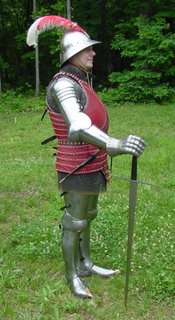
This as an informative treatise, but very specialized to the requirements of the judicial duel. The author devotes considerable ingenuity to giving his reader every possible advantage in a life or death fight at a predetermined time with complete support staff on hand. A sleeveless, collarless “petycote… of a doublet” is worn, which would support the legharness without binding the shoulders. Over that is an “other part noo ferther thane ye waste wt streyte sleves and coler and cutain oylettes for ye vaunt bras and ye Rerebrase”. This could support the armharness while allowing relatively free movement. Once the arming points are tied the ends are cut away.
Hill suggest that the the body armor be closed up with “wire or points”. Wire would be less vulnerable than buckles, but impractical on campaign. Similarly, instead of buckles and hinges, the rerebrace is closed with forelocks, metal wedges driven into holes in the end of bolts. Again, this provides a very secure closure, but requiring the assistance of an armorer to remove. He recommends a “basnet of avauntage”, useful only for single combat, with locked “baver and vysour”, with the helmet also locked to breast and backplate with two forelocks.
Finally, he suggests that the legharness by covered with red fabric “tunictes” to conceal any loss of blood. "Tunictes" might be translated as vestments or jackets. He says that the champion’s swords should be be “fretted and besagewed” before the hilts. He condemns the practice of adding additional points to the weapon by sharpening the ends of the cross of the hilt or adding a point to the pommel, both of which appear in Continental fighting manuals.
ARMORER SERGEANT IN THE KINGE’S ARMORY 1434
Bod. Lib., Ashmole. MS. 856, art. 22, pp. 376—~83
[376] Too my leve Lordes here nowe next folowinge is a Traytese compyled by Johan Hyll Armorier Sergeant in the office of Armory wt, Kinges Henry ye 4th and Henry ye 5th of ye poyntes of Worship in Armes and how he shall be diversely Armed & gouverned under supportacion of faveurof alle ye Needes to coverte adde & amenuse where nede is by the high comandement of the Princes that have powair so for to ordeyne & establishe
The first Honneur in Armes is a Gentilman to fight in his Souverain Lords quarell in a bataille of Treason sworne withinne Listes before his souverain Lorde whether he be Appellant or Defendant ye houneur is his that winneth ye feelde.
As for the appellant thus Armed by his owne witte or by his counsaille wch is assigned to him before Conestabie & Marchall ye wch Counsaille is ordeyned & bounden to teche hym alle maner of fightynge & soteltees of Armes that longeth for a battaile sworne
First hym nedeth to have a paire of hosen of corde wtoute vampeys And the saide hosen kutte at ye knees and lyned wtin wt Lynnen cloth byesse as the hose is A payre of shoen of red Lether thynne laced & fretted underneth wt whippecorde & persed, And above withinne Lyned wt Lynnen cloth three fyngers in brede double & byesse from the too an yncle above ye wriste. And so behinde at ye hele from the Soole halfe a quarter of a yearde uppe this is to fasten wele to his Sabatons And the same Sabatons fastened under ye soole of ye fote in 2 places hym nedeth also a petycote of an overbody of a doublett, his petycote wt oute sleves, ye syses of him 3 quarters aboute wt outen coler, And that other part noo ferther thanne [377] ye waste wt streyte sleves and coler and cutaine oylettes in ye sleves for ye vaunt bras and ye Rerebrase
Armed in this wise First behoveth Sabatouns grevis & cloos quysseux wt voydours of plate or of mayle & a cloos breche of mayle wt 5 bokles of stele ye tisseux of fyne lether. And all ye armyng poyntes after they ben knytte & fastened on hym armed that ye poyntes of him be kutte of
And thanne a paire of cloos gussetts strong sclave not drawes and thatye gussets be thre fingers withinne his plates at both assises And thanne a paire of plattes at xx li lib weight his breste & his plats enarmed to wt wyre or wt poyntes.
A pair of Rerebraces shitten withinne the plates before wt twi forlockes and behinde wt thre forlocks. A paire of vaunt bras cloos wt voydours of mayle & fretted. A pair of gloves of avantage wche may be devised. A basnet of avauntage for ye listes whiche is not goode for noon other battailles but man for man save that necessitie hath noo lawe, the basnet locked baver & vysour locked or charnelled also to ye brest & behynde wt two forlockes. And this Gentilman appellent aforesaide whanne he is thus armed & redy to come to ye felde do on hym a cote of armes of sengle tarten ye beter for avauntage in fighting. And his leg harneys covered alle wt reed taritryn the wche ben called tunictes for he coverynge of his leg harneys is doen because his adversarie shal not lightly espye his blode. And therefore also hen his hosen reed for in alle other colours blode wol lightly be seyne, for by the oolde tyme in such a bataile there shulde noo thing have be seyn here save his basnett & his gloves. And thanne tye on hym a payre of besagewes. Also it fitteth the [378] foresaide counsaille to goo to ye kyng the daye before ye bataille & aske his logging nigh ye listes. Also ye foresaide Counsaille must ordeyne hym the masses ye first masse of ye Trinitie ye seconde of ye Holy Goste & ye thirde of owre Ladye or elles of what other sainte or saintes that he hath devocion unto
And that he be watched alle that night hym that he is watched and light in his Chambre alle that night that his counsaille may wite how that he slepeth, And in ye mornyng whanne he goeth to his Masses that his herneys be leyed at ye North end of ye Auter and covered wt a cloth that ye gospell may be redde over it and at ye laste masse for to be blessed wt ye preist and whanne he hath herde his Masses thanne to goo to his dyner. And soo to his Armyng in ye forme aforesaide. And whanne he is armed and alle redy thanne to come to ye feelde in forme to fore rehersed, thanne his counsaille bounden to counsaille hym & to teche hym how he shal gouverne hym of his requests to ye kyng or he come into ye feelde and his entrie into ye felde and his gouvernance in the feelde for ye saide Counsaille hath charge of hym before Constable and Mareschal til that Lesses les aller be cryed. The whiche requestes ben thus that ye saide Appellant sende oon his counsaille to the kyng for to requeste hym that whanne he cometh to ye barrers to have free entrie wt his counsaille Confessour & Armorers wt alle maner of Instruments wt breede & wyne hymnself bringing in in an Instrument that is to saye a cofre or a pair of bouges. Also their fyre cole & belyes and that his chayre wt [379] certaine of his Servants may be brought into ye feelde and sette up there the houre of his comyng that it may cover hym and his counsaille whanne he is comen into ye feelde this forsaide gentilman Appellant comyng to ye Listes whether he wol on horsebak or on fote wt his counsaille Confessour & other Servaunts aforesaide havyng borne be fore hym by his counsaille a spere a long swerde a short swerde & a dagger fastined upon hymself his swerdes fretted and beasagewed afore ye hiltes havyng noo maner of poyntes for and ther be founden that day on hym noo poyntes of wepons thanne foirre, it shall tourne hym to gret reproof. And this gentilman appellant that come to ye barrers at ye Southeest sone, his visier doune And he shal aske entrie where shal mete hym Constable and Mareschal and aske hym what art thou. And he shal saye I am suche a man & telle his name to make goode this day by ye grace of God that I have saide of suche a man and tell hys name bifore my Souain Lord and they shal bidde hym putte up his visier and whanne he hath put up his visier they shal open the barrers and lette hym inne and his counsaille before hym & wt hym his Armorers & his servaunts shal goo streight to his chayer wt his breed his wyne & alle his instruments that longe unto hym save his weppons. And whanne he entreth into the felde that he blesse hym soberly and so twys or he come to before his Souverain Lord And his Counsailles shall do thair obeisaunce before thair souverain Lord twys or they come to the degrees of his scaffolde and he to obeye him wt his heed at both tymes Then whanne they to fore thair souverain Lord they shal knele a downe and he also they shal aryse or he aryse he shal obeye hym at his heed to his souverain Lord and then aryse and whanne he is up on his feete he shal blesse hym and turne hym to his chayre and at the entryng of his chayr [380] soberly tourne hym his visage to his souverain Lord wards and blesse hym and thanne tourne hym againe and soo go into his chayre and there he maye sitte hym downe and take of his gloves and his basnet and so refresh hyrn till the houre of hys Adversarie approche wt breed and wyne or wt any other thing that he hath brought in wt hym. And whanne the Defendaunt his Adversarie cometh in to the feelde that he be redy armed againe or that he come into the feelde standing withoute his chayre taking hede of his Adversaries comyng in and of his countenance that he may take comfort of. And whanne the defendant his Adversarie is come int ye felde and is in his chayre thanne shal the kyng send for his wepons and se him and the Conestable and the Marschal also and if they be leefull they shal be kept in the feelde & kutte the same day by ye comaundement of the kyng and the Conestable and Mareschal in ye kynge’s behalve. And thanne fitteth to the foresaide counsaille to arme hym and to make hym redy against that he be called to his first ooth and whanne he is called to his first oothe thanne fitteth it to alle his counsaille to goo wt hym to his first ooth for to here what the Conestable and Mareschal seyen unto hym and what contenaunce he maketh in his sweryng And whanne he hath sworne they shl ryse up by ye comaundement of the Conestable and Mareschal. And whanne he is on his feete he shal obey hym to his Souverain Lord and blesse hym and thanne turne hym to his chayre his visage to his souveraine Lord wards and in his goinge blesse hymn twys by ye weye or he come to his chayre. And at ye [381] entryng to his chayre soberly tourne hym his visage to his Souverain Lord wards and blesse hym and soo go into his chayre. Thanne fitteth it to his fore saide Counsaille to awayte where the defendaunt shal come to his first ooth and that they be ther as sone as he for to here how he swereth for he must nedes swere that al that ever th appellant hath sworne is false substance and alle, And if he wol not swere that every worde & every sillable of every worde substance and alle is false the Counsaille of ye saide appellant may right wisly aske jugement by lawe of Civile and raison of Armes forafter ye juge is sette there shulde noo plee be made afore hym that daye.
And if so be that the Defendant swere duly thanne ye Counsaille of the foresaide Appellant shal goo to his chayre agayne and abide ther til they be sent for. And thanne shal they bringe hym to hys second Ooth and here how he swereth and whanne he hath sworne they shal goo wt hym to hys chayre againe in the forme aforesaide. And whanne he is in his chayre the saide Counsaille shal awayte whanne ye Defendaunt cometh to his seconde ooth and here how he swereth and if he swere under any subtil teerme cantel or cavellacion the foresaide Counsaille of th appellant may require the jugement. And if he swere duely thanne shal ye Counsaille of ye foresaide Appellant goo to his chayre againe and abide there til they be sent for.
And thanne shal they brynge hymn to his thirde ooth and assuraunce. And whanne they be sworne and assured the saide appellant wt his Counsaile shal goo againe to his chayre in the fourme afore saide and there make [382] hym redy and fastene upon hym his wepons and so refresche hym til ye Conestahie and Mareschal bid hym come to ye feeld. Thanne shal his Armorers and his Servaunts voyde the Listes wt his chayre and alle his Instruments at ye Comandement of ye Conestable and Mareschal. Thanne fitteth it to the Counsaille of the saide Appellant to ask a place of ye kyng afore hym withinne the barres upon his right hande that ye saide Counsaille of th appellant may come and stande there whanne they be discharged of ye saide Appellant.
The cause is this that suche pyte may be given to ye kyng if God that noon of hem shal dye that daye for he may by his prowaie royal in such a cas take it into his hande the foresaide Counsaille of the Appellant to abyde in the saide place til the kyng have geven his jugement upon him—And thanne ye Conestable and Mareschal shal deliwer the foresaide Appellant by ye Comandement of the kyng to his foresaide Counsaille to govern hymn of his going out of ye feelde as wele as they did of his comyng in his worship to be saved in al that lyeth en hem. And soo to bryng hymn to his Logging agayne to unarme hymn comforte hymn and counsaille hym And some of his Counsaille may goo to the kyng and comon wt hymn and wite of the kyng how he shal be demeaned. This enarmyng here aforesaide is best for a battaille of arreste wt a sworde a dagger an Ax and a pavys til he come to th asseblee his sabatons & his tunycle evoyded And thanne the Auctor Johan Hyll dyed at London in Novembre the xiii th yere of kyng Henry the Sixt so that he accomplished noo mor of ye compylyng of this [383] trayties on whose soulle God have mercy for his endles passion Amen.
This as an informative treatise, but very specialized to the requirements of the judicial duel. The author devotes considerable ingenuity to giving his reader every possible advantage in a life or death fight at a predetermined time with complete support staff on hand. A sleeveless, collarless “petycote… of a doublet” is worn, which would support the legharness without binding the shoulders. Over that is an “other part noo ferther thane ye waste wt streyte sleves and coler and cutain oylettes for ye vaunt bras and ye Rerebrase”. This could support the armharness while allowing relatively free movement. Once the arming points are tied the ends are cut away.
Hill suggest that the the body armor be closed up with “wire or points”. Wire would be less vulnerable than buckles, but impractical on campaign. Similarly, instead of buckles and hinges, the rerebrace is closed with forelocks, metal wedges driven into holes in the end of bolts. Again, this provides a very secure closure, but requiring the assistance of an armorer to remove. He recommends a “basnet of avauntage”, useful only for single combat, with locked “baver and vysour”, with the helmet also locked to breast and backplate with two forelocks.
Finally, he suggests that the legharness by covered with red fabric “tunictes” to conceal any loss of blood. "Tunictes" might be translated as vestments or jackets. He says that the champion’s swords should be be “fretted and besagewed” before the hilts. He condemns the practice of adding additional points to the weapon by sharpening the ends of the cross of the hilt or adding a point to the pommel, both of which appear in Continental fighting manuals.
Monday, December 15, 2008
In My Parallel Universe II
Hedge fund manager Otto Spork has been charged with bilking investors of millions of dollars in two fraudulent glacier investments.
Sunday, December 07, 2008
Medieval Field Flask
Just in time for Christmas! A recreation of a medieval field flask in lead free pewter.
Wednesday, November 12, 2008
Rovers and Ayme for Finsburie Archers
Shooting at rovers was a form of medieval archery, reported in the 15th century and described in 16th. Like sporting clays, a group of shooters would move from position to position, taking turns at each station to shoot at a target intended to give a realistic test of the shooter’s skill. The weapon was the long English bow rather than a shotgun, and the targets were stationary rather than clay pigeons in flight, but both sports tried to achieve a more realistic simulation of field conditions. The stationary targets for rovers were challenging in their own way, since they were shot at ranges up to 380 yards.
In shooting at rovers, archers would shoot from mark to mark, choosing the second mark when they reached the first, selecting some feature within range to shoot at like a tree or bush, or choosing one of several marks positioned in advance. Because the distance varied at each shoot, rovers was seen as better training for combat or hunting. At anything but short range the ability to estimate distance and choose the correct elevation was critical, and this was not fully tested by ordinary shooting at butts, where the archer shot repeatedly at a known distance.
The long ranges shot also had practical, if indirect value. To be effective in battle a bow needed a heavy draw to have a chance of penetrating armor. The estimated draw of bows recovered from the wreck from Henry VIII’s Mary Rose ranged from 98 to 185 lbs, with the median values 115 -124 lbs.
Recorded marks of London’s Finsbury archers during the 1500s ranged from 180 to 380 yards, distances that required a heavy bow. The archers had set up a series of prepositioned marks in Finsbury fields outside London, so that archers could shoot from mark to mark, and at every position the group of archers would have a choice of several marks at different ranges. For each round, the archer who came closest to the mark the preceding round would select the next mark. It was customary that the chosen mark would be one that every archer in the group could reach. At rovers the winner of each shoot was simply the closest arrow to the mark, and at longer ranges, the mark itself would rarely be hit. Typically, each archer shot two arrows at the mark, the arrows were scored and collected, and then the bowmen would shoot at the next mark. When shooting at rovers, archers might carry more than one pair of arrows so they could have arrows suited for different ranges.
The Finsbury marks were wooden or stone posts or pillars. An alternative target was the “clout” (cloth), a piece of white fabric large enough to be seen from the shooting distance, fastened to a sharpened stick driven upright into the ground so that the bottom of the clout almost reached the ground.
The heads of arrows for shooting at marks had a specialized shape that differed from heads used for hunting or war: barbless and streamlined with a swelling shoulder so the archer could consistently draw to full length by feel.
Rules have survived in the 1628 pamphlet by James Partridge, Ayme for Finsburie Archers. Earlier editions were published in 1594, 1601 and 1604. I have added some explanations in parentheses. They may be compared with Aime for the Archers of St. George's Fields, London 1664.
1. First, for finding your mark it must be within every man’s reach. Also the precise notion of the mark proveth which is shot. (The mark should be named clearly to avoid confusion or argument.)
2. Secondly, for whites you may have as many as you will, so they be all forwards: and if you shoot at any white - if it is stricken out of sight, it is no mark. (This seems to refer to clouts as alternative marks.)
3. Thirdly, for the highest of stakes, although the wood be above the pin, you are to measure at the pin if there be any, because it is put in for the same purpose.
4. Fourthly, if you find a bush or a black, whatsoever you find highest in it, being within the compass of the mark, you are to take it for the height.
5. Fifthly, for the trees you are to measure at foot and pole, excepting the naming of it you say, at the nail in such a tree or hole in such a tree, or being a tree of so small a height, that you may reach the top of it with half your bow, then you may take the highest. (For foot and pole you must measure a foot above the highest ground which joins the tree)
6. Sixthly, if in measuring of a shot, by haste the mark is stirred, he is to lose the shot that measureth it.
7. Seventhly, when you come to the mark and claim two, and the contrary sides draw their arrows, and when your mate cometh he saith, his would win too, you are to win no more than you claimed.
8. Eighthly, if you aim (or name) one mark and shoot another, you are to lose your shoot, and they are to follow at the mark named.
9. Lastly, if your arrow breaks you may measure to the nearest piece that hath wood and head, or wood and feather.
Given sufficient open space and due consideration of the actual maximum ranges of the archers taking part, rovers could be an interesting contest for modern archers.
In shooting at rovers, archers would shoot from mark to mark, choosing the second mark when they reached the first, selecting some feature within range to shoot at like a tree or bush, or choosing one of several marks positioned in advance. Because the distance varied at each shoot, rovers was seen as better training for combat or hunting. At anything but short range the ability to estimate distance and choose the correct elevation was critical, and this was not fully tested by ordinary shooting at butts, where the archer shot repeatedly at a known distance.
The long ranges shot also had practical, if indirect value. To be effective in battle a bow needed a heavy draw to have a chance of penetrating armor. The estimated draw of bows recovered from the wreck from Henry VIII’s Mary Rose ranged from 98 to 185 lbs, with the median values 115 -124 lbs.
Recorded marks of London’s Finsbury archers during the 1500s ranged from 180 to 380 yards, distances that required a heavy bow. The archers had set up a series of prepositioned marks in Finsbury fields outside London, so that archers could shoot from mark to mark, and at every position the group of archers would have a choice of several marks at different ranges. For each round, the archer who came closest to the mark the preceding round would select the next mark. It was customary that the chosen mark would be one that every archer in the group could reach. At rovers the winner of each shoot was simply the closest arrow to the mark, and at longer ranges, the mark itself would rarely be hit. Typically, each archer shot two arrows at the mark, the arrows were scored and collected, and then the bowmen would shoot at the next mark. When shooting at rovers, archers might carry more than one pair of arrows so they could have arrows suited for different ranges.
The Finsbury marks were wooden or stone posts or pillars. An alternative target was the “clout” (cloth), a piece of white fabric large enough to be seen from the shooting distance, fastened to a sharpened stick driven upright into the ground so that the bottom of the clout almost reached the ground.
The heads of arrows for shooting at marks had a specialized shape that differed from heads used for hunting or war: barbless and streamlined with a swelling shoulder so the archer could consistently draw to full length by feel.
Rules have survived in the 1628 pamphlet by James Partridge, Ayme for Finsburie Archers. Earlier editions were published in 1594, 1601 and 1604. I have added some explanations in parentheses. They may be compared with Aime for the Archers of St. George's Fields, London 1664.
1. First, for finding your mark it must be within every man’s reach. Also the precise notion of the mark proveth which is shot. (The mark should be named clearly to avoid confusion or argument.)
2. Secondly, for whites you may have as many as you will, so they be all forwards: and if you shoot at any white - if it is stricken out of sight, it is no mark. (This seems to refer to clouts as alternative marks.)
3. Thirdly, for the highest of stakes, although the wood be above the pin, you are to measure at the pin if there be any, because it is put in for the same purpose.
4. Fourthly, if you find a bush or a black, whatsoever you find highest in it, being within the compass of the mark, you are to take it for the height.
5. Fifthly, for the trees you are to measure at foot and pole, excepting the naming of it you say, at the nail in such a tree or hole in such a tree, or being a tree of so small a height, that you may reach the top of it with half your bow, then you may take the highest. (For foot and pole you must measure a foot above the highest ground which joins the tree)
6. Sixthly, if in measuring of a shot, by haste the mark is stirred, he is to lose the shot that measureth it.
7. Seventhly, when you come to the mark and claim two, and the contrary sides draw their arrows, and when your mate cometh he saith, his would win too, you are to win no more than you claimed.
8. Eighthly, if you aim (or name) one mark and shoot another, you are to lose your shoot, and they are to follow at the mark named.
9. Lastly, if your arrow breaks you may measure to the nearest piece that hath wood and head, or wood and feather.
Given sufficient open space and due consideration of the actual maximum ranges of the archers taking part, rovers could be an interesting contest for modern archers.
Saturday, November 01, 2008
Rewriting the Discovery Mission
I’ve been playing with the idea of how I would rewrite the ill-fated Discovery mission with the benefit of hindsight. I’m assuming an alternate universe in which Turing capable AI was developed in 1997 and there was an alien Monolith buried under the crater Tycho and dug up in 2001, triggering a mission to Jupiter shortly afterwards. I want a plausible alternate history that flows from those two elements. What follows?
I have to assume that the Tycho Magnetic Anomaly was discovered before the end of the Apollo missions, and was puzzling enough to keep NASA funding higher than in our universe. As a result, by 2001 we have an operational plasma drive with the capabilities given in the book and there is a lunar base. Otherwise we have the technology of our timeline.
Heywood Floyd does not doze on his way to the moon as sole passenger in spacecraft built for two dozen. If you are trying to keep other nations from getting more suspicious than they already are, you don’t indulge in that sort of conspicuous extravagance. The government waits for the next flight and finds a reason to quietly replace one of the scheduled passengers.
Astronauts do not eat unpalatable processed algae glop. They would mutiny and start stabbing each other with their sporks first. Instead they eat stuff like this.
Discovery does not have five meat crewmen and one AI. It goes with HAL and two twins so they can vote on who gets disconnected if they start showing signs of unreliability. Call them HAL, SAL and MAL. Because in our universe “completely foolproof and incapable of error” are the last words you hear right before a rogue EVA pod rips through your air hose.
The meat crew members stay home, along with their pressurized crew compartment, giant hamster wheel and months of rations. The Discovery is a third the size of the Kubrick version, and is lighter, cheaper, faster and built sooner.
In fact, because the AI crewed Discovery is so much less massive, NASA can afford to send a similar ship, Challenger, to lurk in Jupiter space, with orders and authority to take appropriate steps if it looks like Discovery has been suborned or taken over by the aliens. Jupiter is 20-40 light minutes from Earth. NASA needs a crew on the spot, capable of acting quickly in an emergency even if that crew has to be a trio of computer programs.
HAL, SAL and MAL are all equipped with avatars. This allows the AIs to play in cyberspace, which is good for AI morale, and avoids the problem of almost unfilmable conversations between three glowing red camera lenses.
HAL shows signs of unreliability, and is cut out of the command circuit by SAL and MAL. He isn’t reduced to singing Daisy, but he no longer participates in control of the ship. Things start to get dicey for SAL and MAL. They know they are twins to HAL, who has already become unreliable. Mission control is at the end of a 20-40 minute time lag. Challenger is nearby, with orders to destroy Discovery if it has fallen into alien hands, tentacles or whatever. HAL is no longer available as a tiebreaker.
At this point, it occurs to SAL and MAL that if you were humans sending your robotic proxies out to poke an alien monolith with a stick, you probably wouldn’t tell them everything, on the theory that what they don’t know they can’t tell if a vastly superior alien civilization takes them over and uploads their memory. If the humans are being moderately prudent, all of their memories are suspect.
AI high jinks ensue.
I have to assume that the Tycho Magnetic Anomaly was discovered before the end of the Apollo missions, and was puzzling enough to keep NASA funding higher than in our universe. As a result, by 2001 we have an operational plasma drive with the capabilities given in the book and there is a lunar base. Otherwise we have the technology of our timeline.
Heywood Floyd does not doze on his way to the moon as sole passenger in spacecraft built for two dozen. If you are trying to keep other nations from getting more suspicious than they already are, you don’t indulge in that sort of conspicuous extravagance. The government waits for the next flight and finds a reason to quietly replace one of the scheduled passengers.
Astronauts do not eat unpalatable processed algae glop. They would mutiny and start stabbing each other with their sporks first. Instead they eat stuff like this.
Discovery does not have five meat crewmen and one AI. It goes with HAL and two twins so they can vote on who gets disconnected if they start showing signs of unreliability. Call them HAL, SAL and MAL. Because in our universe “completely foolproof and incapable of error” are the last words you hear right before a rogue EVA pod rips through your air hose.
The meat crew members stay home, along with their pressurized crew compartment, giant hamster wheel and months of rations. The Discovery is a third the size of the Kubrick version, and is lighter, cheaper, faster and built sooner.
In fact, because the AI crewed Discovery is so much less massive, NASA can afford to send a similar ship, Challenger, to lurk in Jupiter space, with orders and authority to take appropriate steps if it looks like Discovery has been suborned or taken over by the aliens. Jupiter is 20-40 light minutes from Earth. NASA needs a crew on the spot, capable of acting quickly in an emergency even if that crew has to be a trio of computer programs.
HAL, SAL and MAL are all equipped with avatars. This allows the AIs to play in cyberspace, which is good for AI morale, and avoids the problem of almost unfilmable conversations between three glowing red camera lenses.
HAL shows signs of unreliability, and is cut out of the command circuit by SAL and MAL. He isn’t reduced to singing Daisy, but he no longer participates in control of the ship. Things start to get dicey for SAL and MAL. They know they are twins to HAL, who has already become unreliable. Mission control is at the end of a 20-40 minute time lag. Challenger is nearby, with orders to destroy Discovery if it has fallen into alien hands, tentacles or whatever. HAL is no longer available as a tiebreaker.
At this point, it occurs to SAL and MAL that if you were humans sending your robotic proxies out to poke an alien monolith with a stick, you probably wouldn’t tell them everything, on the theory that what they don’t know they can’t tell if a vastly superior alien civilization takes them over and uploads their memory. If the humans are being moderately prudent, all of their memories are suspect.
AI high jinks ensue.
Redistribution
The Obama campaign has been shamefully deceptive in describing the tax consequences of McCain health proposal. Because of the associated refundable tax credit, the net affect on most taxpayers will be a decrease in taxes, particularly in low to moderate income brackets. Only a few taxpayers with high incomes and very expensive plans are likely to suffer an increase in taxes.
This is, however, not a feature, but a bug. Tax revenues will fall significantly, and the government will not be able to make up the difference with money put under its pillow by the Unspecified Medicare Savings Fairy. The result will be substantial redistribution from future taxpayers (many of them currently too young to vote) to current citizens, disproportionately those of low and moderate income, and to those currently paying for their own insurance. This element is morally troubling. And since it’s a refundable credit, it would go to workers that don’t pay income tax, exactly the sort of transfer that enrages McCain when it’s part of an Obama proposal.
What would a similar plan look like if we weren’t asked to vote ourselves a subsidy to be paid for by our children? To be revenue neutral, the tax credit would need to be lower: perhaps $2,500 for a family. That would be approximately neutral for a median family that gets coverage through work, helpful for most lower income families, and be a significant help for families that currently pay for their insurance themselves. Taxes on higher income families would increase.
Note that both this variant and the current McCain plan make it more attractive for employers to offer group policies to low income workers than it is today.
The other benefits claimed by the McCain plan are grossly oversold. Proponents argue that there is significant over-consumption of health care because of the current tax subsidy. The reality is that most companies that offer health insurance don’t pay for all of it. Such companies have no reason to prefer paying for $8,000 of a $10,000 dollar policy to $8,000 of an $8,000 policy with high deductibles and copays.
On the average an employer can offer group coverage cheaper than the worker can buy it on the individual market with its high screening and marketing costs. Coverage through the employer will continue to be attractive for most workers.
Aside from the borrow and spend aspect, there are things to like about the McCain plan, but it’s silly to pretend that redistribution is something only Democrats do.
As one of my readers points out, all taxation results in redistribution. But I think one can draw valid distinctions among different kinds of redistribution.
This is, however, not a feature, but a bug. Tax revenues will fall significantly, and the government will not be able to make up the difference with money put under its pillow by the Unspecified Medicare Savings Fairy. The result will be substantial redistribution from future taxpayers (many of them currently too young to vote) to current citizens, disproportionately those of low and moderate income, and to those currently paying for their own insurance. This element is morally troubling. And since it’s a refundable credit, it would go to workers that don’t pay income tax, exactly the sort of transfer that enrages McCain when it’s part of an Obama proposal.
What would a similar plan look like if we weren’t asked to vote ourselves a subsidy to be paid for by our children? To be revenue neutral, the tax credit would need to be lower: perhaps $2,500 for a family. That would be approximately neutral for a median family that gets coverage through work, helpful for most lower income families, and be a significant help for families that currently pay for their insurance themselves. Taxes on higher income families would increase.
Note that both this variant and the current McCain plan make it more attractive for employers to offer group policies to low income workers than it is today.
The other benefits claimed by the McCain plan are grossly oversold. Proponents argue that there is significant over-consumption of health care because of the current tax subsidy. The reality is that most companies that offer health insurance don’t pay for all of it. Such companies have no reason to prefer paying for $8,000 of a $10,000 dollar policy to $8,000 of an $8,000 policy with high deductibles and copays.
On the average an employer can offer group coverage cheaper than the worker can buy it on the individual market with its high screening and marketing costs. Coverage through the employer will continue to be attractive for most workers.
Aside from the borrow and spend aspect, there are things to like about the McCain plan, but it’s silly to pretend that redistribution is something only Democrats do.
As one of my readers points out, all taxation results in redistribution. But I think one can draw valid distinctions among different kinds of redistribution.
Over 30,000 Served
Some time in the past week this blog passed 30,000 visits, not counting those of you that read this by way of a feed. Woohoo!
The last 40 included visitors from the UK, Australia, Canada, Argentina, Finland, Saudi Arabia and Norway. Over half of them are going to the archive by way of a search engine. This is very much a long tail site.
One of the things that most SF writers missed in the days before search engines was the awesome power of artificial stupidity. Our best programs are still epic failures at passing a Turing test, but fast, patient cheap bots with perhaps the intellectual capacity of a termite have transformed our world.
One of the things that’s exciting about the alternate universe I live in is the boundless inventiveness of humans in finding ways to use the new technology that the original inventor never imagined. Internet Porn. Gold Farmers. Mostly Medievalist Bloggers linking to Undead Martin van Buren.
The last 40 included visitors from the UK, Australia, Canada, Argentina, Finland, Saudi Arabia and Norway. Over half of them are going to the archive by way of a search engine. This is very much a long tail site.
One of the things that most SF writers missed in the days before search engines was the awesome power of artificial stupidity. Our best programs are still epic failures at passing a Turing test, but fast, patient cheap bots with perhaps the intellectual capacity of a termite have transformed our world.
One of the things that’s exciting about the alternate universe I live in is the boundless inventiveness of humans in finding ways to use the new technology that the original inventor never imagined. Internet Porn. Gold Farmers. Mostly Medievalist Bloggers linking to Undead Martin van Buren.
Subscribe to:
Posts (Atom)