Monday, September 11, 2006

What Happened at Vannes?

Early in 1381 a deed of arms was fought between the English and French at Vannes. Froissart provides a detailed account of the encounter. So does Cabaret d'Orville in his work La Chronique du bon duc Loys de Bourbon, summarized in Steven Muhlberger's Deeds of Arms.

Unfortunately, the two accounts differ in many ways: the parties involved, the number of combats, and the outcomes of many of the combats. Perhaps it is best to start with where their accounts agree.

The English and French agreed to fight a number of single combats at Vannes. Each combat would be for a set number of blows on foot with different weapons, which included spear, axe and sword. Based on similar combats, this meant that when one or the other champion has struck the set number of blows, either five or three depending on which account you accept, that phase of the combat was completed and they would pick up the next set of weapons. The combat could end early if one of the champions was injured or overmatched and the judges intervened. However, at least one Englishman offered to complete the full number of blows for a companion who was unable to continue, and had his offer accepted.

Each contest began with lance on foot. Froissart describes the champions going at each other at "a good pace" and putting their lances to their breasts. Cabaret also describes the contestants "coming strongly against each other" in a way that seems similar to a later lance combat.

In the first combat one of the champions was wounded in the body by his opponent's spear in spite of the plate defenses he wore.

In the third combat Clarins or Glarains, a bastard of Savoy, struck his opponent, Edward Beauchamp, to the ground twice with his spear.
Then came the last, Edward Beauchamp and Clarins de Savoye. This bastard was a tough and brave squire, and as well formed in all his limbs as the Englishman was not. They ran at each other with a hearty good will: both set their spears on their breast in pushing; so that Edward was struck down and backwards, which angered the English greatly. When he was raised up, he took his spear and went against Clarins and Clarins against him, but the Savoyard again struck him to the ground, which made the English very angry: they said, Edward is too weak against this squire, and the devil was in him to joust against the Savorard. He was carried off among them, and said he would not fight no more.*

In the final encounter, Jean de Chateaumorand fought William Faringdon, who wounded him clear through the thigh in violation of the agreed rules for the encounter. The English were enraged by their own champion's misbehavior and made strenuous apologies and other efforts to make amends, which were ultimately accepted by the French.

Who to trust where the accounts differ? Froissart had an attitude more like a docudrama writer than a modern historian. He strove to create a vivid account of events, and if he didn't know all the details he supplied plausible ones of his own invention. We have no reason to think he was present at Vannes.

Cabaret d'Orville had a well placed source, Jean de Chateaumorand, but hardly an unbiased one. And he was writing about forty years after the encounter, while Froissart was writing when memories were fresher.

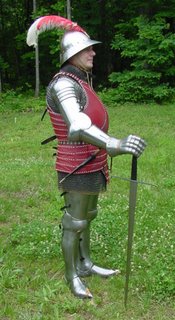
For some details, Cabaret is simply more plausible. He says that the victim in the first combat was wounded "between the lames and the piece" It seems likely that the piece in this case was the breastplate, the largest piece of the body armor. The articulation between it and the lames that covered the belly would be a relatively weak point in the body armor. Froissart says the breastplate itself was pierced, a much more challenging task.

Cabaret says that in the final contest, there was a special concession. Faringdon had a knee injury that prevented him from wearing armor, and asked that both champions fight without legharness, and that neither would strike at the other's legs. This makes the serious wound that Chateaumorand suffered more plausible: such a wound would be much less likely if legharness was worn. Froissart seems to have heard about the legs being off limit in that fight, and mistaken a specific accomodation for a general rule.

Froissart seemed to think the arms were off limit as well, but this, if true, would be a unique restriction for foot combats in this era. Cabaret, on the other hand, says that one of the English was wounded by a sword stroke that broke the mail between the piece and garde bras** and pierced his shoulder so that the fight was halted, another by a lance stroke that pierced his arm between avant-bras* and garde bras*. In neither case was this seen as a foul blow.

Froissart says there were three blows with each weapon, Cabaret five. In this case Cabaret seems more plausible. Three is a relatively low number of blows for a combat on foot: a contest planned in 1400 expected ten blows with each weapon. Three is exactly the number of blows per weapon specified for a mounted combat that Froissart says he witnessed in person, but the smaller number would be more appropriate to contests that included the particularly dangerous courses with sharp lances on horseback.

Cabaret adds that the planned exchanges would also include strokes with dagger, a common feature of such contests around this time, if the fights lasted that long, but that none did.

In all these things Cabaret seems to provide the more plausible account. However, in another dimension his account seems more dubious. In his version, the French are uniformly more generous, competent and victorious than the English, decisively winning every fight before Faringdon's foul blow. In addition to the combats already described, Cabaret also says that Tristan de la Jaille badly wounded his opponent with his second axe stroke, so that he could do no more. In Froissart's version the honors are more evenly distributed. Chateaumorand was both a principal and a partisan in the events described. Is it possible that he forgot, misremembered or shaded some details of a combat forty years in the past that might have been less flattering to his team? Is it probable that the French put so many fully armed opponents out of action in so few blows?

Whoever we believe, at least the two sources agree on many of the details of the deed of arms. Fought on foot with several opponents and a variety of weapons, it provides a valuable prototype for those interested in creating the foot combats of this period.

*Froissart, Jean, 1867-1877 Oeuvres ed. Kervyn de Lettenhove, Brussels Vol. 9 pp. 326-327 Translation copyright Will McLean 2012

**Garde bras: upper portion of armharness. Avant-bras: lower portion of armharness, cognate with vambrace

Sunday, September 10, 2006

Armor Pitfalls: Effigies

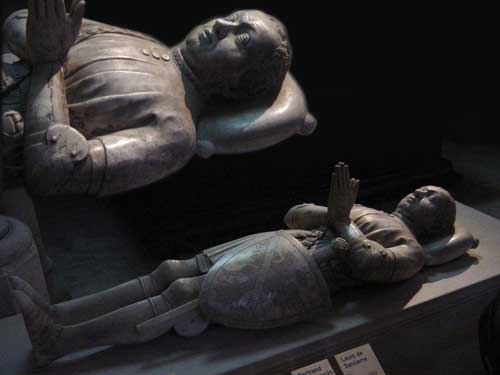
While effigies are an excellent resource for researching medieval armor, they must be used with some caution. Effigies represent the equipment of the elite that could afford them, not the great mass of ordinary men-at-arms.

Also, as Steve Muhlberger points out in response to an earlier post, "just because you have a pic of someone in a classy armor doesn't mean that person owned it." While some brasses seem individual enough to represent actual portraits, others are so stereotyped that they may owe more to the craftsman's pattern book than to the deceased's actual equipment and appearance.

While many brasses were ordered shortly after the death of the individual memorialized, this wasn't always so. Richard Beauchamp, Earl of Warwick's plans for his own memorial included a fine new chapel to put it in, and as a result his splendid bronze effigy wasn't cast until two decades after his death. In the other direction, Thomas, Lord Berkeley ordered a brass for himself and his wife upon her death in 1392. He himself survived for another 25 years.

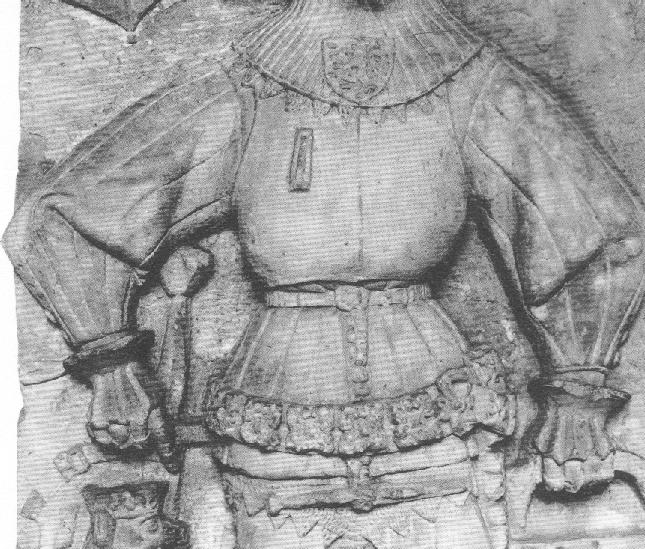
His brass indicates the strain of flattering idealization visible in many effigies. His armored waist is scarcely wider than his helmeted head. It seems unlikely that he had such a slim profile in life. It would be interesting to compare the dimensions of the Black Prince's surviving coat armor with those implied by his effigy.

Effigies can also contain a number of symbolic elements that might never have been worn together at one time. Like many effigies of the late 14th and early 15th c., the head of the Black Prince's effigy rests upon a crested helm. By that period such helms were rarely worn outside the jousting or tournament field. At the same time, he wears a bascinet with a tall pointed skull of the shape often seen on the battlefield, but that couldn't have fit inside the helm. English effigies of this period continue to show conservative sleeveless coat armors even though illuminations from the same period show other designs becoming popular on the battlefield and elsewhere, including the short sleeved coat armor preserved above the Black Prince's tomb. The sleeveless coat armor may have dominated memorial portrayals because it was both traditional and well adapted to displaying arms on a two dimensional brass.

Prince Edward's effigy shows a sword by his side that is the acutely pointed shape of a contemporary fighting weapon. A tournament sword would have had a different shape, and a jouster would not have worn a sword at all.

Effigies were intended to show the symbols of the status, function and ancestry of the deceased gentleman: crest, sword and heraldry. If doing so required combining elements that wouldn't normally be worn together on any given day, so be it.

Wednesday, September 06, 2006

Folksongs Are Your Friends

Things I’ve learned from British folk ballads

To which I'll add:

Don't roughhouse while carrying a wee pen knife, or with someone carrying a wee pen knife. For that matter, don't spend any more time than you have to anywhere near anyone carrying a wee pen knife, particularly if they seem disturbed or agitated.

And don't employ, consort with, or go on moonlit strolls with anyone whose name or job description starts with "False"

Monday, September 04, 2006

Tourney Fences

One authentic possibility for recreators of the medieval tournament seeking to provide an enclosure is to sink uprights into postholes, as was done here. Unfortunately, digging the postholes is laborious and slow.

An equally authentic but less laborious option is use uprights of inverted T shape. The most significant drawbacks of this solution are the transport and storage requirements of the fencing, which are significant.

The Company of St. Michael uses fencing inspired by a 15th c. illumination of the jousts at St. Inglevert, which show the lists surrounded by richly decorated fabric, and spectators viewing the action over the waist-height wall this provides.

This may be intended to show a conventional wooden fence of uprights and horizontal bars draped with fabric. However, we thought it was plausible to reconstruct this "a fence of stakes fixed into the ground at intervals" and hung with cloths, a construction used for some early tilts.

Pieces of cloth are stenciled with the badges of the company, and sewn with casings at top and bottom for ropes strung between banner poles decorated with pennons, as shown here. Metal "portable holes" are used to support the poles. To hold the upper rope taut, rope runs either down to metal stakes or across to wooden corner sections.

These are composed of wooden uprights and bars and pegged together. Rebar extends out of the bottom of the uprights so they can be driven into the ground without digging a hole. The cloth enclosure can be used with or without the wooden corner sections. The whole enclosure breaks down into a fairly compact package, particularly when the corner sections are omitted.

In the future, I may look at configuration with less space between each cloth panel.

Monday, August 28, 2006

Belts Worn with Armor by a Late 14th-early 15th c. Man-at-Arms

You have several options: high, low, diagonal, none, none visible, and baldric. Often more than one belt is worn.

High: usually fairly narrow and worn just below the ribs and just below the breastplate if one is evident.

Low: worn very low on the hips. If a fauld is worn, the low belt should sit approximately on the bottom lame. Walter von Hohenklingen, 1386 wears both a high and low belt.

A horizontal belt worn low on the hips may not be a good way to hold up a heavy sword, so it's not uncommon to see a diagonal, often fairly narrow belt instead of or in addition to the low one. Sir Humphrey Littlebury wears both. (I suspect from his gauntlets that he may be somewhat earlier than 1365.) Lord John de Montacute also has a second belt, in this case neatly rolled around his scabbard.

Even when no diagonal belt is visible, it isn't safe to assume that a low belt is supporting the sword. Swords and daggers can be attached directly to body armor. In Altichiero's Execution of St. George the soldier directly behind the saint has both sword and dagger attached directly to his blue brigandine.

In some cases, a belt may be worn, but beneath the jupon or coat armor. Perhaps that's what's happening in this illumination of Richard II meeting Northumberland

Du Guesclin's effigy shows a baldric worn with a high belt. A baldric is also worn by one of the figures on the right side of a miniature of Siege of Melun

The belts of the knightly elite shown on effigies were often broad and almost always richly decorated: 1-2.25" or more wide, compared to diagonal belts that might be .75-1" wide. These low belts are usually made either of linked metal plaques, or of large mounts densely covering a leather or textile belt for a similar effect. Even when large, these mounts were not necessarily very massive. Many large mounts preserved in the Museum of London were stamped out of metal sheet. Three circular armorial mounts, about 2 3/8" in diameter, also in the Museum of London, of silvered copper alloy with armorial designs of enamel or niello weigh between 43.5 and 57.5 grams. Of composite construction, the central armorial rondel is made of engraved sheet, and surrounded by a ring that shows turning marks. For this class, high and diagonal belts as well as baldrics were often lavishly decorated with mounts.

During this period, most fully armored men-at-arms were not knights, but squires and gentlemen. While an ordinary squire was less wealthy than a knight, anyone that could afford full armor and a warhorse was not poor. Their belts were not as richly decorated as a knight's, but contemporary illuminations still show belts on most men-at-arms richly decorated with mounts. Men of this rank could afford mounts of copper alloy or better

Friday, August 25, 2006

Pluto Not a Planet

The International Animators Union voted on Thursday to declare that Pluto was not a planet but in fact a dog. "It was actually a fairly easy call" said one delegate "Pluto's long nose, tail, and quadrupedal gait made it a relatively easy decision". The upcoming vote on Goofy's status was expected to be more contentious.

"Yes, he has a long nose and floppy ears. And he slobbers. But he's also a biped with opposable thumbs" the delegate continued. The union is debating moving to a more nuanced classification system recognizing animals, funny animals, litigants, mascots and pathetic losers.

Funny animals would officially encompass bipedal anthropoidal animals with opposable thumbs. Litigants would be defined as funny animals sufficiently powerful to be orbited by their own copyright attorneys. An additional category was included, according to one source, because "just because you strap a racoon tail to your butt, that doesn't mean you're a funny animal"

Wednesday, August 23, 2006

Harness 1385-1415

A period of particular interest to those attempting to recreate the visual effect of a medieval man at arms, since so much of the body can be covered by the jupon or coat armor if your hard kit isn’t 100% presentable. The illuminations show a wide range of sleeve designs: banana, bagpipe, angel-wing, elbow length and so on. The brasses show a much stronger bias towards sleeveless coat armors. I think there are several explanations. The brasses tend to show what I think is intended as jousting or tournament full dress: note the jousting or tournament helms used as pillows. While the illuminations show a full range of men-at-arms, the brasses show the elite subset that can afford expensive brasses. Also, a number of the sleeved designs aren’t as congenial to the display of arms on a coat armor, particularly on a two-dimensional brass, and that would be an understandable priority for the effigy buying upper crust.

Update: The British Library has made my links obsolete. For those images you can go to their search page and paste in the shelfmark or title.

Beheading of St. George, Altichiero 1385

Livy, Histoire Romaine Paris; c. 1380-1390
The Hague, KB, 71 A 16
(The link will take you to a search page, and you can enter the shelfmark, which follows "KB" above, to reach the particular manuscript."Images and Text" will then give you both thumbnail images from the MS and text describing their context)

Hohenklingen, 1386
Another View

Cotton Nero D. VI 1386-1399
Richard II appoints Earl Marshal

Churburg 1390

St. George, Champmol Altarpiece 1390

Calveley, ca. 1394

Hartneid von Pettau, ca. 1395

Bardolf 1395

Bettesthorne 1398

Life of Du Guesclin, ca. 1400
Capture of Don Pedro
Jousting
Taking of Pestien
Siege of Melun
Battle of Auray

Chroniques de France ou de St. Denis
Royal 20 C. VII ca. 1400
John Baliol before Edward I
Passage of the Seine
Sea fight off La Rochelle
Death of King of Aragon
Battle of the Spurs
English landing in Normandy
Battle in Picardy
Scenes in Hundred Years' War
Austrians and Saracens defeated
Battle on bridge over Seine
Fight outside Meaux
English army with banner
King of Navarre and his army
French destroy Genoa

Histoire du Roy d'Angleterre Richard II
Harley 1319 1401-1405
Henry of Monmouth knighted
Richard II meets Northumberland
Richard II renounces the throne

Russel 1405

Vincent of Beauvais, Le Miroir Historial (Vol. IV) Paris, Master of the Cité des Dames (illuminator); c. 1400- 1410
The Hague, KB, 72 A 24
(The link will take you to a search page, and you can enter the shelfmark, which follows "KB" above, to reach the particular manuscript."Images and Text" will then give you both thumbnail images from the MS and text describing their context)

Jean Froissart, Chroniques (Vol. 1) Paris, Virgil Master (illuminator); c. 1400-1410
The Hague, KB, 72 A 25
(The link will take you to a search page, and you can enter the shelfmark, which follows "KB" above, to reach the particular manuscript."Images and Text" will then give you both thumbnail images from the MS and text describing their context)

Bagot 1407

Burton, c. 1410

L'Epitre d'Othea
Harley 4431 1410-1411
Memnon and Achilles
Hector prepares for battle
Siege of Babylon
Telamon's army enters Troy
Pyrrhus fights the Trojans
Minerva and Pallas Athene

Peryent 1415

Grandes Chroniques de France
Cotton Nero E. II pt.2 ca. 1415
Charlemagne finds Roland slain
Louis VII fights beside his father
England and France at war
Battle of Crécy
Battle of Poitiers
Louis VII fights beside his father
Guesclin appointed constable

Also see:

Gothic Eye
Monumental Brass Society

Serpentes on a Shippe

Geoffrey Chaucer writes about the new drama Serpentes on a Shippe. Where else can you hear dialog like "Aaargh! There is an adder in my costrel!" and "This amphisbena shall notte comme to the fore-castle, maugre my head"?

Already there is talk of sequels: Beehives in a Siege-Tower and Scorpions on a Haywain. Time will tell if the genre of "dramas with refreshingly direct titles" has legs. If so, look forward to titles like Thwacking on a Grail-Quest and Fart Jokes on a Pilgrimage

Sunday, August 20, 2006

Armor Pitfalls: Breastplate Length

In shopping for (or building) a reproduction of a 14th c. breastplate, look for one that's the correct length. Don't expect the breastplate to cover more than the bottom of your ribs or your navel. If the bottom edge is much lower than your elbows it's probably too long.

Some modern armorers sell longer breastplates, perhaps because their customers want more coverage. Avoid these. They won't look right, and they'll hinder your movement. If you want to protect more of our torso with plate, add an apron of lames, or concealed protection beneath your gypon or gambeson.